
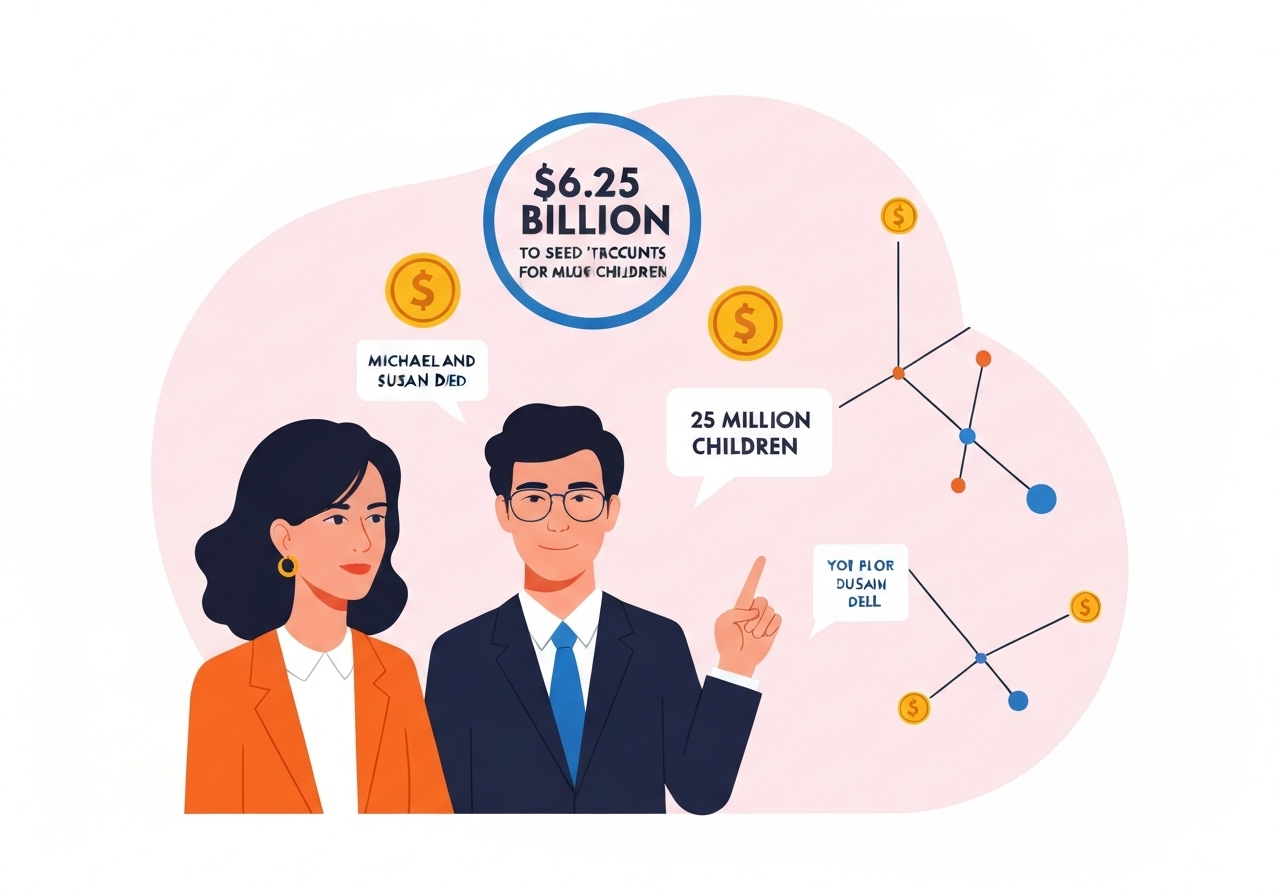
— Michael and Susan Dell announced they will deposit $250 into individual investment accounts for 25 million children, a commitment totaling $6.25 billion. The gift is intended to expand a planned federal program of so‑called “Trump accounts,” under which the government will provide $1,000 to babies born between January 1, 2025 and December 31, 2028. The Dells’ donation extends eligibility to children through age 10 but limits recipients to households in ZIP codes where median income is under $150,000. Officials say the federal accounts are expected to be established next summer, but many operational details remain unresolved.
Key Takeaways
- The Dells will contribute $250 each to accounts for 25 million children, totaling $6.25 billion.
- The federal program will provide $1,000 for newborns born from 2025‑01‑01 to 2028‑12‑31; that federal timeline covers four birth years.
- The Dells’ eligibility cap applies to children up to 10 years old living in ZIP codes with median household income below $150,000.
- The federal government expects to stand up the accounts next summer; registration systems and custodial arrangements have not been announced.
- The gift is presented as a model to encourage other philanthropists, corporations and subnational governments to add funding.
Background
Child-focused savings initiatives have been debated in the United States for years under different names such as baby bonds, child savings accounts and seed‑capital programs. Policymakers and advocates argue such accounts can boost long‑term financial security, increase college and retirement savings, and reduce wealth gaps by giving every child a financial stake from birth. The federal “Trump accounts” plan adopts that model for newborns between 2025 and 2028 with an initial $1,000 seed payment; the program’s administration and delivery model are still being designed by federal agencies.
Philanthropic actors have occasionally complemented public efforts with direct contributions to households or targeted programs; large, unrestricted direct deposits to children on this scale are rare. Michael Dell framed the gift as an extension of his early business approach of selling directly to consumers, positioning it as “direct model philanthropy.” The Dells say their contribution is deliberately structured to be easy for other donors to emulate, avoiding the complexity of founding and operating a private foundation.
Main Event
On December 2, 2025, the Dells announced they would place $250 into designated investment accounts for 25 million children, bringing private seed funding to a subset of the federal program’s intended beneficiaries. Their pledge covers children up to age 10 who live in ZIP codes with median household incomes under $150,000; it therefore reaches some children born before the federal newborn window. The announcement specifies a per‑child donation and a geographic eligibility filter, but it does not name custodial banks, account providers, or the registration pathway beneficiaries must follow.
Federal officials, according to reporting, expect to create a framework for the accounts by next summer but have not published a registration timetable or chosen account custodians. The lack of an implemented enrollment system means families cannot yet sign up or verify eligibility. The Dells have urged other philanthropists, corporations and state or local governments to add funds to the accounts, suggesting their gift is intended to catalyze further private and public contributions.
Michael Dell framed the approach as akin to his company’s early direct sales strategy. He described putting money directly into child accounts as a way to reach individuals without intermediaries, and he emphasized simplicity as a selling point for potential partner donors. The Dells’ foundation provided limited operational detail in the initial announcement and signaled that coordination with federal planners will be necessary to ensure funds reach intended recipients.
Analysis & Implications
The Dells’ $6.25 billion pledge is large in absolute philanthropic terms and notable because the funds flow directly into individual child accounts rather than to institutions. If fully deployed as announced, the gift would meaningfully increase the number of children receiving seed capital, but its impact will depend on how accounts are administered and invested. Administrative design choices — custodial banks, default investment options, opt‑out provisions, and data protections — will shape long‑term outcomes for beneficiaries.
Targeting by ZIP code median income aims to concentrate aid where household earnings are lower, but ZIP codes are an imperfect proxy for individual need and can both under‑ and over‑include eligible children. Limiting the Dells’ gift to certain ZIPs may reduce cost but also risks leaving out eligible low‑income children who live in higher‑median ZIPs. Political and legal actors may scrutinize such geographic filters if they produce disparate outcomes along racial or regional lines.
From a policy perspective, private supplements can expand the reach of public programs but may also introduce fragmentation. Multiple private donors using different eligibility rules and account custodians could create a patchwork of accounts with varying fees and investment options, complicating families’ ability to manage funds. Conversely, if coordinated with federal design choices, philanthropic top‑ups could standardize positive defaults and reduce administrative costs by leveraging a common platform.
Comparison & Data
| Source | Per‑child amount | Eligible cohort | Public total pledged |
|---|---|---|---|
| Federal “Trump accounts” | $1,000 | Babies born 2025‑01‑01 to 2028‑12‑31 | To be determined |
| Dells’ pledge | $250 | Children up to age 10 in ZIPs with median income < $150,000 | $6.25 billion |
The table shows the known per‑child figures and the Dells’ total pledge. Federal aggregate cost will depend on the number of births falling in the 2025–2028 window; that number has not been set in public documents tied to the accounts. Comparing per‑child amounts clarifies that the Dells’ contribution is additive rather than a replacement for the federal seed payment.
Reactions & Quotes
Officials and analysts have framed the Dells’ move as potentially catalytic while underscoring unanswered logistical questions. Below are two short excerpts reported in initial coverage and the Dells’ announcement, followed by context.
“When I started a company 41 years ago, we created the direct model. This is sort of the direct model philanthropy.”
Michael Dell
Michael Dell used his early business strategy as an analogy for giving directly to individuals rather than channeling funds through intermediary organizations. He presented the approach as both efficient and replicable for other donors.
“It is one of the largest philanthropic gifts ever to go directly to Americans.”
The New York Times (reporting)
Coverage emphasized the scale and unusual design of the pledge: sizable, direct deposits into individual accounts rather than funding institutions. Reporters and analysts noted both the potential reach and the number of operational decisions that remain open.
Unconfirmed
- Which financial institutions or custodial platforms will hold the accounts has not been announced.
- Exact registration processes, enrollment deadlines and verification procedures remain unspecified.
- It is unclear whether donors will be able to choose investment options or whether accounts will have standardized default portfolios.
- The total federal cost for the newborn payments depends on the number of births in 2025–2028 and has not been published with the program plan.
Bottom Line
The Dells’ $6.25 billion commitment is notable for its scale and its attempt to pair private philanthropy with a nascent federal child savings program. The contribution could increase the number of children receiving seed capital and serve as an example for other donors, but its ultimate impact depends on the many design decisions still to come. Coordination between private donors and federal implementers will be essential to avoid fragmented account systems with varying fees and protections.
Policymakers, advocates and families should watch for the federal government’s account framework next summer, including custodian selection, enrollment mechanics and data‑privacy safeguards. Those operational choices will determine whether the combined public‑private effort strengthens long‑term economic opportunity for children or introduces new administrative complexity for families and providers.
Sources
- The New York Times — media/press report on the Dells’ announced pledge and federal program timing.