
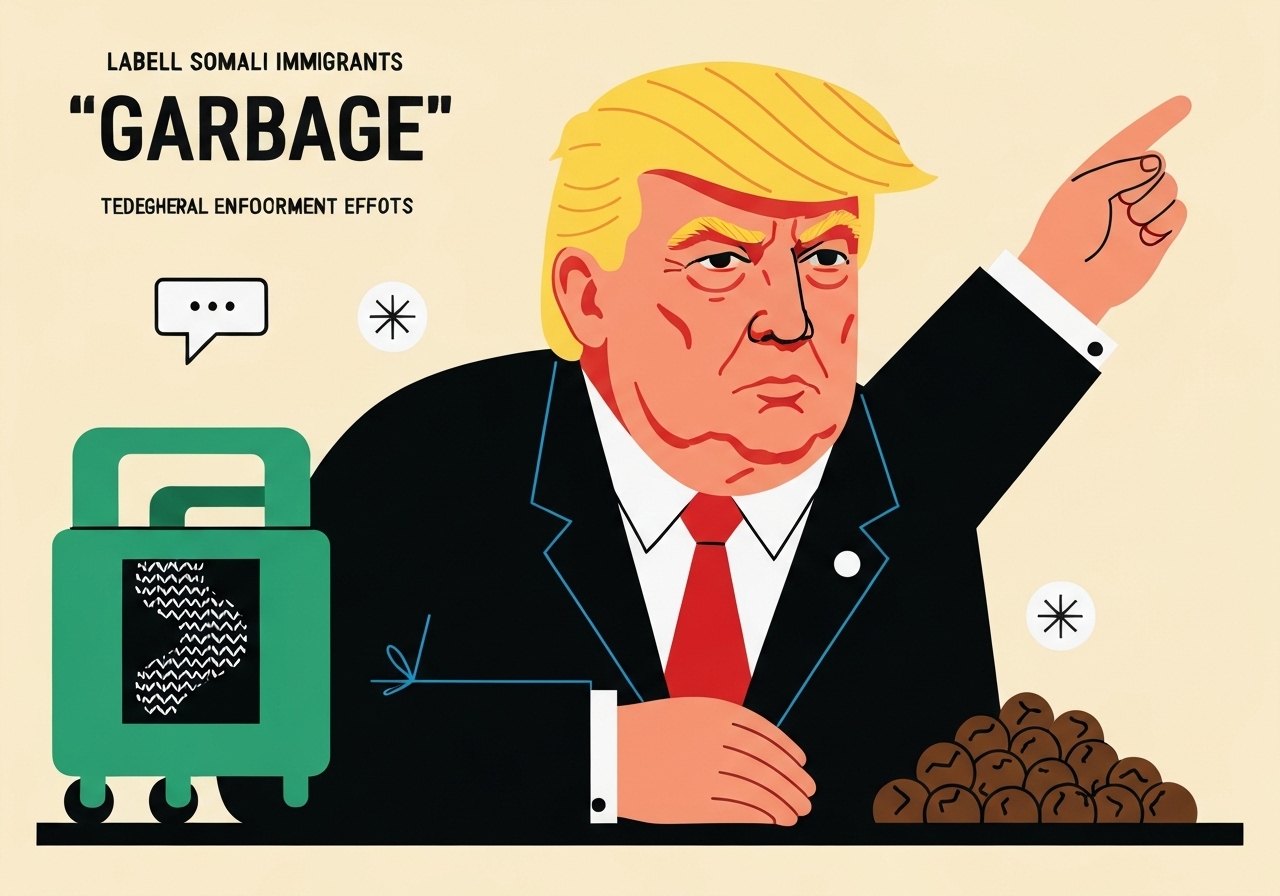
On 2 December 2025, former president Donald Trump used derogatory language about Somali immigrants during a cabinet meeting and said they should be sent back to Somalia, remarks that coincided with reporting that federal immigration enforcement would intensify in the Minneapolis–St. Paul area. The comments singled out Representative Ilhan Omar and described Somalia as “no good,” while administration officials moved to focus deportation efforts on Somalis with final removal orders. Reporting indicates the operation would deploy roughly 100 ICE agents and allied federal officers to the Minneapolis metro, which is home to Minnesota’s large Somali community. Local leaders, including Minneapolis Mayor Jacob Frey, condemned the rhetoric and pledged support for Somali residents.
Key Takeaways
- Donald Trump, during a 2 December 2025 cabinet meeting, referred to Somali immigrants with demeaning language and urged they be sent home.
- The New York Times reported a planned escalation in deportations in the Minneapolis–St. Paul area focused on Somalis with final removal orders and the use of “strike teams” of ICE and federal officers, involving about 100 agents from around the country.
- Minneapolis has the largest Somali population in the U.S.; about 80,000 Somali people live in Minnesota, most of whom are U.S. citizens or legal residents.
- The enforcement push follows multi-year fraud prosecutions alleging false claims by dozens of Somali residents for state benefits, which the administration has cited in its actions.
- Treasury Secretary Scott Bessent said his agency would investigate whether Minnesota taxpayer funds were diverted to the extremist group Al-Shabaab, a claim stemming from right‑wing reporting and not yet independently corroborated.
- City officials said Minneapolis police do not assist with immigration enforcement and stated they receive no advance notice of federal operations.
- Local leaders warned the enforcement plan risks detaining U.S. citizens and violating due process if identification relies on appearance or community origin.
Background
The Minneapolis–St. Paul metropolitan area has been a major destination for Somali immigrants and their U.S.-born children since the 1990s, creating the country’s largest Somali diaspora community. Over time that community has played a prominent role in local politics, business and civic life; Representative Ilhan Omar emerged from that population and has been a focal point in national debates about immigration and integration. Federal attention on the Somali community has flared before, including past administrative moves to restrict Temporary Protected Status (TPS) and heightened scrutiny tied to counterterrorism concerns.
In recent years, state prosecutors in Minnesota brought a series of fraud cases alleging dozens of Somali residents falsified information to obtain reimbursements for services, including meal programs, medical care, housing and autism-related supports. Those prosecutions have been cited by national conservatives and some federal officials as justification for stepped-up enforcement. Simultaneously, refugee resettlement and community advocates have pushed back, arguing that economic and social factors underlie some irregularities and stressing that the majority of Somali Minnesotans are lawfully present.
Main Event
On 2 December 2025, according to contemporaneous reporting, Trump criticized Somali immigrants and Representative Ilhan Omar at a cabinet meeting, using language characterizing Somalia as “stinky” and Somalis as contributing nothing to the United States. The comments were part of a broader, sharply worded attack on immigration and on the Democratic congresswoman’s background and political views. The White House context for the remarks included announcements and internal discussions about targeting immigration enforcement at individuals with outstanding, final deportation orders.
Separately, The New York Times reported that the Department of Homeland Security would deploy “strike teams” of ICE and other federal agents to the Minneapolis–St. Paul metro area to execute deportation orders, bringing in roughly 100 agents from outside the region. The operation was described as focused primarily on people with final removal orders, though community leaders expressed concern that the sweep could catch additional residents, including lawful immigrants or citizens, because of mistaken identity or enforcement methods.
Local officials reacted quickly. Minneapolis Mayor Jacob Frey and other city leaders held a press conference calling the reports “credible” and stating the city would stand with its Somali residents. Minneapolis police reiterated that they do not assist with federal immigration enforcement and that the department is not notified in advance of federal operations. Community organizations mobilized legal aid and monitoring networks to respond to any planned enforcement action.
Analysis & Implications
The administration’s rhetoric and reported operational plans create layered political and legal risks. Rhetorical attacks that single out an identified community can inflame tensions and raise civil‑liberties concerns; they also influence how enforcement is perceived and carried out on the ground. If enforcement relies on broad sweeps or profiling, the probability of mistakes — including detaining lawful residents or citizens — rises, creating legal challenges and community distrust.
Politically, the move aligns with a broader strategy of emphasizing immigration enforcement to court a particular voter base while deflecting criticism from allegations of selective targeting. Targeting a community concentrated in a single region amplifies local impact: Minneapolis city services, schools and employers could face disruptions if residents are detained or fearful of accessing public services. Economically, the threat of removal for community members can depress local commerce and reduce workforce participation in sectors where immigrants are overrepresented.
On national security claims, the linkage of local benefit fraud investigations to terrorism financing requires rigorous, evidence-based analysis. Treasury Secretary Scott Bessent’s stated intent to probe alleged diversions to Al-Shabaab stems from reporting in right‑wing outlets and has not been substantiated publicly. If such allegations remain unproven but are used to justify enforcement, they risk eroding public trust in oversight institutions and could politicize intelligence and financial inquiries.
Comparison & Data
| Item | Reported Figure / Detail |
|---|---|
| Somali population in Minnesota | About 80,000 people |
| Planned federal agents for Minneapolis operation | About 100 agents from across the country |
| Enforcement focus | Individuals with final deportation/removal orders |
The table places recent reporting into numerical context: Minnesota’s roughly 80,000-person Somali community is concentrated within the Minneapolis–St. Paul metro, making targeted enforcement highly visible and likely to affect family networks and workplaces. The reported figure of about 100 federal agents suggests a sizable, concentrated operation but is small relative to the overall size of ICE; the emphasis on people with final orders would narrow scope if implemented precisely. Past operations in other jurisdictions provide precedent for both focused removals and, in some cases, broader collateral impacts when identification or verification is imperfect.
Reactions & Quotes
Local officials and advocates framed the reported enforcement and presidential comments as harmful and potentially unlawful.
“To our Somali community, we love you and we stand with you. That commitment is rock solid.”
Jacob Frey, Mayor of Minneapolis (city official)
Mayor Frey made the statement at a 2 December press conference responding to the reporting, emphasizing city protections and the department’s non‑participation in immigration enforcement. City leaders warned that due process risks increase when operations target a visibly identifiable community.
“They contribute nothing. I don’t want them in our country.”
Donald Trump (former president)
Trump’s remarks were made during a cabinet meeting and widely reported by U.S. outlets; officials and immigrant advocates criticized the language as dehumanizing and inflammatory. National civil‑rights groups said such rhetoric can lead to real-world harassment and complicate cooperative public‑safety efforts.
“We will review whether taxpayer dollars have been diverted to Al‑Shabaab.”
Scott Bessent, Treasury Secretary (executive branch official)
The Treasury secretary announced an investigation tying local benefit misuse to potential extremist financing; independent confirmation of any such diversion has not been presented publicly as of publication, prompting calls for transparency in the inquiry’s methods and evidence.
Unconfirmed
- Precise scope and timing of any federal raids beyond reported plans are not independently confirmed; media reports describe intentions but operations could change.
- Claims that Minnesota taxpayer funds were diverted to Al‑Shabaab remain unverified in public records and rely on secondary reporting from partisan outlets.
- Whether U.S. citizens will be detained in the planned operations is uncertain; local leaders warned of the risk, but official federal protocols for screening were not made public.
Bottom Line
The confluence of incendiary presidential rhetoric and reported targeted enforcement in Minnesota escalates tensions in a community that is both politically prominent and socially integrated locally. If federal actions proceed as reported, the immediate consequence will be heightened fear and mobilization among Somali residents, with legal challenges likely if detentions include people with lawful status or citizens. Longer term, the episode could reshape local politics, affect voter mobilization and alter relationships between immigrant communities and federal authorities.
Key open questions remain: whether the enforcement will strictly adhere to cases with final removal orders, what evidence supports Treasury’s allegations about extremist financing, and how courts and civil‑rights organizations will respond. Close, transparent oversight of operations and clear public documentation of legal bases will be essential to limit wrongful detention and preserve due process.
Sources
- The Guardian (U.S. news outlet reporting on the cabinet remarks and local reaction)
- The New York Times (national newspaper reporting on planned ICE operations)
- The Associated Press (wire service coverage confirming aspects of the enforcement reporting)
- City of Minneapolis (official statements from municipal leadership and police department policy)
- U.S. Department of the Treasury (agency cited for announced financial inquiry)