
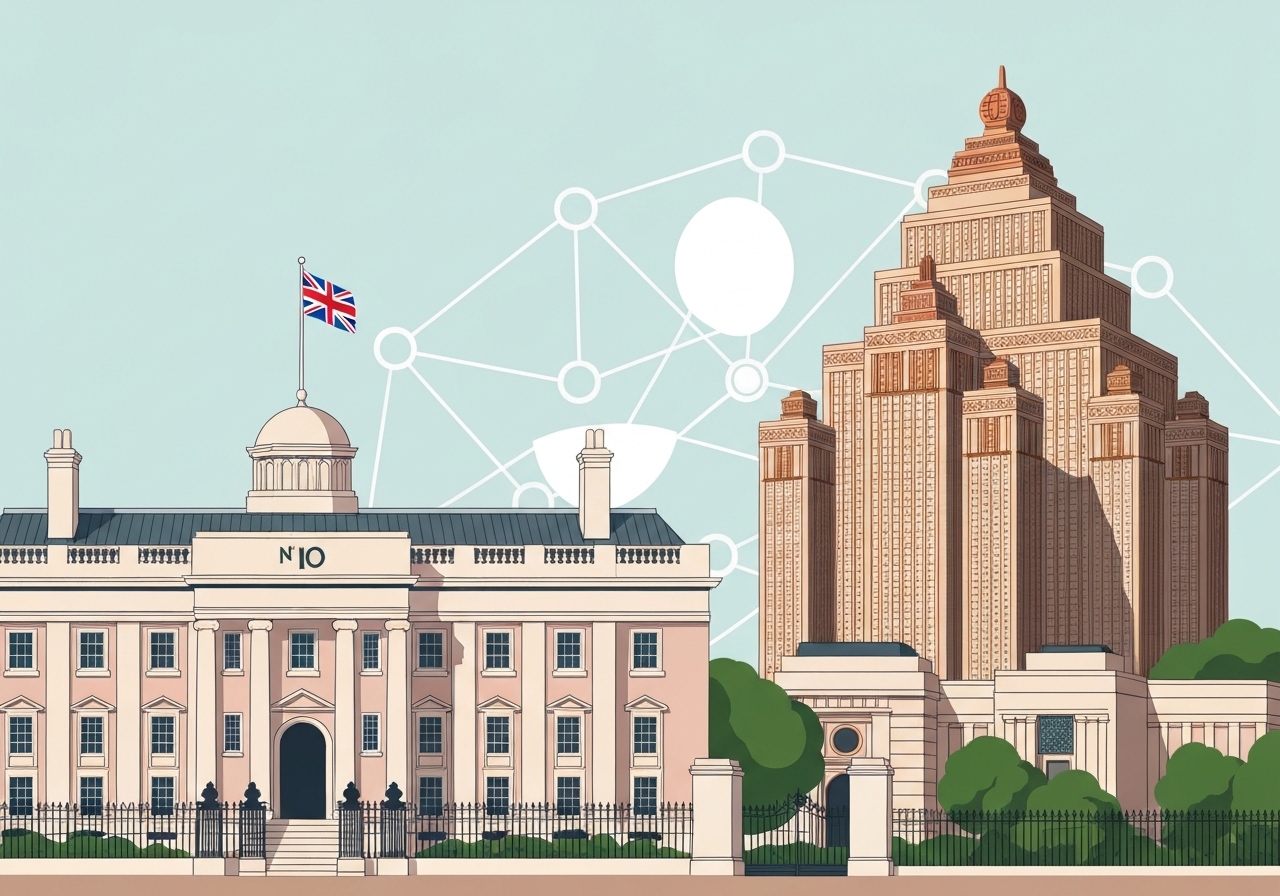
UK government spokespeople have argued that a single, consolidated Chinese embassy in London could provide security advantages, even as opponents warn the complex could become an intelligence hub. Officials confirmed the decision on planning permission has been postponed until 20 January 2026 to allow further consultation. If approved, the Royal Mint Court site would replace seven separate Chinese diplomatic locations across the capital and would be the largest Chinese embassy in Europe, with capacity for about 200 staff and extensive basement space. Critics, intelligence officials and local politicians remain divided over risks tied to proximity to fibre-optic infrastructure and redacted planning drawings.
Key takeaways
- The government delayed the planning decision for the Royal Mint Court embassy to 20 January 2026 to allow further security and stakeholder consultation.
- The proposed complex would consolidate seven Chinese diplomatic sites in London and is reported to house around 200 staff on-site, making it the largest Chinese embassy in Europe.
- No 10 argued consolidation would “clearly bring security advantages,” saying a single site is easier to manage than multiple dispersed locations.
- Planning documents submitted to Tower Hamlets included redacted sections labeled “redacted for security reasons,” which raised public and parliamentary concern.
- MI5 leadership has described Chinese state actors as a persistent national security risk; the security service recently issued an alert about two named LinkedIn profiles allegedly targeting MPs and staff.
- The Home Office and Foreign Office say they have provided security advice and will not finalise a recommendation until outstanding concerns are addressed.
Background
China currently operates its diplomatic presence in London from several sites scattered across the city; proposals would concentrate that footprint at Royal Mint Court near the City of London. The location is notable because it sits close to major fibre-optic cables that carry high volumes of sensitive financial and communications traffic. Consolidation proponents argue that moving to a single gated compound simplifies counterintelligence measures and reduces the number of dispersed locations requiring individual protection.
Opponents counter that a larger, centralized diplomatic campus could increase the stakes of any hostile activity and create a focal point for surveillance or espionage. Concerns intensified when planning documents contained redactions, prompting questions in Parliament and a two-week challenge from then-Deputy Prime Minister Angela Rayner seeking explanations for the blanked sections. Ministers say those explanations have been received and reviewed as part of ongoing security assessments.
Main event
This month Downing Street reiterated its view that consolidation would yield security benefits, while confirming the planning outcome has been moved back to 20 January 2026 to allow more time for cross-departmental scrutiny. The Home Office and Foreign, Commonwealth & Development Office have both supplied input on classified security considerations and have pressed for unresolved matters to be completed before a final decision.
Government letters seen by the Interparliamentary Alliance on China include statements from the home and foreign secretaries indicating active work to address national security issues connected to the site. Labour backbenchers Shabana Mahmood and Yvette Cooper were reportedly told China had agreed to relocate accredited diplomats to a single site should approval be granted, which some ministers cited as a mitigating factor.
Security agencies have escalated warnings about Chinese state-linked activity in the UK. MI5 leaders characterize certain state actors as a daily operational threat, and the service publicly flagged two LinkedIn profiles allegedly attempting to target MPs and parliamentary staff — a move that Beijing denies. Those warnings have added political pressure and fed public debate over how much sensitive material to disclose during planning and review.
Analysis & implications
Consolidation does provide practical protective advantages: a single perimeter, centralized screening and a unified electronic-security posture can be easier to secure and monitor than multiple dispersed sites. For counterintelligence teams, fewer locations reduce the operational burden of physical patrols, technical surveillance counter-measures and diplomatic accreditation oversight. However, those advantages depend on the transparency of access to architectural plans, the integrity of agreed restrictions on basement and communications facilities, and robust mutual commitments on personnel and space usage.
Centralization also concentrates risk. A larger compound near critical communications infrastructure could magnify potential harm from a successful hostile operation, whether technical surveillance, signal interception near fibre routes, or insider approaches to staff. The scale of the proposed site — with substantial basement areas and office capacity — heightens scrutiny about intended uses of enclosed spaces and their proximity to high-value networks in the City.
Politically, the decision forces the UK to balance economic and diplomatic engagement with strategic caution. Prime Minister Sir Keir Starmer has framed relations with China as a mix of opportunity in trade and technology and clear national-security risks. Approving the embassy may ease some logistical aspects of diplomacy and consular work, but if perceived as sidelining security concerns it could provoke parliamentary and public backlash and complicate broader UK-China negotiations.
Comparison & data
| Metric | Current dispersed footprint | Proposed Royal Mint Court |
|---|---|---|
| Number of sites | 7 | 1 |
| On-site staff capacity | Varies by site (combined capacity larger but distributed) | Approximately 200 staff |
| Proximity to City fibre routes | Some sites distant, some adjacent | Adjacent to major fibre-optic cables |
| Decision status (as of report) | Ongoing reviews | Planning decision deferred to 20 Jan 2026 |
The table shows the core trade-offs: consolidation reduces the number of protected locations from seven to one and establishes a clear locus for security measures, but places a larger diplomatic asset closer to sensitive communications infrastructure. Those numerical contrasts underline why security agencies, local planners and Parliament want detailed, unredacted assurances about basement design, equipment rooms and staff accreditation rules.
Reactions & quotes
Government spokespeople defended the pause for further review while emphasizing potential security upsides from consolidation.
“Should the planning decision for a new embassy be approved, the new embassy would replace seven different sites which currently comprise China’s diplomatic footprint in London, which clearly brings security advantages.”
No 10 spokesperson
The remark was made to explain why ministers consider a single, controlled perimeter preferable to multiple dispersed addresses — though the comment does not resolve detailed questions about subterranean space and data-route proximity.
“The authorities must have access to the full, unredacted drawings hidden by the Chinese government.”
Sir James Cleverly, Shadow Housing Secretary
Opposition figures argue that redactions and restricted access to sensitive evidence risk undermining proper scrutiny. They have called for private hearings to allow security services to submit classified material securely to planners.
“Chinese state actors represent a daily national security threat to the UK,”
MI5 (senior official statement summarized)
Security leaders have framed certain activities linked to Chinese state actors as ongoing risks; their public advisories in recent weeks have sharpened the political debate around the embassy proposal.
Unconfirmed
- Claims that the new embassy would be used specifically for covert intelligence operations remain unproven and are not supported by public evidence.
- Details about the redacted areas in planning documents — and whether they involve technical rooms tied to fibre infrastructure — have not been publicly disclosed.
- Reports that every accredited Chinese diplomat would definitely move to the Royal Mint Court site are based on government summaries of discussions and have not been independently confirmed.
Bottom line
The proposed Royal Mint Court embassy presents a classic risk–reward dilemma: consolidating seven sites could simplify protective measures and reduce dispersed vulnerabilities, but it also concentrates assets near critical communications infrastructure and raises legitimate questions about subterranean space and transparency. Ministers and security agencies say they will not conclude their advice until outstanding concerns are resolved; the 20 January 2026 date reflects that continued review.
For policymakers, the key test will be whether technical and classified assurances — including access to unredacted plans and secure briefings for intelligence bodies and planners — are sufficient to mitigate concentrated risk. If those conditions are met, the government may justify approval on pragmatic security grounds; if not, the political and security costs of moving forward without full disclosure could be substantial.
Sources
- BBC News — media report summarising government statements, planning timelines and reactions (news).