
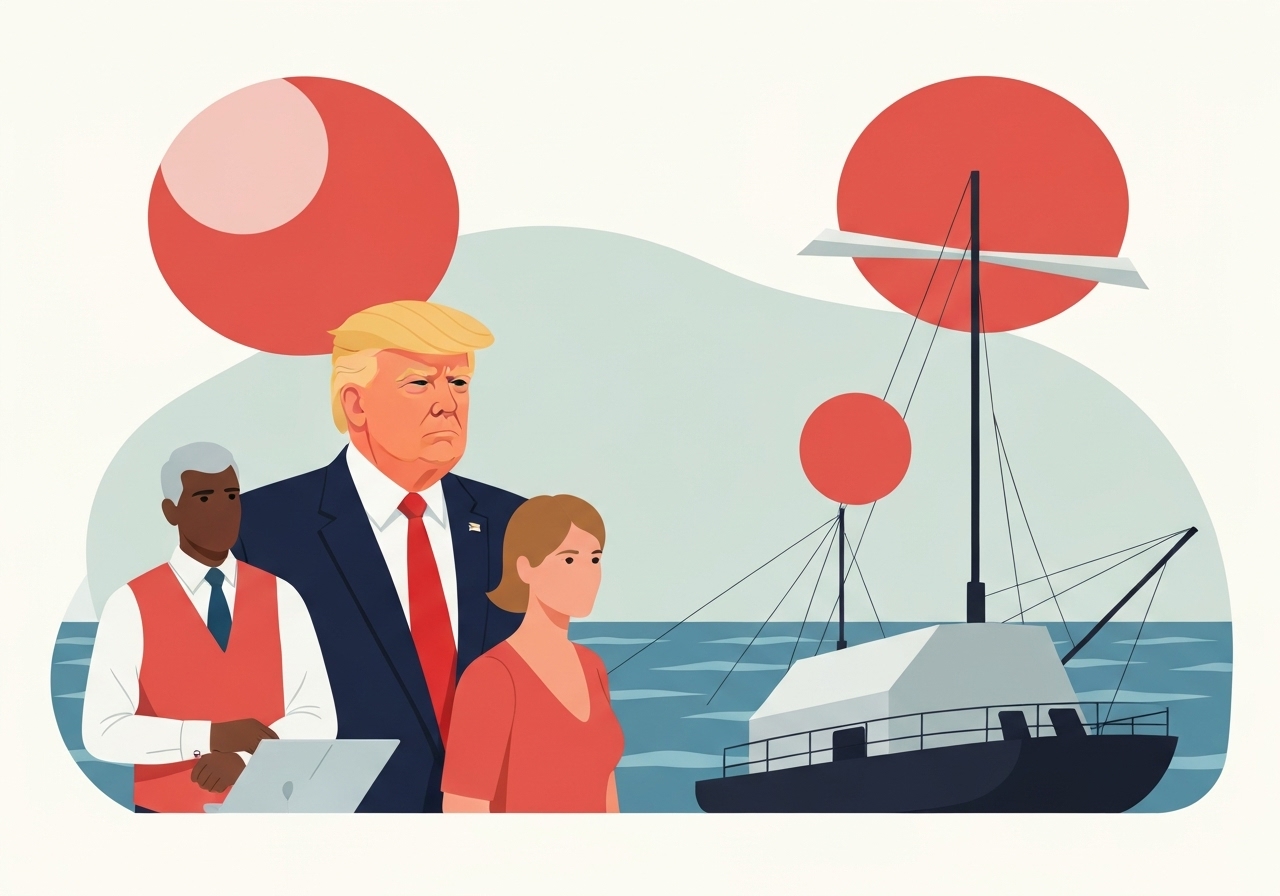
On Sept. 2, President Donald Trump announced a U.S. military strike in the Caribbean that he said killed 11 alleged drug smugglers; he and Defense Secretary Pete Hegseth framed the action as a major blow against South American cartels. Officials initially released limited operational detail and later faced scrutiny after reports that some survivors from the first strike were killed in a follow-up attack. The White House subsequently confirmed there was more than one strike on the vessel, and the episode has prompted questions about rules of engagement, chain of command and legal authority. Lawmakers from both parties opened inquiries while the administration defended the operation as lawful and necessary to stop narcotics flows.
Key Takeaways
- The Sept. 2 strike in the Caribbean killed 11 alleged smugglers, according to the administration’s initial announcement.
- President Trump posted that he ordered “a kinetic strike” targeting members of Tren de Aragua on Sept. 2 and released a video showing a single hit.
- Defense officials later reported 20 additional strikes in the Caribbean and eastern Pacific, saying those operations killed 83 people.
- A Nov. 28 Washington Post report said two survivors from the Sept. 2 attack were alive after the first strike and were later killed in a second strike; ABC News confirmed survivors were killed.
- Officials including Hegseth publicly defended the strikes; Hegseth said he watched the strike “live” and argued traffickers would be treated like terrorists.
- Congressional armed services leaders from both parties announced inquiries following media reporting about a second strike and orders given in the field.
- The White House press secretary said Adm. Frank Bradley ordered the second strike; the exact operational details and legal rationale have not been fully disclosed.
Background
U.S. attention on maritime drug trafficking in the Caribbean has increased amid concerns about large shipments bound for the United States and links to violent transnational criminal groups. The administration has cast Tren de Aragua and similar groups as narcoterrorist threats, arguing that interdiction at sea is necessary to protect the homeland. Historically, U.S. forces have conducted interdictions and seizures in international waters and in cooperation with regional partners, but lethal strikes on smuggling vessels represent an escalation that raises legal and diplomatic questions. Venezuela’s government denied control of the vessel and criticized the attack, deepening regional tensions around the operation.
The Sept. 2 action occurred against a backdrop of broader anti-cartel rhetoric from the White House, where senior officials have argued that existing law-enforcement approaches are insufficient. The Pentagon and the White House have provided limited operational specifics publicly, citing operational security and sensitive-site exploitation. Media reporting in late November introduced new, contested claims about survivors and orders given by senior officials, prompting swift public debate. Members of Congress from both parties have expressed concern and sought additional information about legal authority and command decisions.
Main Event
On Sept. 2 President Trump announced on his social platform that he had ordered “a kinetic strike against positively identified Tren de Aragua Narcoterrorists in the SOUTHCOM area of responsibility,” and the administration released a short video of the strike. The footage distributed publicly showed a single strike, and Trump described seeing “bags of drugs all over the boat” when briefing reporters on Sept. 3. Defense Secretary Pete Hegseth also spoke publicly that day, saying he watched the strike live and rejecting claims the video was artificial intelligence–generated.
In the weeks following, the administration reported a series of additional interdictions at sea: officials said there were 20 more strikes in the Caribbean and eastern Pacific that resulted in 83 deaths. Media reporting later asserted that two survivors from the Sept. 2 attack remained alive after the first impact and were killed in a second strike. ABC News has confirmed that survivors from the initial strike were killed subsequently, while the White House later stated there was more than one strike on the boat.
The Washington Post reported on Nov. 28 that, it alleged, Adm. Mitch Bradley ordered a second strike to comply with an alleged verbal directive by Hegseth to “kill everyone” on the vessel; Hegseth has denied that characterization and said the strikes were lawful. Congressional armed services leaders publicly announced they were reviewing the incident, seeking details on the decision-making, the sequence of events, and the applicable legal authorities. Pentagon and White House spokespeople have issued terse public statements but have not released the complete operational record.
Analysis & Implications
The operation signals a shift toward more aggressive maritime action against suspected narcotics shipments and reflects the administration’s framing of certain trafficking networks as existential threats. Treating maritime traffickers with a kinetic, strike-focused approach increases the likelihood of civilian harm and raises questions about how U.S. forces distinguish combatants from noncombatants at sea. If confirmed orders removed the opportunity to capture survivors, that would exacerbate legal and ethical concerns under domestic and international law governing the use of lethal force.
Politically, the episode places the administration between two pressures: responding to domestic concerns about drug flow and avoiding escalation with regional governments and tribunals that could view such strikes as extrajudicial. Venezuela’s denial of control and condemnation complicate diplomatic engagement in the hemisphere and may affect cooperation on future interdiction efforts. International law scholars and defense lawyers will closely examine the operation’s legal justification, including the claim that certain cartel members constitute “narcoterrorists” subject to military targeting.
Operationally, differences in accounts of who ordered a second strike and why point to potential gaps in command documentation or to rapid judgment calls made under fog-of-war conditions. That ambiguity has immediate oversight implications: Congress has the prerogative to seek classified briefings, and military after-action reviews will be essential to clarify protocols for handling survivors, evidence preservation, and interagency coordination. Absent full public disclosure, confidence in official explanations will remain limited and could fuel bipartisan oversight measures.
Comparison & Data
| Event | Date | Reported Strikes | Reported Fatalities | Survivors Reported |
|---|---|---|---|---|
| Initial narco-boat strike | Sept. 2, 2025 | 1 | 11 (administration) | At least 2 reported by media |
| Additional maritime operations | Sept–Nov 2025 (reported) | 20 (administration) | 83 (administration) | Not specified |
The administration’s tallies (11 killed on Sept. 2; 20 additional strikes killing 83) come from official briefings and public remarks. Independent media reporting—most prominently a Nov. 28 Washington Post piece—added the contested claim that survivors from the Sept. 2 incident were alive after the first impact and later killed, a sequence ABC News has since confirmed in part. Numerical summaries therefore depend on which source is cited: official tallies versus investigative reporting that emphasizes survivor accounts and internal orders.
Reactions & Quotes
White House and Pentagon officials have largely defended the strikes while describing limited operational detail publicly. Regional governments and human-rights advocates have asked for clearer records and legal rationales.
“A kinetic strike against positively identified Tren de Aragua Narcoterrorists in the SOUTHCOM area of responsibility.”
President Donald Trump (social post, Sept. 2)
“That was definitely not artificial intelligence. I watched it live.”
Defense Secretary Pete Hegseth (Fox & Friends, Sept. 3)
“Admiral Bradley made the correct decision to ultimately sink the boat and eliminate the threat.”
Pentagon/Defense official remarks paraphrased
Unconfirmed
- That Venezuelan President Nicolás Maduro controlled the specific vessel targeted on Sept. 2 remains unproven in public records.
- The Washington Post’s claim that Hegseth explicitly ordered that “everyone” on the boat be killed is contested and not independently corroborated in public by an official document.
- The exact number of survivors from the initial strike, and the precise timeline between the first and second strike, remain incompletely documented in public sources.
- Full legal memos, targeting packages and the chain-of-command directives authorizing the second strike have not been released publicly.
Bottom Line
The Sept. 2 operation and the administration’s subsequent public statements illustrate a high-stakes shift toward more forceful maritime action against drug-trafficking networks, accompanied by limited public transparency. Official casualty figures and follow-on strike tallies are publicly reported, but investigative media accounts introduced contested assertions about survivors and orders that have not been fully resolved in the public record.
Given bipartisan congressional interest and the potential legal implications, expect formal oversight and classified briefings to follow. For the public and policymakers, the central questions are: what rules governed the use of lethal force, who made critical decisions in real time, and what documentation exists to support the administration’s account. Until those records are released or summaries provided under oversight, critical aspects of the episode will remain disputed.
Sources
- ABC News — news report and confirmation of survivors killed (media)
- The Washington Post — November 28 investigative report cited in public debate (media)
- U.S. Department of Defense — official statements and briefings (official)
- Truth Social — President Trump’s social post platform where initial announcement appeared (platform)