
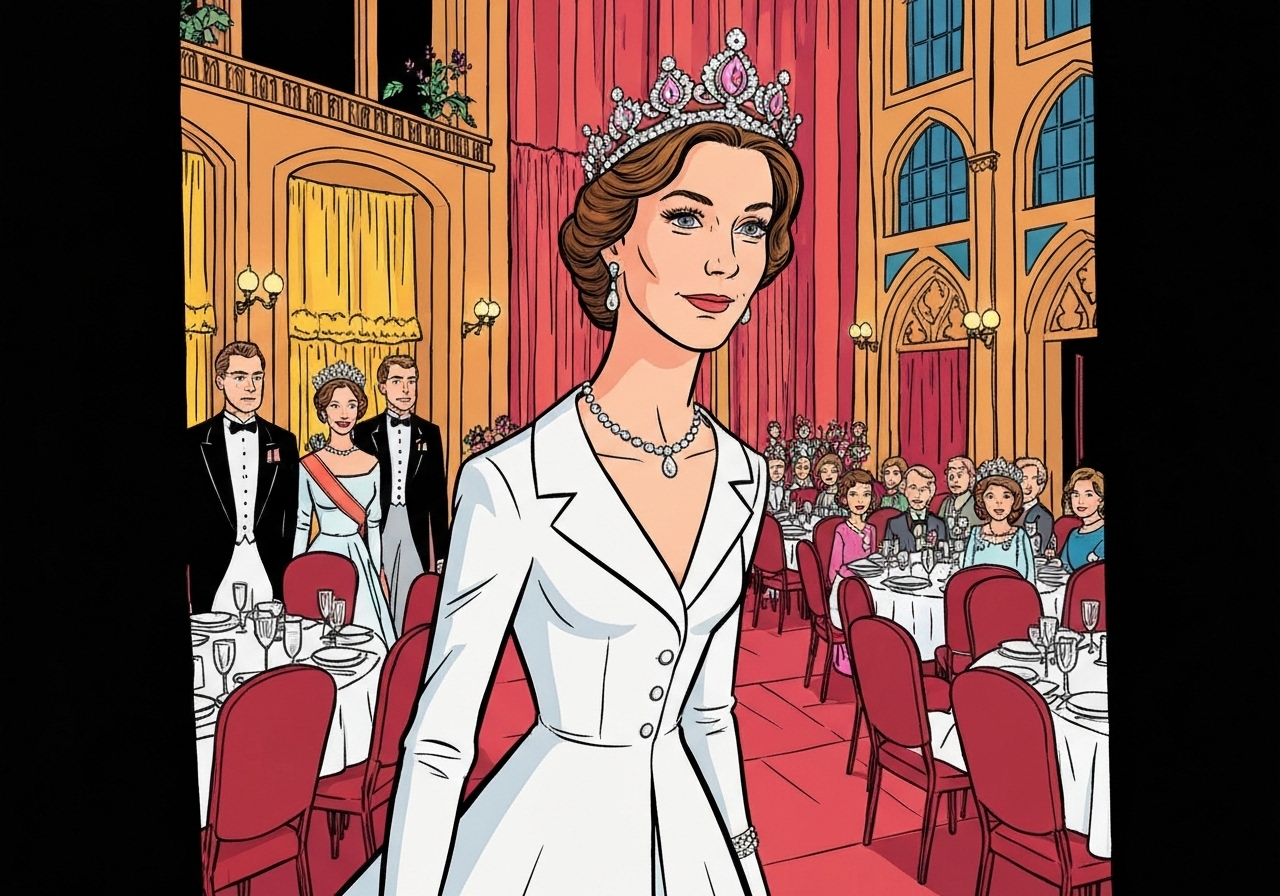
On Wednesday night at Windsor Castle, the Princess of Wales joined Prince William for a state banquet hosted for the German presidential couple, wearing a rarely seen heirloom tiara and a glittering Jenny Packham gown. The piece, identified as the Queen Victoria Oriental Circlet Tiara from the royal collection, combines Burmese rubies and thousands of diamonds and has been publicly worn only a handful of times in modern history. The choice drew attention both for its rarity and for being a departure from the Princess’s usual Lover’s Knot preference, marking a notable moment in royal pageantry during the three-day state visit.
- Kate, Princess of Wales, wore the Queen Victoria Oriental Circlet Tiara at the Windsor Castle state banquet on Wednesday night; Prince William attended in white tie.
- The tiara was made by Garrard in 1853 under direction of Prince Albert and was later reset with Burmese rubies; historical records note the piece originally included opals and about 2,600 diamonds.
- The tiara underwent alterations roughly five years after commissioning; Queen Victoria never wore it again after Prince Albert’s death, and the piece spent decades with other members of the royal family.
- Queen Alexandra reportedly wore the tiara once on a state visit to Germany after replacing the opals with rubies; the Queen Mother wore it frequently in the 20th century, and Queen Elizabeth II wore it on a single occasion in Malta in 2005.
- The Princess paired the tiara with a Jenny Packham gown described by observers as having a slashed neckline, sequin skirt and flowing cape, creating a formally diplomatic evening look.
- The banquet formed the ceremonial centrepiece of a three-day state visit by President Frank-Walter Steinmeier and the First Lady; earlier events included meetings at No. 10 and visits to cultural and educational sites.
- The event was hosted at Windsor Castle while refurbishment continues at Buckingham Palace, and speeches were delivered by King Charles III and President Steinmeier as part of the programme.
Background
The Oriental Circlet was commissioned in 1853 by Garrard for Queen Victoria under the design direction of Prince Albert. Contemporary accounts and firm records indicate it originally combined opals and a profusion of diamonds in an Indian-inspired arrangement of lotus motifs and Mughal arches. Superstition around opals led Queen Alexandra in the 1870s to substitute a set of Burmese rubies—reportedly a gift to Queen Victoria from the ruler of Nepal—altering both the stone palette and, in places, the structure of the circlet.
Five years after its creation the piece returned to Garrard for modification, when a small section was removed to make it no longer a continuous circle. The sudden death of Prince Albert at 42 and Queen Victoria’s prolonged mourning meant the piece fell out of routine use by its original patron. Through the 20th century the circlet resurfaced in royal inventories and portraits, becoming associated with the Queen Mother and later passing to Queen Elizabeth II, whose single public wearing was on a visit to Malta in 2005.
Main Event
The state banquet on Wednesday assembled senior royals and the German President and First Lady at Windsor Castle. The Princess of Wales entered alongside Prince William; officials recorded a Regimental Guard of Honour and national anthems for both countries prior to the evening reception. King Charles III and Queen Camilla were present and took part in the welcome and subsequent formal proceedings.
On arrival the Princess wore the Oriental Circlet Tiara with a Jenny Packham gown that combined sequinned detailing, a dramatic neckline and a cape, which commentators described as both modern and respectful of the occasion. The Duchess of Edinburgh and other senior members of the family attended, underscoring the event’s ceremonial and diplomatic nature during the three-day visit by the German presidential party.
The meal and programme included formal speeches by the King and President Steinmeier, a state dining-room luncheon earlier in the day, and a curated exhibition of Royal Collection items with German links. The itinerary also saw the President visit No. 10 Downing Street and the First Lady visit a London school linked to German-born author Judith Kerr, reflecting cultural as well as political dimensions to the visit.
Analysis & Implications
The Princess choosing the Oriental Circlet over her frequent Lover’s Knot is symbolically significant: tiara selection at state occasions is often read as an intentional signal about continuity, duty and the wearer’s role within the monarchy. Opting for a lesser-seen heirloom draws public attention to deep historic links in the Royal Collection and highlights the curatorial choices that accompany modern royal representation. For royal-watchers, the moment registers as both a fashion statement and a nod to historical resonance—connecting the British court’s 19th-century diplomatic aesthetics to a 21st-century state visit.
Diplomatically, the jewellery choice reinforced the ceremony’s formality. State banquets serve as visual shorthand for bilateral ties; a rare, historically German-linked tiara at such an event accentuates the cultural dimension of the visit. The appearance also has reputational value for the Royal Collection: renewed visibility of seldom-seen pieces can stimulate public interest, museum loans, and scholarly attention to provenance and restoration history.
From a domestic optics perspective, the appearance keeps the Princess in a traditional senior-royal role that combines representational duties with modern styling. Economically, high-profile uses of couture and historic jewels often ripple into short-term interest in designers and conservation funding conversations. Politically, the banquet underscored the UK-Germany relationship at a time of ongoing cooperation on trade, security, and cultural exchange.
Comparison & Data
| Holder | Documented Public Wearings | Notes |
|---|---|---|
| Queen Victoria | 0 (after 1858) | Commissioned 1853; did not wear again after Albert’s death. |
| Queen Alexandra | 1 | Reportedly wore it once on a state visit to Germany after replacing opals with rubies. |
| Queen Mother | Multiple | Photographed wearing it on several high-profile occasions in mid-20th century. |
| Queen Elizabeth II | 1 (Malta, 2005) | Inherited in 2002 and wore it once publicly during her reign. |
| Princess of Wales | 1 (Windsor, 2025) | This banquet marks her first public wearing of the Oriental Circlet. |
The table above places Wednesday’s appearance within a measured history of the piece. While exact counts of informal or private wearings are harder to verify, the public record shows the Oriental Circlet has been worn visibly only on a limited number of state and portrait occasions, making the Princess’s choice notable for heritage visibility.
Reactions & Quotes
The jeweller Garrard highlighted the circlet’s Indian-inspired lotus motifs and Mughal arches as key design elements that remain largely unchanged from the 19th-century work.
Garrard (jeweller)
Palace sources described the ensemble as a formally appropriate pairing for the state banquet, emphasizing continuity with the ceremonial programme at Windsor Castle.
Palace sources (official)
Public response across social platforms noted admiration for the historic choice and the gown’s combination of modern tailoring with traditional pageantry.
Social media reaction
Unconfirmed
- Whether the Princess’s choice signals a sustained change away from her usual Lover’s Knot tiara is speculative and not officially confirmed.
- Any private discussions about the tiara’s future use within the royal collection or loan arrangements to institutions have not been publicly disclosed.
Bottom Line
The Princess of Wales’s appearance in the Oriental Circlet Tiara at the Windsor state banquet combined a rarely seen historical jewel with contemporary couture, producing a moment that resonated for both fashion watchers and royal historians. The tiara’s layered provenance—from Garrard and Prince Albert to Queen Alexandra, the Queen Mother and Queen Elizabeth II—adds symbolic weight to a state occasion focused on UK-Germany ties.
While the immediate outcome is largely ceremonial and cultural, the public visibility of a seldom-worn royal heirloom may prompt renewed interest in the Royal Collection and shape how future state occasions are read for symbolism. For now, the appearance stands as a carefully staged expression of continuity, history and diplomatic theatre.
Sources
- Tatler — media report detailing the banquet and tiara appearance.
- Garrard — jeweller and maker historically associated with the piece (jewellery house).
- Royal Collection Trust — institutional archive for items in the royal collection (institutional resource).