
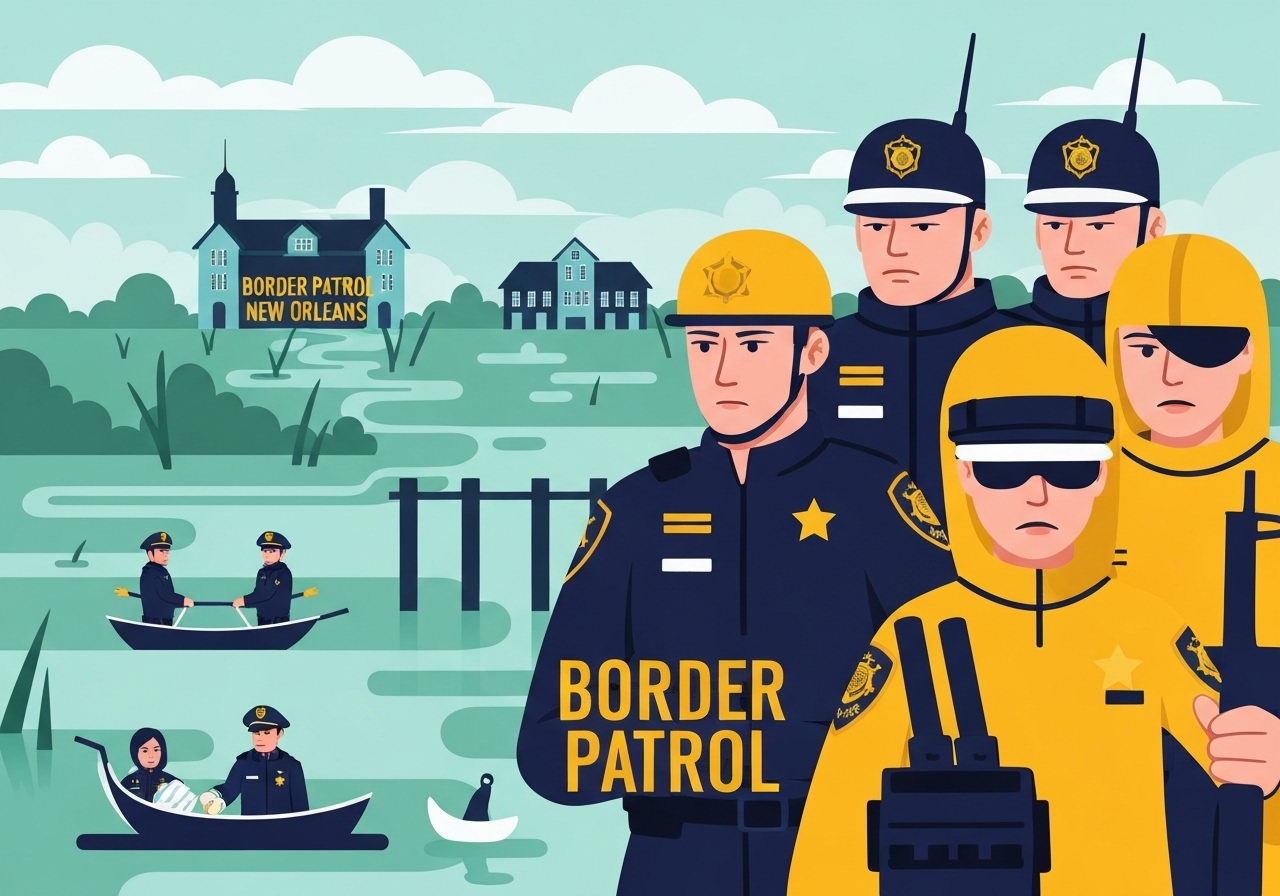
Federal Border Patrol agents began moving into neighborhoods across the New Orleans metro area on Dec. 3, 2025, initiating a new enforcement action announced by the Department of Homeland Security. The administration said the operation is focused on violent criminals believed to be in the country illegally, and distributed a list of 10 people it said had been released from local jails. Agents, including a team led by senior official Gregory Bovino, were reported in the French Quarter, at Home Depot locations and in residential areas as immigrant groups and local advocates warned residents to limit outdoor activity. Louisiana’s Republican governor welcomed the deployment even as city officials and community leaders voiced alarm about tactics and public-safety consequences.
Key Takeaways
- On Dec. 3, 2025, Border Patrol agents dispersed into immigrant neighborhoods across the New Orleans area, marking the latest field operation by federal immigration authorities.
- The Department of Homeland Security said its stated targets included violent criminals and released publicized a list of 10 individuals it said were released from local custody.
- Gregory Bovino, who led prior operations in Los Angeles, Chicago and Charlotte, confirmed arrival and led what he calls a “green team” in the city.
- Agents were observed at Home Depot stores, in the French Quarter and in residential blocks, recalling controversial tactics used in earlier sweeps.
- Immigrant advocates warned residents to reduce time outdoors and said the deployment could chill cooperation with local police and public services.
- State and city political alignment differs: New Orleans is led by Democrats while Louisiana’s governor, a Republican, publicly supported the federal action.
Background
Federal immigration enforcement operations that sweep into urban immigrant communities have become a recurring feature of recent administrations, often framed by officials as focused on public-safety priorities. In other cities where similar actions occurred, critics documented encounters at workplaces, grocery-store lots and big-box retailers; advocates say those tactics disproportionately affected people who are law-abiding but undocumented. Sanctuary policies in some municipalities have limited local detention or transfer of certain detainees to federal immigration authorities, producing jurisdictional tension between city governments and federal law-enforcement priorities.
New Orleans sits at a political crossroads: the city’s municipal leadership is largely Democratic while the state government is controlled by Republicans who have supported tougher immigration enforcement. That political split has shaped local preparation and public messaging ahead of the operation, with municipal officials expressing concern about community trust and state leaders endorsing federal action. Community groups have responded by issuing safety advisories, legal-resource referrals and hotlines in anticipation of enforcement activity.
Main Event
On the morning of Dec. 3, agents fanned out into neighborhoods and commercial corridors. Observers reported Border Patrol personnel at Home Depot parking areas and moving through the French Quarter; other teams entered residential streets. The Department of Homeland Security released a statement identifying its targets as violent offenders who had been released from custody and provided a list of 10 names it said fit that description.
Gregory Bovino, the senior Border Patrol official who has led similar operations elsewhere, personally confirmed the deployment and described the configuration of his unit. Local advocates and residents said the visible presence of agents generated fear and uncertainty, prompting advisories urging people to spend less time in public and to keep children indoors where possible. City leaders requested clarity from federal authorities about operation scope, legal safeguards and measures to protect residents’ civil rights.
Federal officials framed the operation as targeted and limited to individuals with serious criminal records, while community groups and some civil-rights observers pointed to prior reports of sweeping stops and mistaken detentions in other cities. Local law enforcement agencies said they were coordinating to the extent required by law but emphasized separate priorities around community policing and victim cooperation.
Analysis & Implications
The operation raises immediate legal and community-relations questions. Officials argue that deportation efforts focused on violent offenders enhance public safety, but enforcement that appears broad or publicly visible can erode trust between immigrant communities and local authorities. Reduced cooperation with police—by victims or witnesses fearful of contact—can hinder investigations and public-safety outcomes long after an operation concludes.
Politically, the deployment underscores a broader federal strategy to use high-visibility enforcement in jurisdictions described by the administration as providing sanctuary. In a state like Louisiana, where the governor endorsed the intervention, the move reinforces state-federal alignment on immigration policy; in Democratic-led cities, it risks heightening partisan tensions and could drive litigation or local policy pushback. The optics of agents operating in tourist-facing areas such as the French Quarter also carry economic considerations for hospitality and small businesses concerned about customer perceptions.
Operationally, prior sweeps in other cities suggest outcomes vary: narrowly targeted arrests of individuals with criminal records can be accomplished without broad disruption, but previous reporting documented instances where agents detained people—occasionally including U.S. citizens—after stops at workplaces or retail parking lots. That history increases scrutiny on rules of engagement, identification checks and avenues for legal recourse for those detained or affected.
Comparison & Data
| City | Reported Tactics | Local Reaction |
|---|---|---|
| Los Angeles | Large-scale patrols near workplaces and stores | Legal challenges, community protests |
| Chicago | Targeted arrests in neighborhoods | Advocate warnings, civil-rights monitoring |
| Charlotte, N.C. | Visible presence in commercial areas | Community advisories, legal aid mobilized |
| New Orleans (2025) | Agents in French Quarter, Home Depot, residential blocks | City concern; governor support; community fear |
The table above summarizes commonly reported tactics and responses across recent operations; it does not list arrest counts or case outcomes, which have varied and are subject to official reporting. Context matters: local legal frameworks, the presence of sanctuary policies, and levels of coordination between federal and municipal agencies shape both tactics and aftermath.
Reactions & Quotes
“We are focused on the worst of the worst — violent individuals who were released from custody,”
Department of Homeland Security (official statement)
The DHS statement framed the operation as limited to high-priority criminal cases; that characterization is central to federal legal and political messaging.
“My team is on the ground and conducting enforcement across multiple neighborhoods,”
Gregory Bovino, Border Patrol senior official
Bovino’s confirmation on social media and in the field signaled leadership continuity from prior operations and drew immediate attention from local reporters and advocates tracking tactics and locations.
“We have urged residents to reduce outdoor activity and seek guidance from legal-aid groups,”
Local immigrant advocates (community organizations)
Advocates framed community guidance as a precautionary measure intended to reduce encounters that could lead to detentions or confrontations while legal resources are mobilized.
Unconfirmed
- The exact duration of the New Orleans operation has not been confirmed by federal authorities.
- Comprehensive arrest figures for this sweep were not released at the time of reporting.
- Reports that U.S. citizens were detained in New Orleans during this operation are not independently verified.
- The identities and current locations of all 10 people named by DHS have not been independently confirmed in public records accessible to reporters.
Bottom Line
The Dec. 3, 2025 deployment in New Orleans is a high-profile example of the Biden-era-of-administration’s enforcement priorities implemented by Border Patrol under the Trump administration’s policy framework; federal officials emphasize a focus on violent offenders, while community leaders warn of broader harms. The operation is likely to intensify debate over sanctuary policies, intergovernmental cooperation and the balance between enforcement and community trust in cities with sizable immigrant populations.
Key indicators to watch in the coming days include official tallies of arrests and releases, any legal challenges from city or civil-rights groups, and changes in public-safety cooperation between immigrant communities and local law enforcement. Clearer, timely reporting from federal and local authorities will be essential for assessing whether the operation meets its stated narrow goals or produces wider civic and legal consequences.
Sources
- The New York Times — news reporting and on-the-ground coverage