
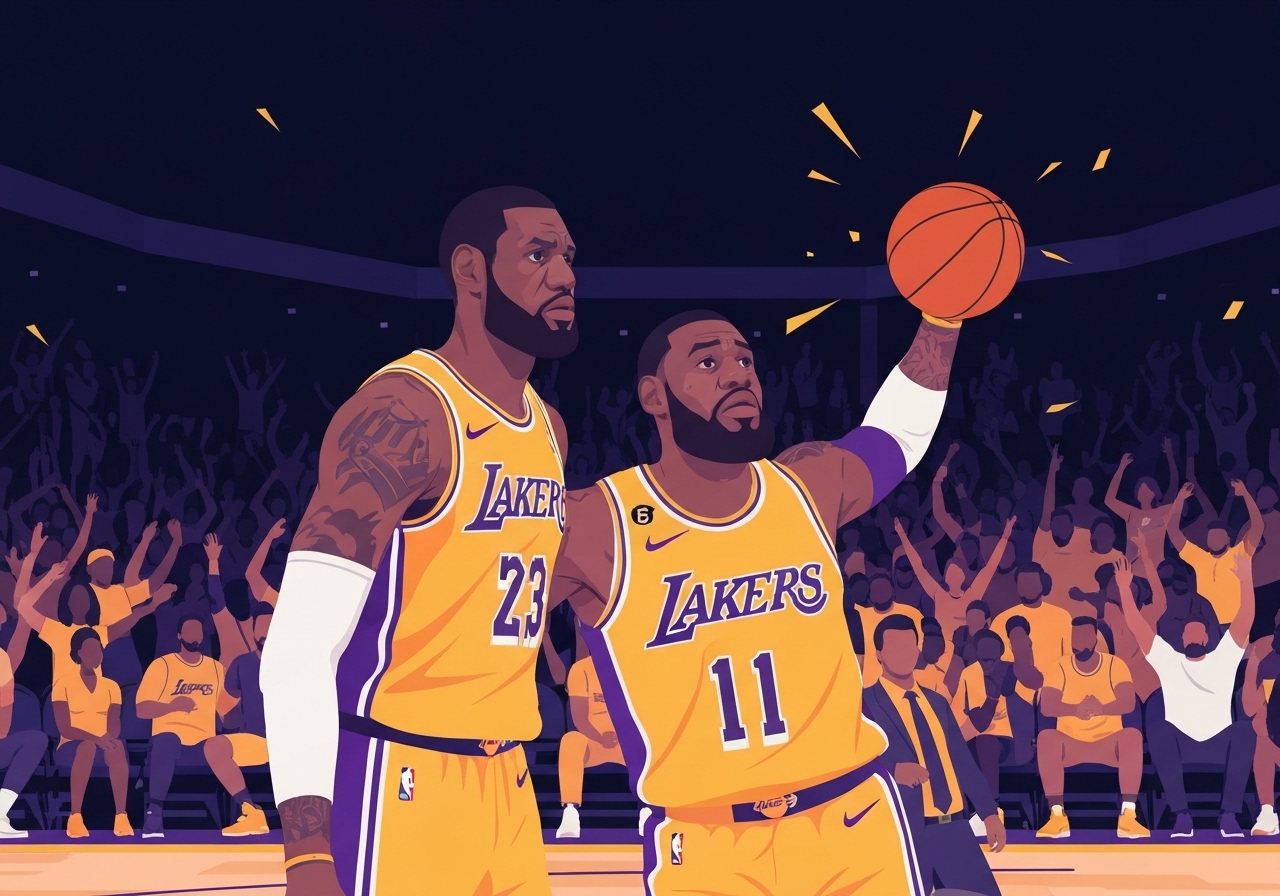
— In Toronto on Thursday night, LeBron James’ historic run of scoring at least 10 points in every regular-season game ended at 1,297 games. James finished with eight points and 11 assists as the Los Angeles Lakers beat the Toronto Raptors 123-120, after James passed to Rui Hachimura for a corner buzzer three. The streak dated to Jan. 5, 2007; instead of hunting a personal mark on the final possession, James made the play that won the game and raised his arms as the milestone closed.
Key Takeaways
- LeBron James’ double-digit scoring streak ended at 1,297 consecutive regular-season games; he scored eight points and handed out 11 assists in the 123-120 victory in Toronto.
- The streak began after an eight-point game early in James’ fourth NBA season on Jan. 5, 2007, and spanned more than 18 years of regular play.
- Michael Jordan holds the second-longest consecutive double-digit streak at 866 games; LeBron’s run exceeded Jordan’s by 431 games.
- The current longest active streak is Kevin Durant’s 267 games; at 37, Durant would need to play into his late 40s to match James’ mark.
- There were multiple close calls during James’ streak, including a high-ankle sprain on March 20, 2021 (Solomon Hill collision) and several single-digit shooting nights where he still reached 10.
- After the game James emphasized team victory over individual milestones, saying the right play produced the game-winning shot.
- Critics have framed some late-game efforts to reach 10 points as stat-seeking; those assessments remain opinion-based rather than proven manipulation of game strategy.
Background
LeBron James established the streak after a low-scoring outing in early January of his fourth season. From that point through Thursday, he scored at least 10 points in every regular-season game he played, a run that began before the iPhone era and spanned multiple teams, rule changes, and stages of his career. The streak excludes playoff games; James had two playoff outings below 10 points during the same period, which do not factor into the regular-season count.
The streak’s longevity has made it a recurring metric in debates about durability and consistency. Players and analysts cite it as evidence of James’ sustained offensive contribution even when his role has shifted toward playmaking or minutes management. Teams, including the Lakers, have had to balance his legacy milestones with short-term roster and season objectives.
Main Event
On Thursday in Toronto, James struggled to get shots to fall. He ended the night with eight points on limited makes, while orchestrating offense with 11 assists. In the final seconds, rather than forcing a contested shot, James delivered a pass to Rui Hachimura in the corner; Hachimura’s 3-pointer at the buzzer gave the Lakers the 123-120 win and closed the book on the streak.
The play illustrated James’ long-standing approach: when a team possession required a singular decision, he opted for the teammate with the best look. Coach J.J. Redick and teammates have framed that choice as consistent with James’ career-long selflessness. Raptors forward Scottie Barnes, who defended James much of the night, noted James’ tendency to make the correct play even when it frustrates observers.
The game featured several earlier attempts and defensive stops that foreshadowed the finale: a blocked jumper by Barnes late in the fourth quarter preserved the scoring drought, while James contributed across the stat sheet with assists and leadership on the floor. The final sequence underscored that the streak’s end came in a moment that directly produced a team victory, rather than in an unforced scoring collapse.
Analysis & Implications
Statistically, a 1,297-game streak of double-digit scoring is an outlier in modern professional sports. It reflects not only scoring skill but durability, team role, and coaching decisions across nearly two decades. The streak’s end does not materially alter James’ place among the all-time leaders in points or appearances; it does, however, mark the close of a persistent narrative thread used to measure his consistency.
For the Lakers, the episode poses a mild philosophical question about allocation of minutes and choices that prioritize either legacy markers or season-long optimization. Critics who suggested instances of “stat-padding” point to isolated plays where a player appears to chase a personal number; defenders note that James’ pass to Hachimura produced the win, aligning personal history with team success.
League-wide, the streak highlights how rare long-term, game-to-game consistency is in an era of load management, injuries, and strategic rest. Kevin Durant’s active 267-game streak is impressive in its own right, but the gap to James’ 1,297 underscores how exceptional the latter’s record is. Teams and front offices may use this moment to reassess how they frame veteran usage—balancing player milestones against playoff positioning.
Comparison & Data
| Player | Consecutive Regular-Season Games with ≥10 Points | Span |
|---|---|---|
| LeBron James | 1,297 | Jan. 5, 2007 – Dec. 4, 2025 |
| Michael Jordan | 866 | Mar. 25, 1986 – Dec. 26, 2001 |
| Kevin Durant (active) | 267 | Active as of Dec. 4, 2025 |
The table puts James’ achievement in context: his run exceeds Jordan’s by 431 games and dwarfs the next-best active streak. While raw totals do not capture changing season lengths, minutes restrictions, or role shifts, they do offer a clear numerical comparison of consistency over time.
Reactions & Quotes
“Just playing the game the right way. You always make the right play. That’s how I was taught the game.”
LeBron James
James framed his final decision as routine team play rather than a commentary on the streak’s end.
“I remember him getting ridiculed for it early on… He did it like he’s done so many times.”
Coach J.J. Redick
Redick defended James’ choice to prioritize the best shot for the team, noting the repeated pattern across James’ career.
“He’s always making the right play. That’s what he gets criticized for.”
Scottie Barnes, Toronto Raptors
Barnes, who defended James in the game, emphasized that critiques of James’ decision-making often miss the consistency of his team-first approach.
Unconfirmed
- Suggestions that the Lakers system deliberately altered late-game plays across multiple contests to protect or prolong the streak are unproven and rest on anecdotal interpretation rather than disclosed team strategy.
- Claims that James’ reduced minutes earlier this season were primarily to engineer a streak extension lack corroborating internal team directives or scheduling records.
Bottom Line
LeBron James’ 1,297-game streak of scoring at least 10 points in every regular-season game is a statistical monument to longevity and adaptability in professional basketball. Its end came not in a solo scoring failure but with a pass that secured a team victory—an outcome consistent with James’ long-standing reputation for prioritizing winning possessions.
While commentators will debate whether isolated plays during the run constituted stat-seeking, the broader takeaway is James’ sustained contribution across roles and seasons. For fans and analysts, the end of the streak closes a remarkable chapter but does not diminish James’ historic career or immediate value to the Lakers as they manage a long season and playoff ambitions.
Sources
- The Athletic / The New York Times — major news outlet reporting the game and streak details
- StatMuse tweet (Dec. 5, 2025) — statistical timeline and social media summary
- NBA.com box score — official game statistics and box score (league)