
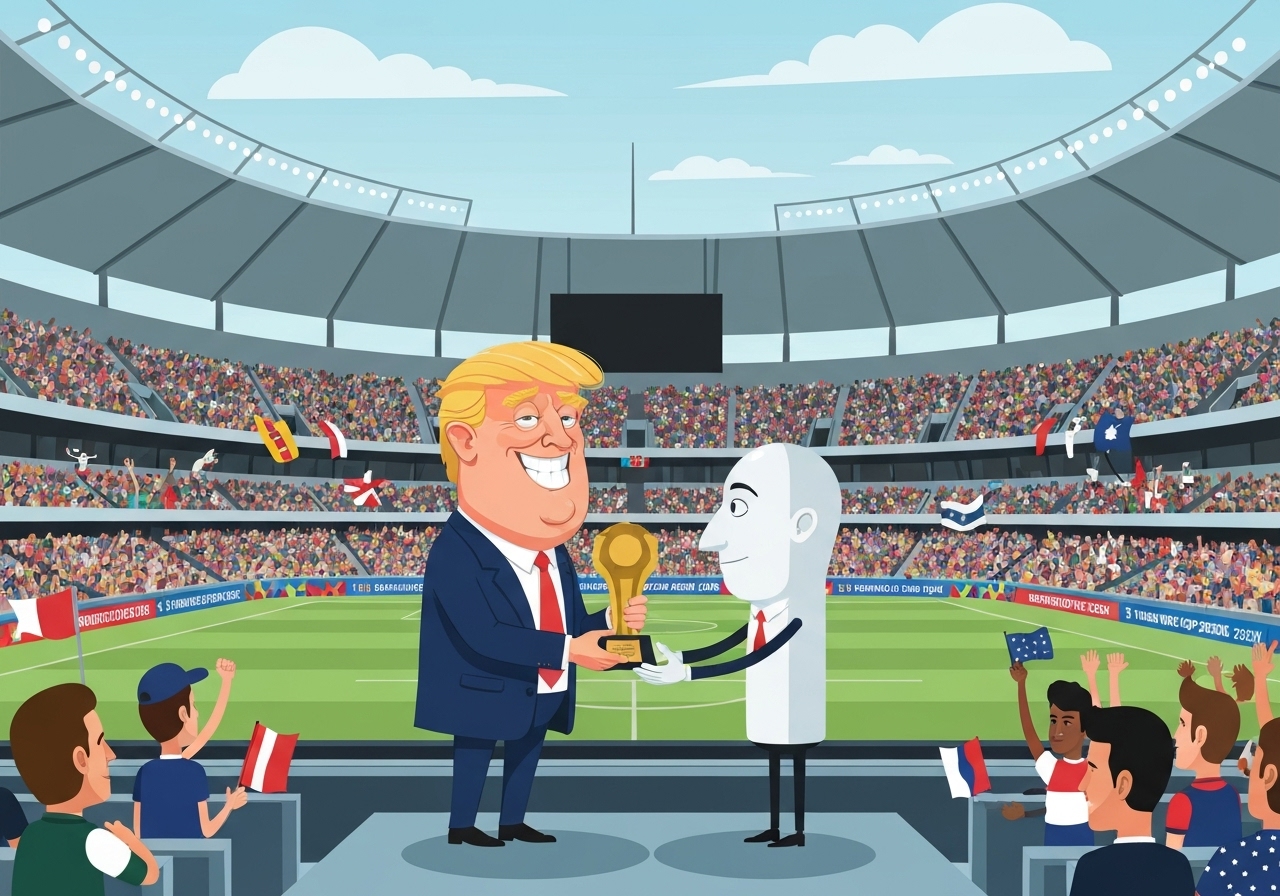
Lead: FIFA has invited President Donald J. Trump to address the 2026 World Cup draw on Friday, Dec. 5, 2025, in Washington after plans to present the new FIFA Peace Prize at the same event. The nearly two-hour ceremony at the Kennedy Center is expected to include brief remarks from Trump, alongside Mexican President Claudia Sheinbaum and Canadian Prime Minister Mark Carney. Multiple people briefed on planning say Trump will be allotted a couple of minutes on stage; FIFA has not publicly confirmed the prize recipient. Human Rights Watch has sought details about the selection process, and FIFA declined to comment to reporters.
Key Takeaways
- FIFA plans to present the inaugural “FIFA Peace Prize — Football Unites the World” during the World Cup 2026 draw on Dec. 5, 2025, at the Kennedy Center in Washington.
- Multiple anonymous sources involved in planning told reporters that President Donald Trump has been invited to speak and is widely expected to receive the first award, though FIFA has not formally announced a winner.
- Attending leaders include Mexico’s Claudia Sheinbaum and Canada’s Mark Carney; Trump is reported to have only a few minutes on stage during the almost two-hour program.
- FIFA announced the new prize on Nov. 5, 2025; the timing followed public remarks by FIFA president Gianni Infantino and by President Trump at separate events in Miami earlier that week.
- Human Rights Watch sent a letter to Infantino on Nov. 11 asking five detailed questions about criteria, nominations and human-rights considerations; the group set a Nov. 20 deadline and reports it received no response.
- The event’s program has been altered in ways planners say reflect Trump’s preferences, including the choice of the Kennedy Center as venue and a scheduled performance by the Village People.
Background
On Nov. 5, 2025, FIFA unveiled a new honor, the “FIFA Peace Prize — Football Unites the World,” describing it as an annual recognition for individuals who have worked to unite people and promote peace through football. FIFA president Gianni Infantino framed the award as a response to global divisions and said the sport can help bring people together. The organization said the inaugural prize would be presented at the World Cup draw in Washington on Dec. 5, 2025, with Infantino scheduled to make the presentation.
The announcement arrived amid a week in which Infantino and President Trump both made public appearances in Miami, and in the aftermath of international commentary around diplomacy and ceasefires — notably an Israel-Gaza cessation referenced by Infantino. Trump had publicly expressed an interest in winning a major peace award earlier in the year after the Nobel Peace Prize went to María Corina Machado. FIFA’s new prize is separate from the Nobel and is controlled by the sport’s governing body.
FIFA’s internal decision-making, as reported by media outlets, appears to have unfolded without wide consultation of the FIFA Council or vice presidents, according to people quoted in reporting. That absence of formal consultation — if accurate — has helped trigger scrutiny from rights groups and media as the organization prepares to present the first award at a high-profile public ceremony hosted in the U.S. capital.
Main Event
Organizers say the World Cup draw will run nearly two hours at the Kennedy Center and will include ceremonial elements around the inaugural FIFA Peace Prize. Multiple sources briefed on the ceremony say Trump will be given time on stage immediately after receiving the award, though FIFA has not issued a program that confirms speaking order or precise timings. The Kennedy Center was chosen as the venue; sources describe the setting as adapted to preferences associated with Trump and his allies.
Mexican President Claudia Sheinbaum and Canadian Prime Minister Mark Carney are reported to be among the dignitaries in attendance. The event will also feature musical performances; FIFA announced the Village People will perform at the draw, a decision that has drawn attention because the group’s song “Y.M.C.A.” has been frequently used at Trump events and rallies in recent years.
White House spokesperson Davis Ingle issued a statement praising U.S. standing under Trump’s leadership and tying that claim to the U.S. role as host for the 2026 World Cup. Separately, the White House declined to comment specifically on the question of whether Trump would speak at the ceremony. FIFA likewise declined to provide an on-the-record confirmation of the prize recipient when asked by reporters.
Analysis & Implications
The convergence of a new FIFA award and a U.S.-hosted World Cup draw raises questions about the overlap of sports diplomacy and political theater. Presenting an inaugural “peace” honor at a high-profile event amplifies the symbolic value of the prize; if awarded to a sitting U.S. president, it will immediately place FIFA at the center of a broader debate over the role of sporting institutions in geopolitical recognition. The optics of a ceremony adapted to the preferences of one potential recipient will be closely scrutinized.
Procedural transparency is central to questions now being posed by rights groups and journalists. Human Rights Watch’s formal letter requesting selection criteria, a timeline for publication and details about decision-makers underscores concern that an award of this kind should rest on clear, published standards. FIFA’s refusal so far to publish those procedural details or to confirm whether internal bodies were consulted risks undermining the credibility of the prize from its launch.
There are reputational and practical stakes for FIFA. The organization has worked to expand football’s global diplomacy role, and an award tied to peace would normally be expected to carry rigorous safeguards against politicization. If the inaugural selection process is perceived as ad hoc or politically driven, FIFA may face pressure from member associations, sponsors and human-rights advocates, with potential consequences for future governance reforms and public support.
For the U.S. political scene, the moment carries domestic resonance. A high-profile international accolade presented to a sitting president on U.S. soil — combined with a short onstage stint at a globally broadcast sports event — would supply immediate campaign and diplomatic talking points. Opponents and civil-society groups are likely to challenge the optics and the process, while supporters will highlight the ceremonial recognition.
Comparison & Data
| Award | Frequency | Issuer | Transparency Expectations |
|---|---|---|---|
| Nobel Peace Prize | Annual | Nobel Committee (Oslo) | Named committee, published criteria, multi-stage nomination |
| Inaugural FIFA Peace Prize | Announced as annual | FIFA (Zurich-based governing body) | Selection criteria and process not publicly detailed as of Nov–Dec 2025 |
The table contrasts an established international prize, the Nobel Peace Prize, which uses a formal committee and published nomination processes, with FIFA’s new award, where—based on available reporting—selection rules and governance have not been disclosed. That absence of detail is a primary driver of outside scrutiny and explains why rights groups are seeking written answers from FIFA ahead of the ceremony.
Reactions & Quotes
Rights groups and media organizations have publicly and privately pushed FIFA for clarity. Human Rights Watch sent a formal letter requesting the award’s criteria and the names or qualifications of decision-makers; reporters say FIFA has not responded to requests for details.
“The United States of America has never been more respected or successful than it is now under President Trump’s historic leadership,”
White House spokesperson Davis Ingle (statement reported)
The White House statement framed U.S. stature under Trump as part of why the country is an appropriate World Cup host; the administration did not publicly confirm the speech arrangement. FIFA president Gianni Infantino has made public comments linking football to peace and, in related posts, signalled that an announcement about the prize would come at the draw.
“Football stands for peace…the FIFA Peace Prize — Football Unites the World will recognise the enormous efforts of those individuals who unite people,”
Gianni Infantino (FIFA statement/Instagram)
Infantino’s published remarks position the award as an instrument for celebrating unifying figures; critics note that without published selection rules, such statements offer limited assurance about the process. Media outlets including Politico and The Athletic reported on internal planning and the lack of consultation with FIFA’s council, increasing scrutiny of the prize’s governance.
Unconfirmed
- That Donald Trump has been formally selected and will be the recipient of the inaugural FIFA Peace Prize; FIFA has not issued an official announcement.
- That FIFA consulted its FIFA Council or vice presidents in designing the prize—media reporting claims there was no consultation, but FIFA has not publicly released internal deliberation records.
- That the program order and full speaking schedule for the Dec. 5 draw are finalized; organizers have not published the event run sheet.
Bottom Line
FIFA’s decision to stage the inaugural Peace Prize presentation during the World Cup 2026 draw in Washington has turned a sports ceremony into a potential diplomatic and political flashpoint. The reports that President Trump will receive the award and will speak briefly on stage, if confirmed, would immediately raise questions about the intersection of sports governance and partisan politics at a global moment for football.
The central issue for observers and stakeholders is process: awarding a prize tied to “peace” without publicly documented criteria or a transparent selection mechanism invites skepticism and reputational risk. For FIFA, the immediate test is whether it will disclose the evaluation framework and the identities or mandates of decision-makers; failing to do so will likely prolong scrutiny and erode trust in the prize from its inception.
Readers should watch for an official FIFA announcement and any published selection criteria ahead of the ceremony. If those materials are released, they will be key to assessing the legitimacy of the award and the broader implications for sports diplomacy heading into the 2026 World Cup.
Sources
- The New York Times / The Athletic (news report) — original reporting summarizing planning and sources.
- FIFA (official) — FIFA press statements and news release archive on the Peace Prize announcement.
- Human Rights Watch (international NGO) — public statements and correspondence requests regarding accountability and rights considerations.
- Politico (news) — reporting cited about the scheduled speaking appearance and event details.