
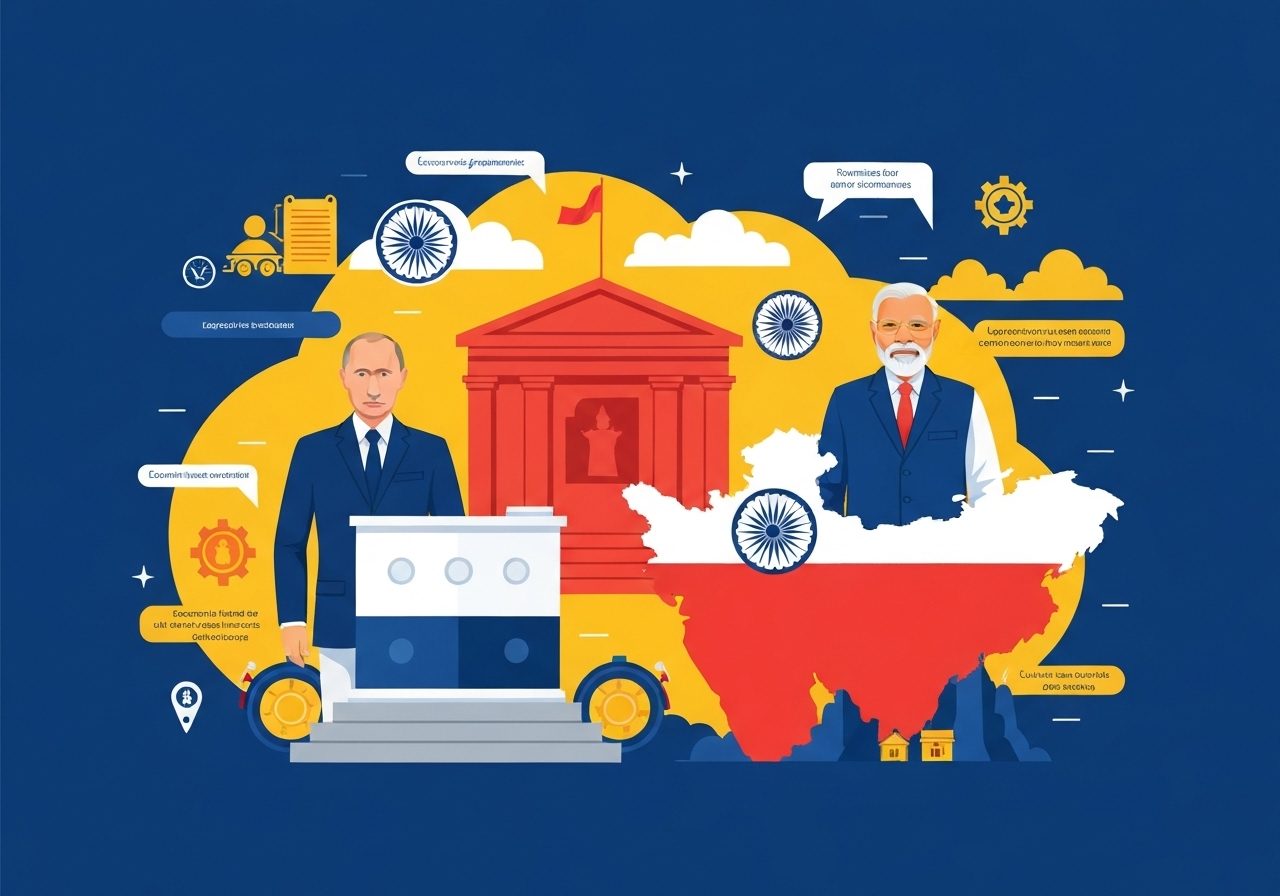
Russian President Vladimir Putin made his first trip to India since the 2022 invasion of Ukraine for a one-day Delhi visit that combined ceremony, business talks and bilateral signings. Meeting Prime Minister Narendra Modi, Putin attended a state banquet, inspected a guard of honour and spoke at a business forum where multiple memorandums were signed. The two leaders framed the visit as a reinforcement of a “special and privileged strategic partnership,” but left without any headline defence purchase or a detailed oil supply agreement. Instead, the talks produced economic frameworks and sectoral pacts that signal a pragmatic pivot toward trade and market diversification for both capitals.
Key Takeaways
- Putin’s visit was his first to India since the Ukraine war began in 2022 and featured full state honours and a presidential banquet in New Delhi.
- Bilateral trade was highlighted: current trade stands at $68.72 billion, up from $8.1 billion in 2020, with a stated target of $100 billion over five years.
- No major new defence contract was announced; outstanding deliveries such as parts of the S-400 order remain an unresolved timing issue.
- Russia pledged readiness to ensure “uninterrupted shipments” of oil to India, but provided no contractual details on volumes, pricing or payment terms.
- Agreements were signed across shipbuilding, critical minerals, pharmaceuticals (a new factory in Kaluga), civil nuclear cooperation, visa facilitation and seafarer training for polar operations.
- India and Russia discussed a potential free trade agreement with the Eurasian Economic Union (EAEU) to broaden market access within the region.
- Delhi sought to expand non-energy trade to reduce reliance on discounted Russian crude; many deals aim to diversify cooperation beyond hydrocarbons.
Background
Since Russia’s full-scale invasion of Ukraine in February 2022, Moscow has faced diplomatic isolation and sweeping Western sanctions targeting its economy and key export sectors. India has maintained historic defence and energy ties with Russia even as it deepened security and strategic ties with the United States. That dual orientation has constrained New Delhi: it values Russian technology and military platforms but also needs to manage rising leverage from Washington, which has used tariffs and public pressure to discourage large-scale energy purchases from Moscow.
The economic relationship between India and Russia has expanded sharply in recent years, largely driven by India’s purchases of discounted Russian crude that helped sustain Russian export revenues. New Delhi and Moscow now talk of a five-year economic framework and an ambitious $100 billion bilateral trade goal, but much of the recent growth is concentrated in energy. Historically, defence cooperation has been the backbone of the relationship—platforms from MiG and Sukhoi aircraft to S-400 air-defence systems—but procurement choices are increasingly influenced by delivery timelines, sanctions risk and India’s desire to diversify suppliers.
Main Event
The one-day programme opened with a ceremonial reception that included a guard of honour and a state banquet at the presidential residence in New Delhi. Mr Modi personally greeted Mr Putin at the airport, a departure from usual protocol and a visible sign of the importance India places on the relationship. The leaders held bilateral talks, followed by a business forum where government and private delegations explored commercial opportunities, especially in mining, pharmaceuticals and shipping.
Several memorandums and agreements were signed, covering areas such as critical minerals, a Russia-India economic cooperation programme, shipbuilding cooperation and a proposed Russian-Indian pharmaceuticals factory in Kaluga. Modi emphasised boosting business ties and market access, while Putin framed the visit around ensuring energy continuity and deepening economic channels as Russia faces Western restrictions.
Despite speculation before the visit about high-end defence sales—such as Su-57 fighters or new air-defence packages—no headline defence purchase was announced. Officials signalled that procurement discussions may be continuing behind the scenes, and delivery schedules for existing orders remain a practical concern for New Delhi.
One element that drew attention was an “informal dinner” described by a senior Russian aide as a key confidential contact between the two leaders. Moscow has characterised such face-to-face meetings as opportunities to address the most sensitive bilateral and international issues away from public briefings.
Analysis & Implications
Strategically, the visit served multiple aims for both capitals: for Russia, it was an attempt to break diplomatic isolation and keep important markets open for energy and critical supplies; for India, it was a balancing act that sought to preserve long-standing ties while expanding commercial cooperation. The optics of full state reception signalled to Western capitals that New Delhi will not wholly capitulate to external pressure on its sovereign economic choices.
Economically, the headline goal of $100 billion in trade is plausible only if both sides substantially increase non-oil commerce. With current trade at $68.72 billion, much of the recent increase is energy-driven; scaling up sectors such as pharmaceuticals, critical minerals processing and shipping services will be required to reach that target without relying on discounted crude.
On defence, the absence of a blockbuster sale likely reflects India’s wider supplier diversification and the practical realities of Russian industrial capacity being stretched by the war in Ukraine. Delays in S-400 deliveries or in delivering ordered platforms could nudge New Delhi toward alternate suppliers, but Russia remains a dominant source of certain systems and spares for India’s existing inventory.
Regionally, deeper economic engagement between Moscow and New Delhi complicates U.S. efforts to isolate Russia economically but also creates leverage for India in negotiations with Washington. How New Delhi manages commercial ties with Moscow while pursuing a strategic partnership with the U.S. will matter for trade policy, defence sourcing and geopolitical alignments in Asia.
Comparison & Data
| Metric | 2020 | Latest reported | Target |
|---|---|---|---|
| Bilateral trade (USD) | $8.1 billion | $68.72 billion | $100 billion (5-year target) |
| Primary driver | Mixed trade | Discounted Russian oil imports | Diversified non-oil trade & services |
The sharp increase in bilateral trade since 2020 is largely attributable to oil purchases at discounted prices following Western restrictions on Russian energy. To meet the $100 billion goal without replicating the same energy dependency, both countries have emphasised deals in shipbuilding, critical minerals, pharmaceuticals and logistics. Data on exact oil volumes and pricing terms were not disclosed publicly during the visit.
Reactions & Quotes
Official and independent reactions ranged from praise of diplomatic engagement to caution about unresolved details.
“During such confidential face-to-face contacts, the most urgent, most sensitive and most important issues are discussed,”
Yuri Ushakov, Russian foreign policy aide (as quoted in Russian media)
This description was presented by Russian officials as characterising the leaders’ private dinner meeting, which Moscow called a central element of the visit. Observers noted that such meetings often cover topics officials avoid discussing in public, but details were not released.
“Moscow stands ready to ensure uninterrupted shipments of oil,”
Vladimir Putin (remarks in Delhi)
Putin framed energy supplies as a priority but stopped short of announcing contractual commitments on volumes, pricing or payment mechanisms. Analysts point out that without specifics, the pledge is a political assurance more than an immediate operational guarantee.
“We must broaden ties in business and technology to make this partnership future-facing,”
Narendra Modi (public remarks)
Modi emphasised economic diversification and new areas of cooperation, underlining India’s interest in expanding trade beyond the energy sector while maintaining traditional ties with Russia.
Unconfirmed
- Specifics of any secret arrangements on oil pricing, volumes or payment currency were not disclosed and remain unverified.
- Whether substantive defence procurement agreements were finalised in private during the informal dinner is unconfirmed and has not been publicly detailed.
- Timetables for delivery of pending defence orders, including remaining S-400 components, are uncertain given Russian defence production pressures.
Bottom Line
The Delhi summit was a carefully staged reaffirmation of India–Russia ties that delivered multiple sectoral memorandums and a political signal of continued cooperation, but it stopped short of any single transformative agreement on defence or a binding long-term energy contract. Both capitals gained political optics and commercial footing: Moscow secured a high-profile reception and avenues to sustain trade, while New Delhi expanded its non-oil cooperation menu and reinforced a long-standing partnership.
Achieving the $100 billion trade target without re-entrenching energy dependence will require concrete follow-through on industrial, minerals and technology deals and clear implementation plans. Meanwhile, how India manages U.S. pressure over Russian energy purchases and how quickly Russia can meet delivery timelines under wartime constraints will shape whether this summit yields durable strategic and economic benefits.
Sources
- BBC News (international broadcaster; reporting and analysis on the Delhi visit)
- Reuters (international news agency; broader coverage of India-Russia economic and defence ties)
- Rossiyskaya Gazeta (Russian state-linked newspaper; cited by Russian officials for commentary)
- Komsomolskaya Pravda (Russian tabloid; reported on ceremonial aspects of the reception)