
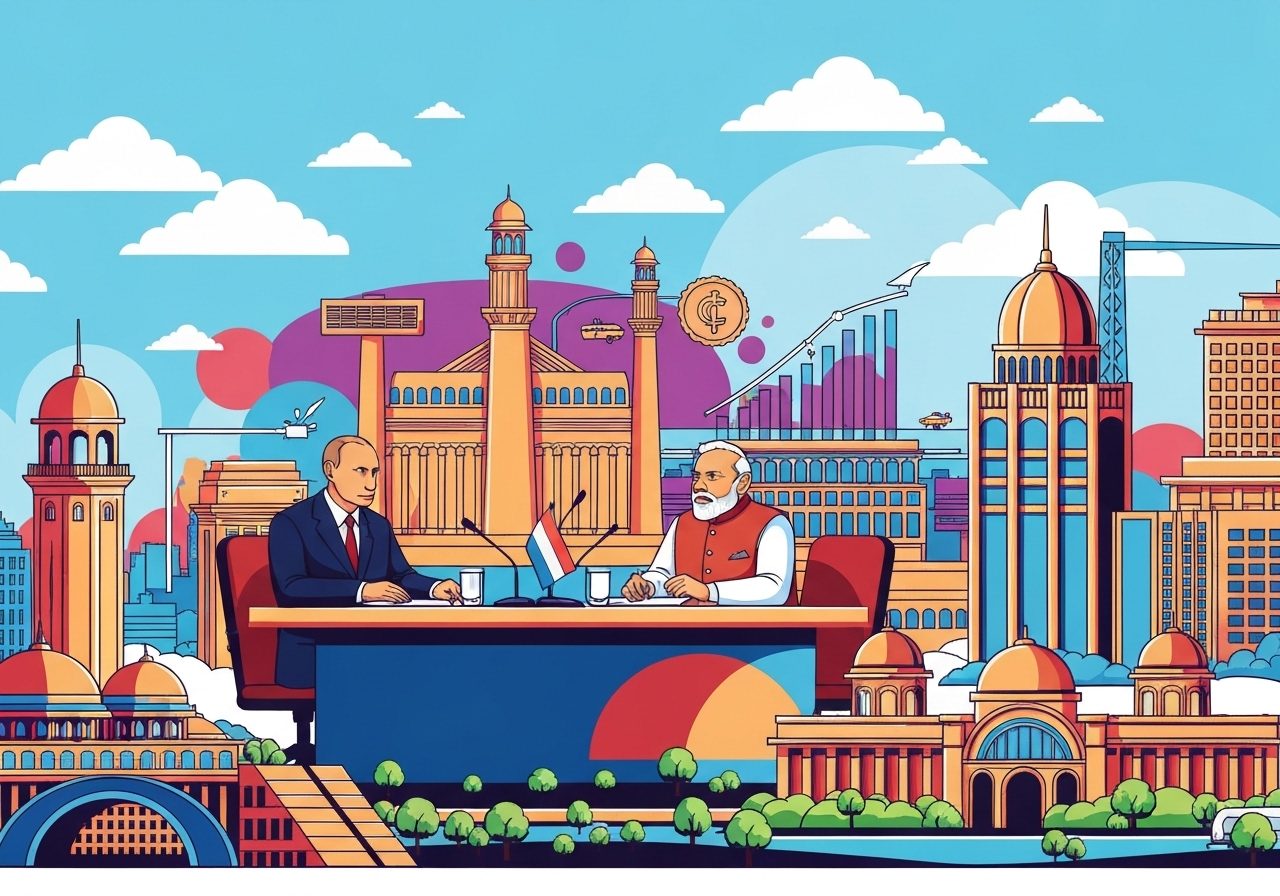
On Dec. 5, 2025, Russian President Vladimir Putin began a two-day state visit to New Delhi, meeting Indian Prime Minister Narendra Modi in a high-profile reception that included ceremonial honors and public displays of welcome. The leaders used the visit to announce measures aimed at deepening economic links — notably a labor mobility agreement and a Russian pledge to sustain energy deliveries — while New Delhi sought to balance those moves with growing ties to the United States. The trip was Putin’s first to India since Russia’s 2022 invasion of Ukraine and came after an International Criminal Court arrest warrant issued in March 2023, giving the visit unusual diplomatic weight and media attention. Both sides described the talks as a step toward larger bilateral trade, with a repeated target of $100 billion in exchange.
Key Takeaways
- Putin’s two-day state visit to New Delhi began on Dec. 5, 2025, his first trip to India since the 2022 invasion of Ukraine.
- Leaders announced a deal to ease entry and work rules for more Indian nationals in Russia following talks on Dec. 6, 2025.
- Putin said Russia is “ready to continue uninterrupted shipments of fuel” for India’s expanding economy, a pledge made amid Western sanctions.
- The U.S. has recently raised trade pressure on India, including punitive tariffs that were doubled to 50% under the Trump administration, affecting some Indian firms’ purchases of Russian oil.
- Reliance Industries reportedly halted purchases of Russian crude for certain export-refined products in late November 2025 to comply with EU restrictions.
- The Center for Research on Energy and Clean Air has documented increased evasion tactics by some oil shipments, including suspicious flag changes, since sanctions intensified.
- India and Russia reiterated a mutual ambition to boost bilateral trade to roughly $100 billion, although current flows are heavily weighted toward Indian purchases of Russian fossil fuels.
Background
India and Russia have a long-standing relationship dating back to the Cold War era, when New Delhi leaned on Moscow as a strategic partner while managing hostile or uncertain ties with neighboring states. The partnership became institutionalized across defense purchases, energy deals and diplomatic support, built in part from India’s desire to avoid being isolated along its northern frontiers. India and China still contest more than 2,000 miles of Himalayan border, a persistent strategic factor that historically pushed New Delhi toward Moscow as a reliable arms and diplomatic supplier.
Those Cold War roots have given way to a more complex modern calculus: New Delhi now pursues a multi-vector foreign policy that aims to maintain ties with Moscow while deepening strategic, economic and defense cooperation with the United States and other Western partners. Since Russia’s full-scale invasion of Ukraine in early 2022, India has increased purchases of Russian oil and fuel products, drawing international scrutiny and sporadic pressure to reduce that dependence. Simultaneously, India has expanded trade and energy imports from the U.S., attempting to narrow a bilateral trade deficit and mollify Washington’s concerns.
Main Event
The visit opened with visible pomp: Modi personally greeted Putin, and public ceremonies — a limousine ride photo op, devotional lamps on the Ganges and an honor guard — underscored the message of welcome. Diplomats framed the optics as New Delhi asserting the independence of its foreign policy even as it faces reciprocal pressures from Western capitals. Putin’s itinerary included private and recorded exchanges with Modi and later a bilateral session where the two governments announced several agreements, including a visa and labor framework to facilitate more Indian workers in Russia.
In prepared remarks relayed through a translator, Putin pledged that Moscow would “continue uninterrupted shipments of fuel” to meet India’s needs, language aimed at reassuring New Delhi about its energy security. Indian statements were more circumspect on the conflict in Ukraine: Modi referred to “the situation in Ukraine” and welcomed efforts toward a peaceful resolution without explicitly endorsing any particular diplomatic plan. The two leaders also said they hoped to substantially raise bilateral trade, citing a long-term target of about $100 billion.
Practical obstacles remain. Several Indian firms reduced Russian crude purchases amid punitive measures from the Trump administration — most notably a tariff increase to 50% — and EU rules restricting third-country imports of refined products from Russian crude. Reuters reported that Reliance Industries paused buying Russian crude for some refined exports in late November 2025 to comply with the EU measure. Independent analysts and monitoring groups have flagged increased attempts by some tankers to obscure origin and routing to evade sanctions, complicating any pledge of uninterrupted shipments.
Analysis & Implications
The visit highlights New Delhi’s tightrope strategy: maintain a historically close relationship with Moscow while managing an increasingly consequential partnership with Washington. For India, Russian energy supplies and defense ties remain strategically valuable, but the economics have become fraught as Western penalties raise the cost and legal risk of continued high-volume purchases. New Delhi’s elevation of U.S. energy imports alongside sustained Russian purchases reflects a hedging approach rather than a simple pivot.
For Moscow, the trip provided diplomatic and reputational dividends. Putin’s presence in the world’s largest democracy draws attention and undercuts some isolation imposed by Western travel and financial restrictions following the ICC warrant in March 2023. Yet strategic gains may be limited: the Russia-India trade relationship remains uneven and largely one-directional, driven by Indian demand for fossil fuels rather than balanced industrial or technology exchange.
The broader sanctions architecture faces a stress test. If Russia can maintain or reroute shipments to India despite Western measures, it may inspire similar workarounds elsewhere — increasing the complexity of enforcement for the U.S. and EU. Conversely, sharper penalties on intermediaries and secondary sanctions could further drive costs and disruptions for Indian importers, intensifying pressure in New Delhi to diversify suppliers.
Comparison & Data
| Item | Key Data / Date |
|---|---|
| Putin’s visit | Begun Dec. 5, 2025 (two-day state visit) |
| ICC arrest warrant | Issued March 2023 |
| U.S. tariffs on some Indian goods | Doubled to 50% (Trump administration) |
| Reliance crude purchase pause | Reported late Nov. 2025 (Reuters) |
| India-Russia trade target | $100 billion (stated ambition) |
The table compiles concrete milestones and figures that frame the visit. While targets such as the $100 billion goal are aspirational and lack a single time horizon, the other items are dated facts that shape practical constraints — from legal liabilities tied to sanctions to signals about diplomatic normalization after a high-profile absence.
Reactions & Quotes
Analysts in London and New Delhi interpreted the visit as New Delhi asserting diplomatic autonomy amid external pressure. Observers emphasized both the symbolic nature of the welcome and the practical limits on how much Moscow can expand energy sales given sanctions enforcement.
“India has options,”
Chietigj Bajpaee, Chatham House
Bajpaee used the phrase to underscore New Delhi’s attempt to signal independence without fully alienating either Moscow or Washington. He argued that India wants to preserve strategic ties to Russia while increasingly integrating economically with the West.
International commentators also noted the publicity value for Putin, whose movements have been curtailed since legal actions in international courts. Strategists said the visit gives Russia diplomatic visibility, particularly in countries outside the Western alliance system.
“To visit the world’s largest democracy… will bring him enormous global attention,”
Swaran Singh, international relations analyst
Singh’s comment highlighted the reputational element of the trip; he and other analysts stressed that visibility does not automatically translate into broad policy wins for Moscow given the sanctions landscape.
“Ready to continue uninterrupted shipments of fuel,”
Vladimir Putin (translated)
Putin’s pledge aimed to reassure Indian officials and markets about supply stability; enforcement realities and evolving sanctions make the durability of that promise subject to legal and logistical constraints, analysts say.
Unconfirmed
- Precise mechanisms for how Russia plans to maintain “uninterrupted” fuel shipments to India under tightened sanctions remain unclear and unverified.
- Details and terms of the labor mobility agreement announced during the visit, including timelines and numerical caps, were not fully disclosed and await official publication.
- Reports of systematic fraudulent flagging and widespread sanction-evasion require corroboration at the vessel-ownership and insurer levels; monitoring groups have documented cases, but the scale and frequency are still being assessed.
Bottom Line
The Dec. 5–6, 2025 meetings between Putin and Modi reinforced a long-standing bilateral relationship and produced concrete steps — notably a labor mobility accord and public assurances on energy supplies — meant to deepen economic engagement. Yet the visit also exposed enduring tensions: India’s need to secure energy and defense ties with Russia collides with legal and commercial pressures from the West, especially the United States and the European Union.
In practice, New Delhi appears to be pursuing a hedged approach: sustaining strategic ties with Moscow where feasible while expanding economic cooperation with the West to reduce vulnerabilities. That balancing act is likely to continue shaping India’s foreign and commercial policy in the near term, with the feasibility of ambitious trade targets and claims of uninterrupted energy flows hinging on how sanctions, corporate compliance and global market conditions evolve.
Sources
- NPR (U.S. public media report on the visit)
- Chatham House (think-tank commentary and analyst profile)
- Reuters (international news agency reporting on Reliance and trade)
- Centre for Research on Energy and Clean Air (independent research on ship movements and sanction evasion)
- India Today (Indian news outlet reporting on diplomatic meetings)