
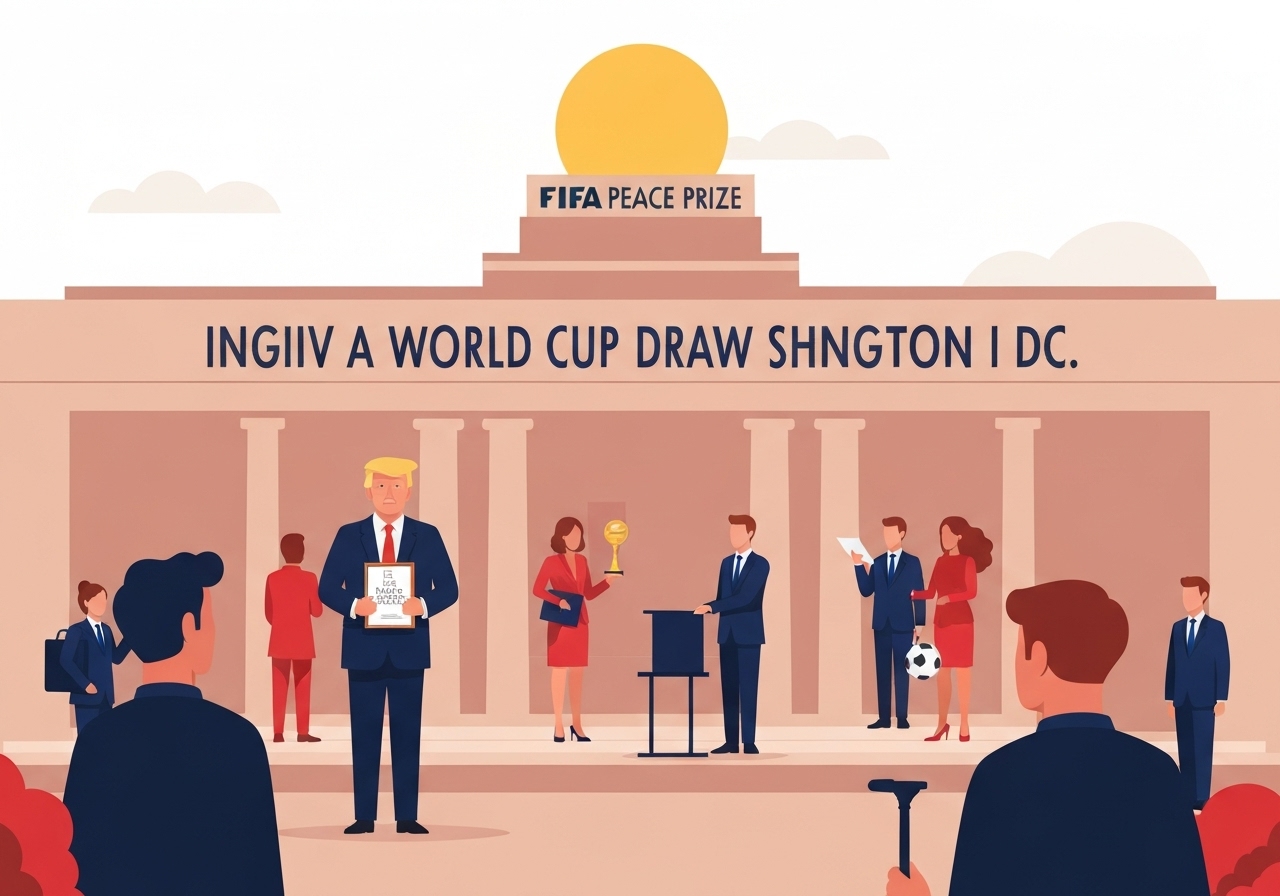
Lead: On Friday, 5 December 2025, at the 2026 World Cup draw in Washington D.C., former US president Donald Trump received FIFA’s newly created inaugural Peace Prize onstage at the Kennedy Center. FIFA president Gianni Infantino presented the award, saying it recognized exceptional actions to promote peace and unity. Trump accepted a trophy, medal and certificate and used the platform to claim broad peacemaking achievements. The presentation immediately prompted scrutiny of both the selection process and Trump’s public record on conflict intervention.
Key Takeaways
- FIFA presented its first-ever Peace Prize at the 2026 World Cup draw in Washington D.C. on 5 December 2025, with Gianni Infantino as presenter.
- Donald Trump accepted a trophy, medal and certificate and declared the world “a safer place now,” while asserting he had saved “millions” of lives in multiple conflicts.
- FIFA describes the prize as honoring individuals who “help unite people in peace”; the governing body has not publicly disclosed full selection criteria or the decision-making process.
- A new FIFA social responsibility committee, reportedly chaired by Myanmar businessman Zaw Zaw, will propose processes for future awards, according to investigative reporting.
- The decision occurs ahead of the expanded 2026 World Cup, which begins on 11 June 2026, will stage 104 matches across 16 host cities and has been promoted as a unifying event.
- Observers and analysts immediately questioned the match between the prize’s intent and several contested or ongoing conflicts Trump cited as examples of his peacemaking.
- FIFA has strengthened ties with Trump’s circle recently, including an education board appointment tied to 2026 revenues involving Ivanka Trump and a $100m initiative.
Background
FIFA announced the creation of a Peace Prize to recognize individuals purportedly advancing unity and peace through exceptional actions. The award debuted at the official draw for the 2026 World Cup, an expanded tournament that will open on 11 June 2026 with a record 104 matches across 16 host cities in the United States, Canada and Mexico. The new prize is framed by FIFA as part of broader social-responsibility commitments tied to the federation’s global profile.
Gianni Infantino, FIFA’s president and a visible ally of Trump in recent months, presented the honour at the Kennedy Center for the Performing Arts in Washington, D.C. FIFA has not released a full public record of the selection panel or scoring rubric for the inaugural award. Independent reporting has linked a newly formed social responsibility committee to the prize’s future governance; that committee is reported to be chaired by Myanmar businessman Zaw Zaw, a figure with his own controversies.
Main Event
The presentation unfolded at Friday’s draw ceremony where diplomats, FIFA officials and invited guests were in attendance. Infantino placed the prize in the context of football’s claimed ability to build bridges, saying the award recognized actions to promote global unity. Trump took the stage to accept a trophy, a medal and a certificate and framed the recognition as among his greatest honors, reiterating broad claims about ending or averting multiple conflicts.
In his remarks, Trump said he had “saved millions and millions of lives,” citing the Congo and other hotspots as examples. He also praised Infantino’s commercial achievements for FIFA, including record ticket sales tied to the 2026 tournament, and described the United States as “the hottest country anywhere in the world.” Those statements were delivered amid applause from some attendees and immediate criticism from others.
FIFA’s public description of the prize is brief: it honours individuals who help unite people in peace through steadfast commitment and special actions. The organization has not published the short list or the deliberations that led to selecting Trump for the first award, and details about nomination sources and conflict-of-interest safeguards remain undisclosed.
Analysis & Implications
The award’s optics complicate FIFA’s stated aim of promoting unity. Presenting the prize to a sitting or former political leader who makes expansive and contested claims about his role in multiple conflicts raises questions about whether the prize assesses outcomes, intentions, or publicity impact. For an organization that depends on global legitimacy, perceptions of partisan alignment can erode credibility.
Politically, the ceremony reinforces a pattern in which sporting platforms amplify high-profile political figures. Trump has consistently used international stages to seek validation; FIFA’s recognition is likely to be interpreted by supporters as international endorsement while critics see it as politicization of a sporting body. That divide may deepen geopolitical scrutiny of FIFA ahead of the 2026 event.
Operationally, the lack of published selection criteria or an independent audit trail increases the risk of reputational fallout for FIFA. The reported role of a committee chaired by Zaw Zaw—an entrepreneur with contested standing in international media—adds complexity to governance questions. Sponsors, host cities and national associations will watch how FIFA responds to calls for transparency.
For U.S. and global diplomacy, the episode may have mixed effects: it gives Trump a diplomatic talking point but also invites renewed examination of claims he made about specific conflicts, some of which remain unresolved or were accompanied by direct U.S. military action. The gap between rhetorical reach and verifiable mediation success will shape how the award is interpreted internationally.
Comparison & Data
| Conflict | Trump’s Claim | Status / Verifiable Record |
|---|---|---|
| Gaza | Claimed he “ended” or reduced the conflict | Two-year conflict continues at varying intensity with ongoing strikes and occupation of parts of the coastal strip. |
| Israel–Iran | Claimed to have ended hostilities | A 12-day exchange occurred in which the U.S. conducted strikes tied to Iran; broader hostilities remain regionally volatile. |
| India–Pakistan (May flare-up) | Claimed decisive mediation | India stated U.S. role was not especially pivotal; tensions de-escalated but attribution is disputed. |
| Rwanda–DRC | Claimed to have halted clashes | Fighting involving Rwandan-backed forces and the DRC has continued with episodic clashes. |
The table summarizes contested claims against publicly observable conflict trajectories. In several cases, de-escalation was partial, contested by other actors, or followed by renewed violence, underscoring the difficulty of attributing durable peace to single interventions.
Reactions & Quotes
Infantino framed the prize as recognition of Trump’s contributions while emphasizing football’s social role; his remarks were delivered onstage immediately before the presentation.
This is your prize, this is your peace prize.
Gianni Infantino, FIFA President
Trump used his acceptance to restate broad claims about his peacemaking record and to promote the 2026 tournament’s commercial promise, drawing both support and skepticism from attendees and commentators.
The world is a safer place now; we’re the hottest country anywhere in the world.
Donald Trump, recipient
Critics outside the ceremony emphasized the need for clear criteria and independent verification for awards that confer moral authority, with some analysts warning of reputational risk to FIFA.
A prize tied to peace requires transparent standards and independent verification to maintain credibility.
Independent analyst (commenting on FIFA governance)
Unconfirmed
- That Trump definitively “ended” the Gaza conflict: Gaza remains the site of ongoing hostilities and occupation in parts of the territory.
- That Trump’s interventions ended an Israel–Iran war: the 12-day exchange involved U.S. strikes and regional volatility continues.
- That Trump’s role was decisive in the India–Pakistan flare-up: Indian officials disputed the centrality of U.S. mediation.
- That clashes between Rwandan-backed groups and the DRC ceased as a result of U.S. action: reports indicate continued clashes in the region.
Bottom Line
FIFA’s presentation of its inaugural Peace Prize to Donald Trump at the 2026 World Cup draw has produced a contested moment: the ceremony confers symbolic recognition, but the substantive claims tied to the award remain disputed. Lack of a transparent selection process and reliance on a limited narrative of peacemaking weaken the claim that the prize represents an uncontested moral endorsement.
For FIFA, the episode highlights the trade-offs of engaging political figures in high-profile ceremonies: the organization can raise global attention for football’s social ambitions, but it also exposes itself to reputational risk when award criteria and decision-making are not publicly documented. Observers will watch whether FIFA releases a detailed account of the selection process and whether future awards follow clearer, independently verifiable standards.
Sources
- The Guardian (news report)
- FIFA (official organization site)
- Kennedy Center for the Performing Arts (venue official site)