
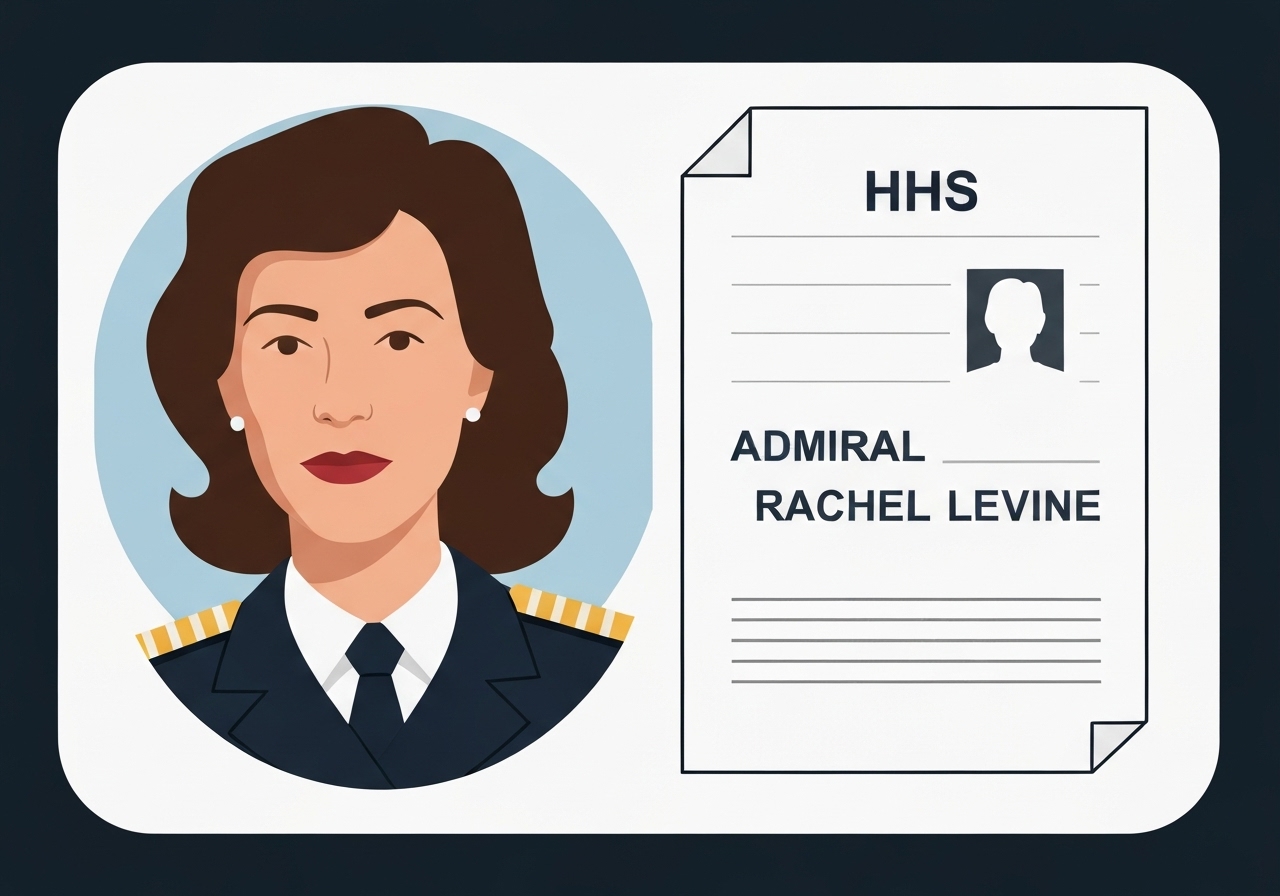
Admiral Rachel L. Levine’s framed photograph in the Humphrey Building was recently relabeled to show a prior name, officials and colleagues tell NPR. The portrait—displayed shortly after Levine won Senate confirmation in 2021 as assistant secretary for health and head of the Public Health Service Commissioned Corps—was altered during the federal government shutdown in late 2025. The change was discovered by staff and confirmed to reporters by HHS. The episode has drawn sharp criticism from former colleagues and raised questions about how the department is implementing personnel and identity policies under new leadership.
Key Takeaways
- Admiral Rachel L. Levine served four years as assistant secretary for health and was the first openly transgender federal official confirmed by the Senate in 2021.
- The portrait in the Humphrey Building hallway was relabeled during the federal shutdown in late 2025 to display a previous name beneath the photograph.
- An HHS spokesperson told NPR the department is prioritizing what it described as biological reality and reversing policies enacted under Levine.
- Adrian Shanker, Levine’s spokesperson and a former deputy assistant secretary for health policy, called the relabeling an act of bigotry.
- The current assistant secretary for health, Adm. Brian Christine, was confirmed by the Senate in October 2025.
- Several HHS staffers described the change as disrespectful and indicative of broader policy shifts affecting transgender and intersex people across federal agencies.
- Officials have not publicly identified which individual ordered the label change or whether it was an individual or office-level decision.
Background
Rachel L. Levine was confirmed by the Senate in 2021 to the four-star admiral position that leads the Commissioned Corps of the U.S. Public Health Service. Her appointment marked a historic first: she was the first openly transgender person to win Senate confirmation to a federal post. A portrait of Levine was installed on the seventh floor of the Humphrey Building soon after her confirmation and became the only image in that series depicting a transgender leader.
The Department of Health and Human Services (HHS) houses multiple offices that set public-health guidance and manage uniformed public health officers. The assistant secretary for health oversees the Public Health Service Commissioned Corps and has a prominent hallway display honoring past leaders. Portraits and name plates in federal offices are ordinarily managed by agency administrative units and updated when new leaders are installed or when official names change.
Main Event
During a recent federal government shutdown in late 2025, staff walking the seventh-floor corridor noticed that the printed label beneath Admiral Levine’s framed photograph had been changed to show a prior name. The photographic print itself remained the same; the alteration was limited to the text mounted inside the frame under the glass. NPR obtained a photo showing the revised label and sought comment from HHS.
Adrian Shanker, who served in the Biden administration and now represents Levine, told reporters that current leadership in the Office of the Assistant Secretary for Health directed the change. He characterized the action as ‘‘bigotry against her’’ and urged leaders to focus on public-health priorities instead of personnel vindictiveness. Levine declined to engage in a prolonged public response, saying she would not comment on ‘‘petty action’’ and emphasizing her record of public-health work.
HHS spokesperson Andrew Nixon responded to inquiry by telling NPR the agency is committed to ‘‘gold standard science’’ and said leadership is working to reverse what it called harmful policies enacted under Levine. Nixon’s statement framed the relabeling in the context of a broader departmental shift on transgender-related policy. The department has not publicly named who authorized the change or provided an internal record of the administrative action.
Analysis & Implications
The relabeling has symbolic and practical implications. Symbolically, altering the displayed name beneath a portrait of a confirmed public-health leader sends a message to staff and visitors about which identities and histories the agency recognizes. For transgender employees and those who work on gender-related health issues, that message can affect morale and willingness to serve openly. Practically, the incident signals how personnel actions and administrative details can be used to reflect broader policy shifts inside a federal agency.
Politically, the move comes amid a coordinated federal effort under the current administration to rescind or revise policies that expanded protections and recognition for transgender and intersex people across multiple departments. Since taking office in 2025, the administration has implemented changes at the Departments of Health, Justice, Education and State, among others, and at the Pentagon and passport services. Those policy reversals have intensified partisan debates and created new legal and administrative tests for federal agencies.
For public health operations, the episode risks diverting attention from programmatic priorities. Levine’s tenure focused on COVID-19 response, rising syphilis and HIV rates, and opioid mitigation—issues that remain active and require continuity of expertise. If administrative focus shifts toward personnel identity disputes, program delivery could suffer. Observers will watch whether this event precipitates formal policy changes governing how federal offices record and display names, or whether it remains an isolated, symbolic alteration.
Comparison & Data
| Item | 2021 (Levine Confirmed) | Late 2025 (After Relabeling) |
|---|---|---|
| Portrait status | Installed in Humphrey Building hallway with current legal name | Photograph unchanged; printed nameplate shows prior name |
| Assistant Secretary | Adm. Rachel L. Levine (confirmed 2021) | Adm. Brian Christine (confirmed Oct 2025) |
| Public discussion | Historic confirmation, emphasis on diversity | Relabeling sparks debate about identity recognition and policy shifts |
The table summarizes visible changes in portrait labeling and leadership between Levine’s confirmation in 2021 and the relabeling in late 2025. While portraits themselves are static images, name displays convey administrative recognition; changing a plate is an inexpensive action but carries outsized communicative power inside an agency. The data point of particular consequence is the timing—during a federal shutdown—when routine oversight and administrative staffing are often disrupted.
Reactions & Quotes
Several current and former officials offered immediate reactions. A spokesperson who previously worked with Levine condemned the action and framed it as both personal and political. A staff member who asked for anonymity cited fear of retribution and described the change as an attempt to erase transgender presence from institutional memory.
The current leadership of the Office of the Assistant Secretary for Health changed Admiral Levine’s photo to remove her current legal name and use a prior name.
Adrian Shanker, former deputy assistant secretary for health policy (spokesperson for Levine)
HHS’s official line emphasized policy direction rather than personnel details, placing the relabeling in the context of a larger mission statement shift.
Our priority is ensuring that the information presented internally and externally by HHS reflects gold standard science. We remain committed to reversing harmful policies enacted by Levine and ensuring that biological reality guides our approach to public health.
Andrew Nixon, HHS spokesperson
An anonymous HHS staff member described the label change as ‘‘disrespectful’’ and said it exemplified shifting priorities that make some employees feel erased.
The relabeling is disrespectful and exemplifies the erasure of transgender individuals by this administration.
HHS staff member (requested anonymity)
Unconfirmed
- No public record has confirmed which individual or office within HHS ordered the relabeling; attribution remains unverified.
- There is no independently confirmed evidence that the relabeling was part of a formal written policy directed at portraits or names across the department.
- Claims about the motive—whether targeted erasure versus administrative housekeeping—have not been corroborated by documentary evidence at the time of reporting.
Bottom Line
The relabeling of Admiral Levine’s portrait is a small administrative act with outsized symbolic resonance. It occurred against the backdrop of a broader federal policy shift affecting transgender and intersex rights and follows a period of political and personnel change at HHS. Because administrative displays signal institutional values, the action has prompted concern among staff and advocates about who is recognized within federal public-health institutions.
For agency leaders and policymakers, the immediate choice is whether to treat this as a discrete personnel incident or as a prompt to define and publish clear rules governing name displays and archival recognition. Observers and affected communities will watch whether formal guidance or corrective steps follow, and whether this episode influences broader debates about inclusion, record-keeping and the handling of personnel history in federal offices.
Sources
- NPR (news report citing HHS spokesperson and Levine’s representatives)
- U.S. Department of Health & Human Services (official agency site; departmental statements and news releases)