
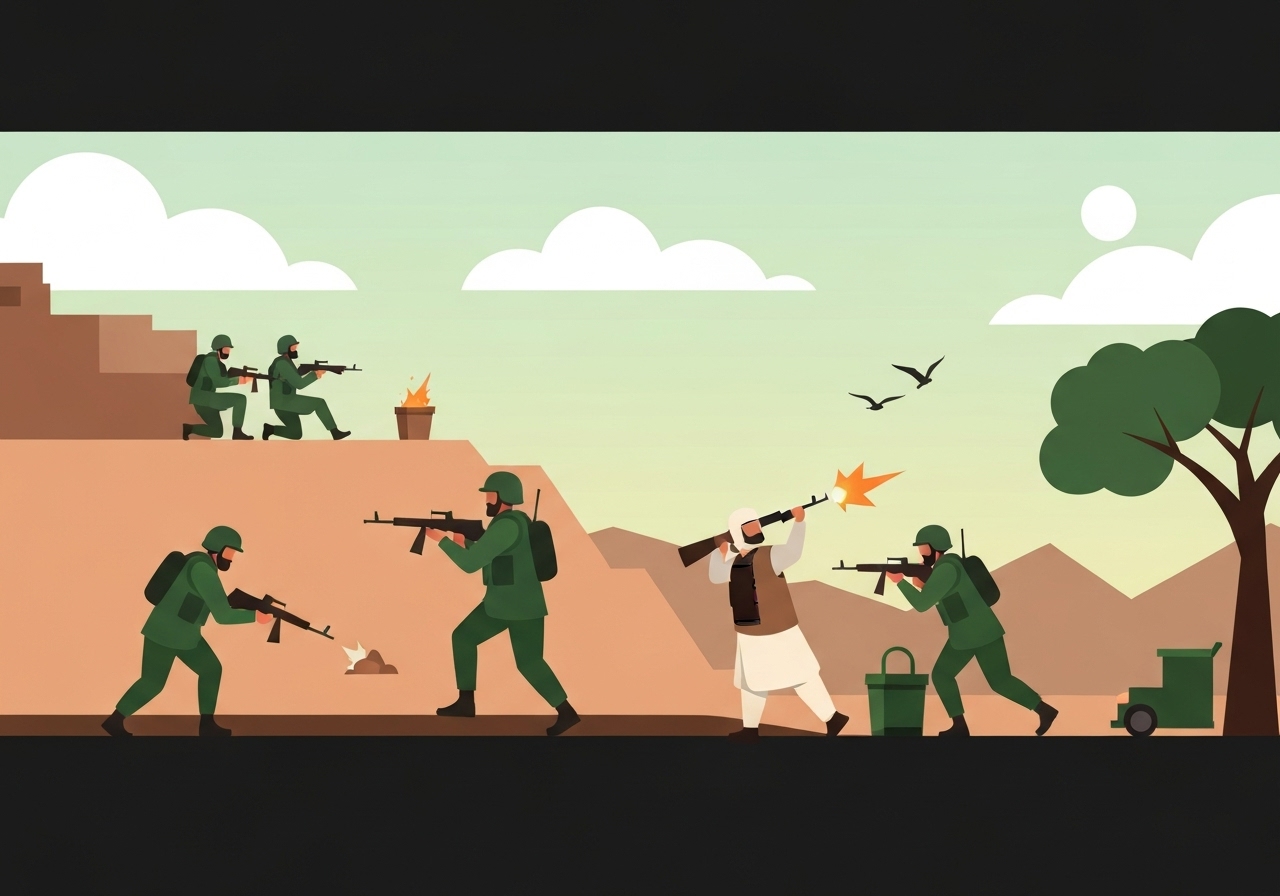
Lead: Fresh fighting broke out overnight along the Pakistan–Afghanistan border on the night of the clash, centered around Spin Boldak and nearby districts. Both Islamabad and the Afghan Taliban say the other side opened fire, and officials report a four‑hour exchange that forced civilians to flee. A Kandahar medical source reported four bodies brought to a local hospital, and Pakistani authorities said three people were wounded. The incident comes less than two months after a ceasefire mediated by Qatar and Turkey.
Key takeaways
- Clash location: Spin Boldak area on the 1,600‑mile (2,574 km) Pakistan–Afghanistan border, with nearby towns seeing mass displacement.
- Casualties reported: four bodies received at a Kandahar hospital and three injured reported in Pakistan, according to local and Pakistani sources.
- Duration and timing: both sides report a roughly four‑hour overnight exchange of fire.
- Ceasefire context: the fighting resumed less than two months after a ceasefire brokered by Qatar and Turkey.
- Diplomatic track: delegations from Pakistan and the Taliban met in Saudi Arabia last week for a fourth round of negotiations but left without a final settlement.
- Longstanding friction: Islamabad has long accused Afghanistan’s Taliban of sheltering militants who attack Pakistan; the Taliban deny the claim.
Background
The Pakistan–Afghanistan border stretches about 1,600 miles (2,574 km) and includes numerous crossing points and conflict flashpoints, among them Spin Boldak and neighboring districts in Kandahar province. Since the Taliban regained control of Afghanistan in August 2021, relations between Islamabad and Kabul have been strained by cross‑border security incidents, mutual accusations of supporting armed groups, and periodic skirmishes. Pakistan has publicly urged the Taliban to clamp down on militant networks it blames for attacks inside Pakistan; the Taliban government rejects the charge and points to Pakistan’s own security gaps.
Repeated short‑duration clashes and accusations of air strikes have occurred in recent months, prompting diplomatic efforts to reduce hostilities. Qatar and Turkey mediated a ceasefire agreement reached less than two months ago intended to halt the worst fighting since 2021, and both sides have since entered talks, most recently in Saudi Arabia. Despite those meetings, mistrust and tactical incidents along the porous border have continued to fuel instability and civilian displacement.
Main event
Overnight fighting erupted in the Spin Boldak area, prompting residents to flee on foot and by vehicle into neighboring towns and districts. Local footage and witness accounts showed convoys and families leaving in the early hours, fearing the escalation might spread. Pakistani officials said their forces exchanged fire with militants they said were operating from Afghan territory, while Taliban spokespeople accused Pakistani forces of initiating strikes across the border.
A medical source in Kandahar told BBC Pashto that a local hospital had received four bodies linked to the clashes. Pakistani authorities reported three injuries on their side. Both sides confirmed they returned fire during the roughly four‑hour engagement but blamed each other for starting the incident, leaving the precise trigger disputed.
Pakistan’s prime minister’s office, via spokesperson Mosharraf Zaidi, described the Taliban action as “unprovoked firing” and said Pakistan responded decisively to protect its territorial integrity and citizens. The Taliban spokesperson countered that Pakistan “once again initiated attacks,” saying Taliban forces had been compelled to respond. Independent verification of strike origins and initial shots fired remains constrained by limited access to the affected border stretches.
Analysis & implications
The renewed clashes underscore the fragile nature of the ceasefire reached under Qatari and Turkish mediation and highlight how local incidents can rapidly erode broader confidence between the two sides. Even a short, four‑hour exchange can have outsized diplomatic impact by hardening official positions and reducing political space for negotiators who are attempting a wider settlement. The recent Saudi talks, which did not yield an agreement, illustrate the limits of diplomacy when frontline commanders and local militias remain engaged.
For Pakistan, the government frames border stability as central to domestic security; any perceived sanctuary for militants in Afghanistan is politically sensitive and operationally consequential. For the Taliban administration in Kabul, accusations of harboring militants are rejected as misdirected blame for Pakistan’s internal security issues, and cross‑border responses are portrayed as defense of Afghan sovereignty. This dynamic raises the risk of tit‑for‑tat escalation if clear verification and de‑escalation mechanisms are not maintained.
Economically and humanitarianly, repeated flare‑ups amplify civilian displacement, interrupt trade and transit along key border crossings, and increase pressure on local health and aid services in Kandahar and adjoining Pakistani districts. International mediators face the challenge of translating ceasefire commitments into durable monitoring and incident‑management arrangements that both sides trust. Without such mechanisms, negotiated pauses may be repeatedly punctured by local clashes or miscalculations.
Comparison & data
| Item | Known fact |
|---|---|
| Border length | 1,600 miles (2,574 km) |
| Reported fatalities (this incident) | 4 bodies received at Kandahar hospital |
| Reported Pakistani injuries | 3 people |
| Duration of exchange | About four hours overnight |
| Ceasefire status | Ceasefire agreed fewer than two months ago (Qatar & Turkey‑mediated) |
The table summarizes the verifiable figures and milestones reported by local medical sources, Pakistani officials, and diplomatic reporting. While casualty counts and duration are those publicly reported, access restrictions and the fluidity of frontlines mean numbers may change as additional verification becomes possible.
Reactions & quotes
Pakistan’s federal spokesperson framed the incident as an unprovoked assault and pledged a robust military response to protect citizens, language that signals Islamabad’s intent to maintain pressure on cross‑border threats.
“Unprovoked firing was carried out from across the border; an immediate, befitting & intense response has been given by our armed forces.”
Mosharraf Zaidi, spokesperson for Pakistan’s prime minister
The Taliban’s public reply framed Pakistan as the initiator and justified reciprocal moves as defensive, reflecting the mutual accusation pattern that has complicated de‑escalation.
“Pakistan once again initiated attacks and our forces responded to defend Afghan territory and people.”
Taliban spokesperson
Civilians and local relief groups said people fled their homes in Spin Boldak and neighboring towns, describing scenes of families moving at night and clinics receiving wounded and fatalities. Those on the ground emphasize humanitarian urgency even as political actors exchange blame.
Unconfirmed
- Precise trigger of the exchange: each side blames the other, and independent verification of which party fired first is not available.
- Claims of Pakistani air strikes inside Afghanistan: Taliban accusations and Pakistani denials lack on‑the‑ground confirmation in public reporting.
- Full casualty figures: local reporting lists four bodies and three Pakistani injuries, but totals could change pending hospital or official updates.
Bottom line
The overnight fighting around Spin Boldak is a reminder that the ceasefire achieved under Qatari and Turkish auspices remains fragile and vulnerable to local incidents. Even limited exchanges, measured in hours, can produce civilian displacement, inflame public opinion and stiffen negotiating positions on both sides.
To prevent further cycles of violence, mediators and the parties will need to agree on clearer incident‑management steps, independent verification and communication channels that rapidly contain local clashes before they escalate. For now, both diplomatic and humanitarian attention should focus on verifying casualties, securing safe access for aid and pushing for mechanisms that translate ceasefire commitments into durable stability.
Sources
- BBC News (International news outlet; original reporting and statements)