
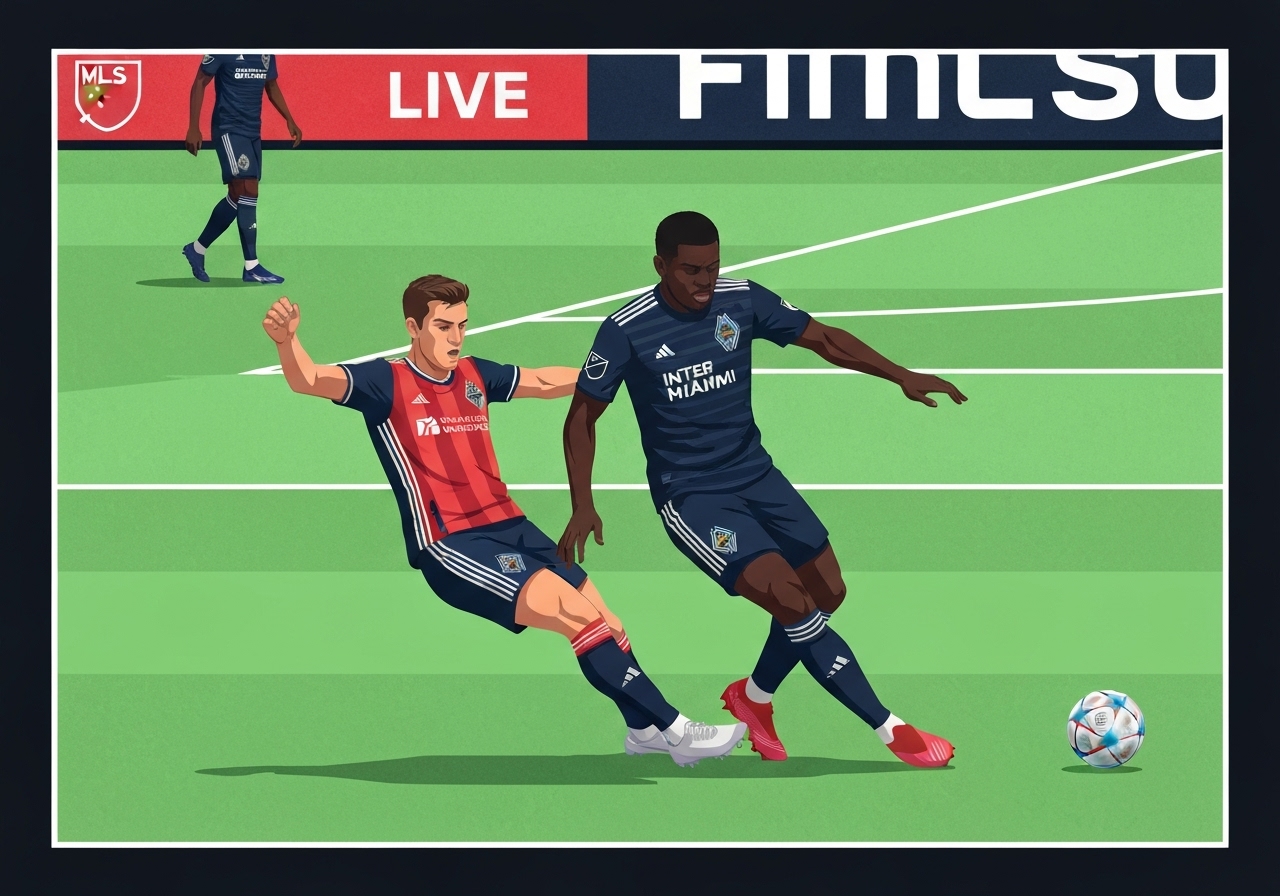
Lead: Inter Miami led Vancouver Whitecaps 1-0 at halftime in the MLS Cup final after an 8th-minute own goal by Edier Ocampo on Saturday in a match played across a 2,800-mile (about 4,500 km) continental divide. Lionel Messi started for Miami alongside a full-strength attacking unit while Thomas Müller featured for Vancouver. The first half featured heavy Vancouver possession, a sequence reviewed by VAR, and decisive saves from Miami keeper Rocco Rios Novo that preserved Miami’s lead.
Key takeaways
- Halftime score: Inter Miami 1, Vancouver Whitecaps 0 following an own goal by Edier Ocampo in the 8th minute.
- Possession and passing: Vancouver held 58.23% possession and completed 250 passes to Miami’s 149, according to match statistics cited during the broadcast.
- Fouls and discipline: Vancouver committed 14 fouls to Miami’s 10; referee Drew Fischer issued several yellow cards across the first half.
- Goalkeeping and chances: Miami keeper Rocco Rios Novo made multiple crucial saves, including a point-blank stop from Ali Ahmed and a high, reflex save later in the half.
- Key starters: Inter Miami started Messi, Rodrigo De Paul and Jordi Alba; Vancouver fielded Thomas Müller, Brian White and Yohei Takaoka in goal.
- VAR involvement: A potential penalty incident in the first half was reviewed by VAR but play continued without a spot kick awarded.
- Tactical snapshot: Vancouver largely controlled possession and territorial pressure, while Miami’s threat came in quick transitions and set-piece moments.
Background
The 2025 MLS Cup final pitched two of the league’s headline teams against one another in a contest framed by global names and long travel between the clubs’ home cities. Inter Miami, led by Lionel Messi and supported by a midfield containing Rodrigo De Paul, reached the final on the back of creative, transition-based play. Vancouver, featuring Germany international Thomas Müller, arrived with a domestic-leaning squad that emphasized pressing and ball retention.
MLS’s growth over three decades has mixed star arrivals with homegrown development, and this final represents that duality—global superstars on display alongside local talent. The fixture also highlighted logistical extremes within the league: Miami and Vancouver sit roughly 2,800 miles (4,500 km) apart, underscoring travel demands for cross-continent matchups. Expectations ahead of kickoff focused on whether individual brilliance or collective control would decide the trophy.
Main event
The match opened with frenetic midfield exchanges and Miami forcing an early infield moment that culminated in an 8th-minute own goal. Tadeo Allende’s run and cross into the box ricocheted off Vancouver defender Edier Ocampo and looped past Yohei Takaoka, giving Miami a fortuitous lead. The goal settled Miami and prompted Vancouver to increase ball circulation and pressure.
Vancouver dominated possession for long spells after the goal and engineered several promising set-piece situations. Thomas Müller repeatedly found pockets between lines but touches were few for certain key players during the opening period. Miami’s goalkeeper Rocco Rios Novo produced at least two reflex saves — a point-blank stop after a recycled free kick and a leaping reaction that kept a late-half strike out — which proved decisive to maintain the narrow advantage.
Referee Drew Fischer faced sustained scrutiny as players clashed and multiple stoppages interrupted rhythm. A VAR check for a potential penalty involving Tristan Blackmon and a Miami defender was undertaken early but did not result in a spot kick. Discipline was a theme: yellow cards were shown for tactical fouls and post-contact reactions, and the contest featured numerous physical duels that left the turf marked by divots and wear.
Analysis & implications
Statistically, Vancouver’s control of possession (58.23%) and a higher pass count (250) indicate territorial dominance and an intent to probe patiently; however, high possession without clinical finishing can be neutralized by a compact defensive setup and timely goalkeeping. Miami’s approach — quieter in possession but sharper on transitions — converted a single set-piece sequence into the match’s decisive moment so far.
For Vancouver, the challenge is converting sustained territorial advantage into clear-cut chances and goals. Repeated set-piece entries and recycled crosses produced openings but the finishing and final delivery were imperfect or met by Rios Novo. Tactically, Vancouver may need to vary penetration routes or introduce changes that increase players in central scoring positions.
For Miami, maintaining defensive concentration while attempting to exploit the counter will be essential. Lionel Messi’s role, while prominent as a target of attention, must be complemented by midfield support to relieve pressure and create second-phase opportunities. The match-opening own goal demonstrates that marginal moments and concentration lapses can tilt high-stakes finals.
Comparison & data
| Stat | Inter Miami | Vancouver Whitecaps |
|---|---|---|
| Possession | 41.77% | 58.23% |
| Passes (completed) | 149 | 250 |
| Fouls | 10 | 14 |
The data underlines a classic possession-versus-efficiency narrative: Vancouver amassed more of the ball and passing volume, while Miami converted a low-volume situation into a decisive score. These patterns reflect differing season-long tendencies — one team emphasizing control, the other prioritizing transition — and they shape likely second-half tactical decisions.
Reactions & quotes
“They’ve weathered the Vancouver storm,”
The Guardian live report
The live coverage noted Miami’s resilience amid Vancouver’s territorial pressure; the characterization reflected the contrast between Miami’s goal-saving interventions and Vancouver’s numerical dominance in possession.
“A pulsating final with an early goal that has made things open up,”
The Guardian live report
That summary framed the match as one whose single early event widened tactical openings for both teams, prompting more direct attempts and risk-taking as the half progressed.
Unconfirmed
- VAR review details: While a first-half VAR check was visible, the broadcast did not publish the full reasoning for the decision in real time.
- 45+1 injury: Jordi Alba’s stoppage and a subsequent call appeared contentious; final medical assessments were not confirmed during the half.
- Penalty appeals: Early contacts inside the box generated protests but definitive conclusive camera evidence for a penalty award was not publicly released during the live feed.
Bottom line
This MLS Cup final is finely poised: Miami’s 1-0 lead is small but significant, preserved by goalkeeping and an early, fortunate intervention. Vancouver’s superior possession numbers signal control, yet the Whitecaps must convert territory into high-quality chances to level the match and force Miami out of a defensive posture.
Second-half adjustments — tactical substitutions, set-piece strategies and how each team manages momentum swings — will determine the trajectory. For neutral observers, the game remains a study in contrasting models within the same competition: possession dominance versus counter-attacking efficiency, and how single events can reshape a championship match.