
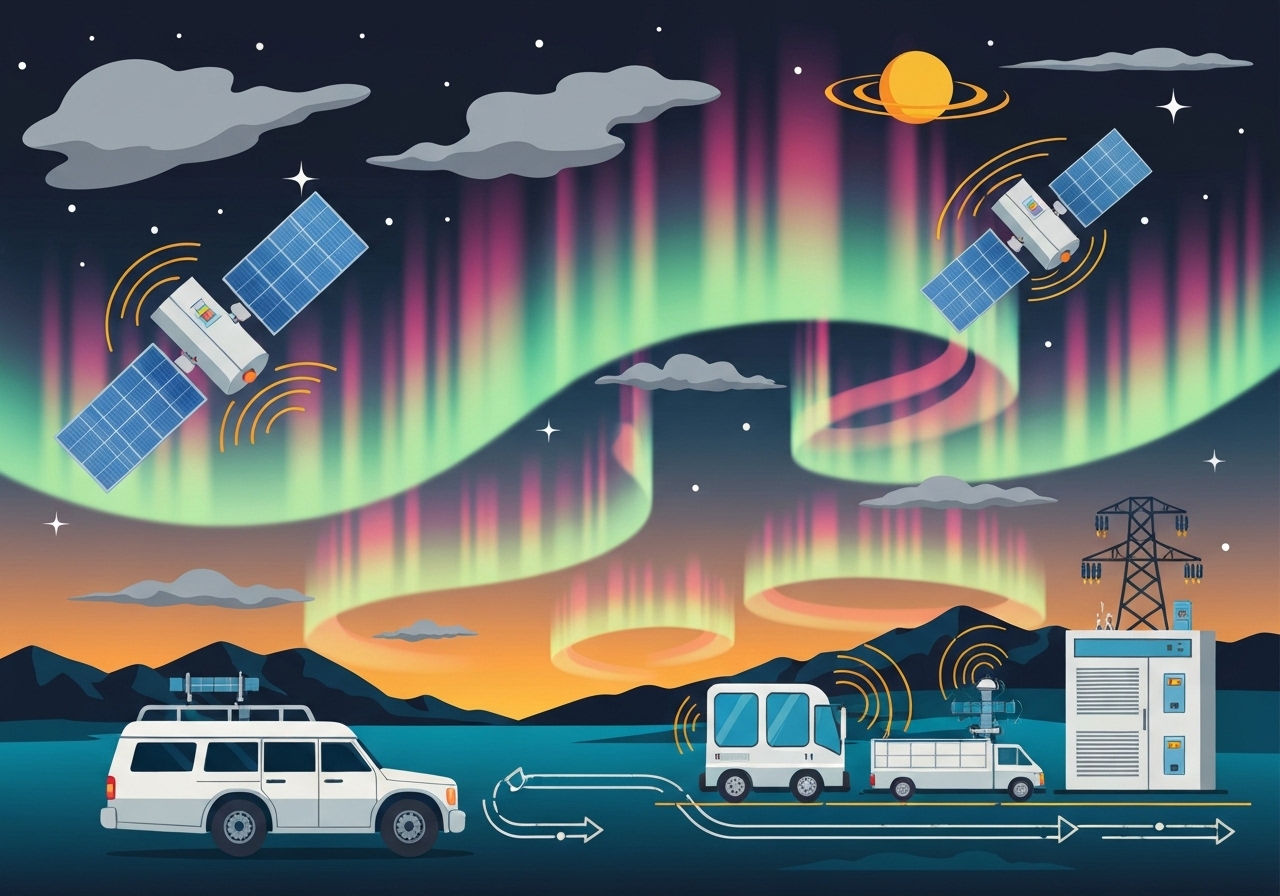
Bright curtains of aurora delight observers high above the Arctic, but the same bursts of charged particles from the Sun that make those lights can also trigger rare yet severe disruptions on Earth. In recent years the consequences have extended from satellite failures to aviation incidents and large-scale power outages. A high-profile case in October 2025 led to a temporary grounding of thousands of aircraft after on-board systems were corrupted. Governments and scientists now treat extreme space weather as a national-risk scenario that merits planning and urgent mitigation.
Key takeaways
- Solar storms eject charged particles and magnetic disturbances that can induce currents in infrastructure; the Carrington Event of 1859 is the historical benchmark for severity.
- On 30 October 2025 a JetBlue Airbus A320 experienced an unexpected loss of altitude on a Cancun–Newark flight; Airbus grounded more than 6,000 aircraft pending software updates or hardware changes.
- Strong geomagnetic storms can expand Earth’s upper atmosphere, increasing drag and causing satellites to slow or deorbit; a February 2022 storm was linked to the loss of 38 satellites.
- Power systems are vulnerable: the March 1989 geomagnetic storm left Quebec without electricity for nine hours after grid equipment failed under geomagnetically induced currents.
- Navigation and radio services, including GPS, can be degraded for days during extreme events, with cascading effects on aviation, shipping and road traffic.
- Tree‑ring and cosmogenic isotope research (Miyake events) point to the possibility of solar events substantially stronger than the Carrington Event, though timing and frequency are uncertain.
Background
Solar activity follows an approximately 11‑year cycle, but individual eruptions such as solar flares and coronal mass ejections (CMEs) are episodic and can vary widely in strength. When a CME is directed toward Earth it perturbs the magnetosphere and can inject high-energy particles and magnetic disturbances into near‑Earth space. That process produces aurorae when particles interact with the upper atmosphere, but it also poses risks to modern technological systems that did not exist in the 19th century.
Planning for extreme space weather draws on historical events and contemporary modelling. The most cited precedent is the Carrington Event of 1859, which produced intense magnetic variations that induced currents in telegraph networks; operators reported shocks and equipment sparking. With today’s interconnected grids, satellites and avionics, comparable currents or particle fluxes would have far greater scope to cascade through critical services, prompting emergency preparedness by governments and operators.
Main event
On 30 October 2025 a JetBlue Airbus A320 en route from Cancun to Newark unexpectedly pitched down; the aircraft diverted and landed safely in Florida, though 15 passengers were treated for injuries. Airbus and aviation authorities investigated and concluded that corrupted data in an elevator/aileron computing unit — consistent with space‑weather‑related radiation interference — caused the uncommanded motion. In response, an Emergency Airworthiness Directive (EAD) required software updates or hardware protections, leading to the temporary grounding or operational restriction of over 6,000 Airbus aircraft until mitigations were applied.
Earlier examples illustrate how different systems are affected. In March 1989 a geomagnetic storm induced currents that caused protective relays and transformers in Quebec to trip, producing a province‑wide outage lasting about nine hours. In February 2022 another storm increased atmospheric drag and was associated with the loss of multiple low‑orbit satellites; reports attributed roughly 38 craft to uncontrolled re‑entry or severe anomalies after perturbations.
Satellite operators report a spectrum of effects from severe storms: increased atmospheric density and drag, single‑event upsets in sensitive electronics, degraded solar arrays, and altered orbital tracking that raises collision risk. On the ground, GPS disruption and long‑range radio blackouts can impede navigation and air traffic management, forcing route changes and altitude restrictions that multiply fuel costs and delays.
Analysis & implications
Space weather is a low‑probability, high‑impact risk that crosses sectors. For national infrastructure the key vulnerabilities are long conductive networks (power grids, pipelines, rail signalling) that can host geomagnetically induced currents, and distributed assets (satellites, aircraft) whose failure modes differ but can cascade via service dependencies. A Carrington‑scale geomagnetic storm today would test grid protections, emergency response, and international coordination.
Aviation is particularly exposed because aircraft rely on satellite navigation, radio communication and resilient flight‑control electronics. The October 2025 incident showed how a single corrupted data stream can produce an immediate airworthiness hazard and trigger system‑wide operational responses. Airlines and regulators must balance immediate mitigations (temporary groundings, software patches) with longer‑term designs that harden avionics and navigation architecture against radiation effects.
Satellite operators face policy and insurance implications: increased drag shortens orbital lifetimes for low‑Earth orbit constellations, while electronic upsets raise failure rates and replacement costs. For critical services that depend on satellites — weather forecasts, communications, timestamping for financial transactions — outages could induce broader economic disruption. National risk planning must therefore integrate space‑weather scenarios into resilience frameworks, including redundancy, rapid patching procedures and prioritized restoration of services.
Comparison & data
| Event | Date | Primary impact | Notable outcome |
|---|---|---|---|
| Carrington Event | 1859 | Extreme geomagnetic disturbance | Telegraph equipment sparks and shocks |
| Quebec outage | March 1989 | Grid collapse from induced currents | Province‑wide blackout ~9 hours |
| Satellite losses | February 2022 | Increased drag / anomalies | ~38 satellites lost or disabled |
| JetBlue Airbus incident | 30 October 2025 | Avionics data corruption | 6,000+ Airbus aircraft grounded (EAD) |
The table frames historical and recent events to show how hazards translate into distinct operational failures. The Carrington Event is the canonical benchmark for geomagnetic intensity; modern consequences are amplified because society depends on electrically and electronically coupled systems that did not exist in 1859. Quantitative modelling of worst‑case scenarios remains uncertain, but insurers, grid operators and space agencies now include extreme geomagnetic storms in stress tests.
Reactions & quotes
Airbus said the grounding and mandated updates were necessary to address corrupted flight‑control data identified in the October 2025 incident.
Airbus (manufacturer)
National risk planners list severe space weather alongside pandemics, terrorism and major industrial accidents because of its potential to disrupt multiple critical services simultaneously.
UK National Risk Register (official assessment)
Researchers studying Miyake events caution that cosmogenic isotope spikes in tree rings point to the possibility of infrequent but far stronger solar events than the Carrington benchmark.
Academic research (Miyake et al.)
Unconfirmed
- Magnitude and frequency: the exact probability and return interval of a Miyake‑scale event (potentially an order of magnitude larger than Carrington) remain uncertain and are under active study.
- Attribution detail: while investigations linked the October 2025 Airbus software corruption to space weather effects, full technical root‑cause analyses and classified flight data have not been exhaustively released in the public domain.
- Satellite loss counts: reports associate the February 2022 storm with about 38 satellite losses, but counts vary by operator and some anomalies were later attributed to a combination of factors.
Bottom line
Solar storms that produce spectacular aurorae are not merely scenic — they are a credible systemic hazard for modern technology. Historical precedents and recent incidents show the threat spans satellites, aviation and electricity networks, and that a Carrington‑scale event today would impose far larger costs and societal disruption than in 1859.
Mitigation requires coordinated action: hardening critical systems, rapid operational procedures (such as software patches and temporary restrictions), and international data‑sharing so that operators can anticipate and respond to extreme space weather. Policymakers should treat severe geomagnetic storms as a cross‑sector resilience challenge rather than an isolated scientific curiosity.
Sources
- BBC — Weather and space‑weather reporting (media)
- UK National Risk Register (official assessment)
- NOAA Space Weather Prediction Center (government space‑weather agency)
- Miyake et al., Nature (2012) — cosmogenic isotope evidence (peer‑reviewed research)
- NASA — space weather and historical event summaries (space agency)