
Lead
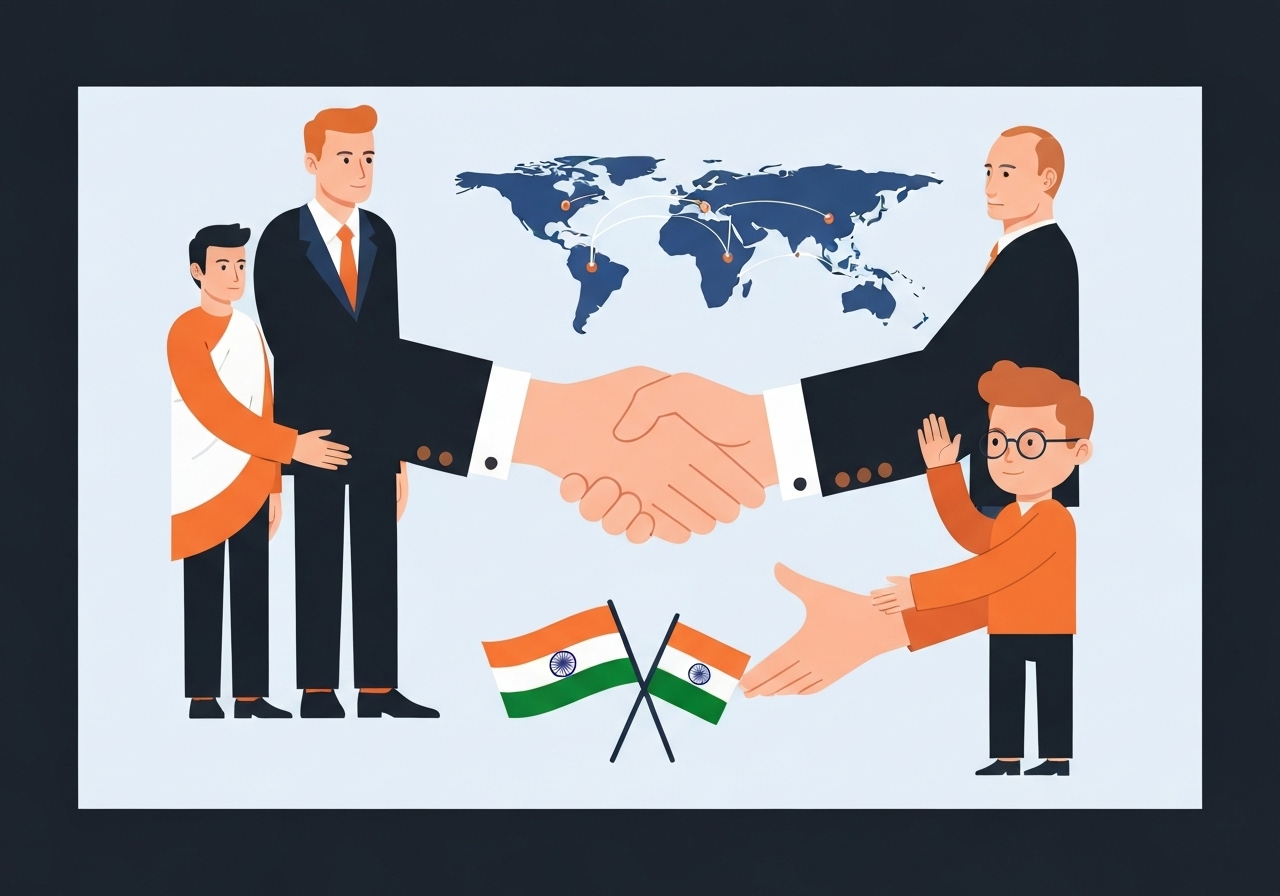
Russian President Vladimir Putin made a 30-hour state visit to New Delhi beginning December 5, 2025, receiving ceremonial welcomes at the tarmac and Rashtrapati Bhavan from Prime Minister Narendra Modi and President Draupadi Murmu. The visit produced a string of economic accords — notably a labour mobility pact, a urea-plant MoU and port/customs cooperation — but yielded only modest strategic breakthroughs. Key defence, energy and advanced-technology deals were not announced, leaving the summit’s material payoff limited. The meeting nonetheless reaffirmed India’s long-standing ties with Russia amid a complex geopolitical backdrop.
Key Takeaways
- Visit timing: Putin visited New Delhi on December 5–6, 2025; ceremonies included a red-carpet reception and a state banquet at Rashtrapati Bhavan.
- Economic focus: Leaders prioritized the 2030 India–Russia economic roadmap launched in 2024 and signed a Labour Mobility Agreement to address Russian shortages of up to three million jobs by decade’s end.
- Energy and trade: There were no new oil procurement commitments despite oil accounting for more than $60 billion of last year’s $69 billion bilateral trade.
- Industrial deals: A memorandum of understanding was signed between Indian and Russian fertiliser firms to build a urea plant in Russia; additional accords covered maritime cooperation, ports and customs.
- Trade facilitation: Both sides pledged progress on the Chennai–Vladivostok Eastern Maritime Corridor and the International North–South Transport Corridor and signalled moves to increase settlements in national currencies.
- Defence and tech: Anticipated defence and high-technology contracts — aircraft, air-defence, drones, missiles, space and nuclear cooperation — produced no concrete announcements.
- Sanctions effect: European and U.S. measures, plus a steep 25% U.S. tariff on some Indian goods, have complicated deeper economic and strategic commitments; Russian oil imports to India fell about 38% year-on-year in value by October 2025.
Background
India and Russia share a decades-long strategic partnership dating to the Cold War; Moscow has been a major supplier of defence hardware and energy to New Delhi. That relationship has weathered changing geopolitics, including Russia’s February 2022 invasion of Ukraine, which prompted Western sanctions that reshaped trade and finance channels. New Delhi’s ties with Washington have been broadly closer in recent years, but specific trade frictions and tariff disputes have cooled aspects of that relationship in 2025.
Against this backdrop, New Delhi has pursued a policy of strategic autonomy: maintaining historic cooperation with Moscow while engaging the West, including steps toward an EU-India Free Trade Agreement and ongoing talks with the United States. Modi’s 2024 roadmap with Russia — the “Development of Strategic Areas of India–Russia Economic Cooperation till 2030” — set a framework for economic collaboration that both sides sought to advance during the December 2025 visit.
Main Event
The visit began with a formal reception on December 5, 2025: Mr. Modi met Mr. Putin on the tarmac and later hosted a private dinner at the Prime Minister’s residence; President Murmu provided a state banquet before the delegation departed. Protocol and pageantry signalled New Delhi’s intent to keep the relationship on a steady footing despite international sensitivities.
Meetings between defence ministers ahead of the summit — between Rajnath Singh and Russian counterpart Andrei Belousov — concluded without public announcements, dampening expectations of large defence procurement deals. Instead, the communiqués and signed documents emphasized economic measures: mobility of skilled labour, a fertiliser plant MoU, maritime and customs cooperation, and infrastructure corridor development.
On trade facilitation, officials highlighted efforts to ease bilateral commerce through the Chennai–Vladivostok Eastern Maritime Corridor and the International North–South Transport Corridor, and reiterated a mutual intention to expand rupee and ruble settlements. Notably absent were commitments on oil procurement volumes, and no new public agreements on space or nuclear collaboration were disclosed during the trip.
Analysis & Implications
Sanctions on Russia and secondary pressure on counterparties have materially influenced Delhi’s calculus. Western measures and the potential for U.S. sanctions under CAATSA (Countering America’s Adversaries Through Sanctions Act) remain a deterrent for high-value strategic purchases from Moscow, limiting India’s appetite for headline defence or energy transactions. The 38% year-on-year fall in value of Russian oil imports by October 2025 illustrates how trade patterns have already adjusted.
For India, the visit served dual aims: reaffirm the historical partnership with Russia while avoiding concrete steps that could provoke punitive responses from Western partners. New Delhi’s balancing act is sharpened by a busy diplomatic calendar: visits by European leaders for Republic Day and summit-level engagements with the EU, France, Canada and the United States in early 2026. Those upcoming interactions raise the stakes for preserving both strategic ties and economic opportunities with the West.
Economically, the agreements signed advance practical cooperation — labour mobility and fertiliser production, corridor logistics and customs coordination — that can deliver measurable benefits without triggering major geopolitical backlash. Politically, however, the modest scale of outcomes signals restraint: both sides appear to have prioritized continuity over transformational deals at a moment of heightened international scrutiny.
Comparison & Data
| Item | Value |
|---|---|
| India–Russia bilateral trade (last year) | $69 billion |
| Oil share of trade | More than $60 billion |
| Russian oil imports to India (value), Oct 2025 y-o-y | Down 38% |
These figures underline why oil and energy were central to expectations. Oil dominated bilateral trade in the prior year, but the sharp drop in import value signals either lower volumes, price effects or a shift in transaction channels. The economic accords signed during the visit are targeted at diversifying cooperation and easing logistics, but they do not substitute for large-scale energy agreements.
Reactions & Quotes
Indian leaders framed the visit as reaffirmation of steady ties while emphasising peace and pragmatic cooperation.
“India is not neutral, it stands on the side of peace,”
Prime Minister Narendra Modi
This line, offered before the talks, was framed by New Delhi as evidence that India seeks progress on conflict resolution while continuing candid dialogue with Moscow. Officials stressed India’s desire for an end to the Ukraine conflict without aligning unilaterally with any bloc.
“I hope for peace,”
President Vladimir Putin
Mr. Putin’s similar public wish for peace was read as a diplomatic interlocution during sensitive multilateral negotiations on a possible U.S.-led proposal. Analysts noted the wording left room for various approaches to ceasefire and settlement discussions.
“The article’s public advice to India is unacceptable,”
Ministry of External Affairs (India)
The MEA response addressed a prior op-ed by three European ambassadors criticising Russia; New Delhi publicly defended its sovereign policy choices while also signalling discomfort with external pressure to change its posture toward Moscow.
Unconfirmed
- No public confirmation was made of specific new oil procurement volumes or pricing arrangements between India and Russia during the visit.
- Details and financing models for the proposed urea plant MoU remain to be disclosed, including ownership splits and construction timelines.
- Reports of large-scale defence procurements or immediate transfers of advanced missile/space technology were not substantiated by official announcements.
- The extent to which settlements in national currencies will substitute dollar transactions is still under negotiation and lacks a firm implementation timeline.
Bottom Line
Mr. Putin’s December 5–6, 2025 visit to New Delhi reinforced the enduring India–Russia relationship while delivering largely incremental economic measures rather than sweeping strategic bargains. Practical accords on labour mobility, fertiliser production and trade route facilitation may yield medium-term gains, but they stop short of altering the strategic architecture shaped by sanctions and geopolitical realignments.
For New Delhi, the trip achieved a calibrated reaffirmation of ties without provoking fallout from Western partners — an outcome consistent with India’s stated goal of strategic autonomy. The next test will be how India translates today’s incremental agreements into durable economic outcomes while navigating upcoming high-stakes engagements with the EU, France, the U.S. and other Western actors.
Sources
- The Hindu (Indian newspaper: original report and timeline of the visit)