
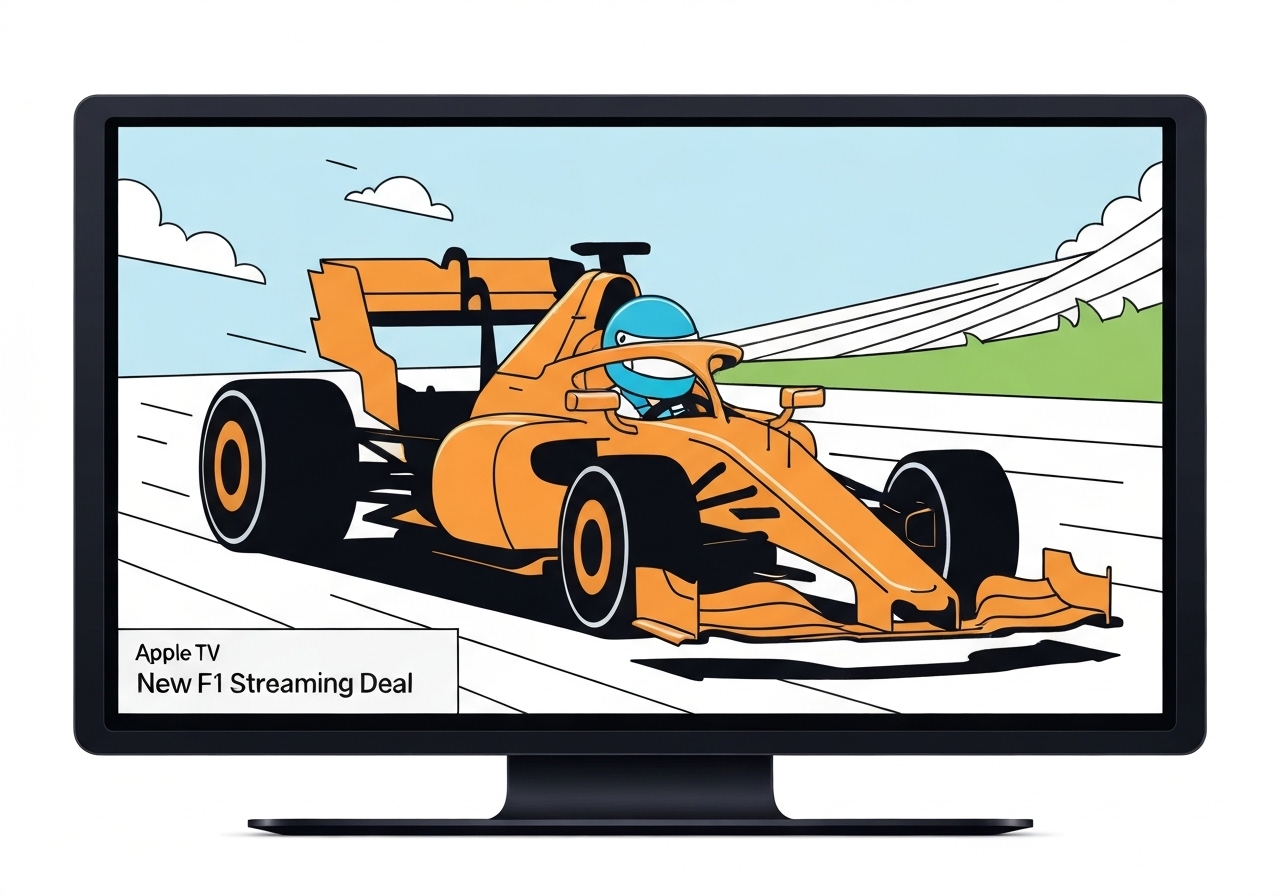
Lead: Apple unveiled a preview of its forthcoming Formula 1 channel inside the Apple TV app as the 2025 F1 season concluded, confirming that onboard driver cameras will be part of its offering. The change marks the end of ESPN’s broadcasts of F1 in the United States, with Apple beginning exclusive U.S. coverage under a five-year deal starting with the 2026 season. Apple says every practice, qualifying, sprint and Grand Prix session will stream through the TV app, included with an Apple TV subscription. The company also signaled additional production and product details will be revealed ahead of the first race weekend, scheduled March 6–8, 2026.
Key Takeaways
- Apple is the exclusive U.S. broadcaster for Formula 1 under a five-year contract beginning with the 2026 season.
- All race sessions—practice, qualifying, sprint and Grand Prix—will stream within the Apple TV app at no extra charge for Apple TV subscribers.
- Preview screenshots show onboard driver camera streams and Multiview support, enabling multiple simultaneous camera feeds on compatible devices.
- The first 2026 race weekend is set for March 6–8, and preseason content may appear in the app earlier.
- Existing F1.TV features will remain accessible by signing into F1.TV using an Apple TV account, removing the need for a separate F1.TV subscription for core content.
- Apple TV subscription pricing is currently $12.99 per month or $99 annually; Apple One bundles remain an alternative for bundled discounts.
Background
The 2025 Formula 1 season wrapped up with its final race in December 2025, concluding ESPN’s tenure as the U.S. broadcaster. Apple announced a five-year exclusive partnership to distribute F1 in the United States, shifting the primary distribution model from linear broadcast to streaming via the Apple TV app starting in 2026. The deal reflects broader trends in live sports moving toward platform-driven streaming services, where rights holders and tech companies seek longer-term, direct-to-consumer relationships.
Previously, U.S. fans who wanted driver onboard camera feeds and advanced viewing features often subscribed to F1.TV or separate services. Under the Apple deal, those features appear to be integrated into the Apple TV app experience while preserving the option to access F1.TV itself through account sign-in. Rights negotiations of this scale typically include technical, production and regional licensing clauses; Apple’s public previews so far emphasize viewer experience and multi-angle streaming rather than contract mechanics.
Main Event
Apple released a social-media advertisement and screenshots that preview the F1 channel interface inside the TV app. The visuals highlight a dedicated F1 hub, session schedules, and video tiles for live sessions. Notably, the preview displays onboard driver camera feeds and a Multiview grid, suggesting viewers can switch between cockpit perspectives or view several at once during live coverage.
Apple confirmed the TV app will carry every session type across a race weekend—practice, qualifying, sprint and the Grand Prix itself—meaning fans will no longer need separate paywalls for basic live access in the U.S. The company also indicated previews and preseason content may appear in the app before the 2026 opener on March 6–8, giving subscribers an early look at production and features.
Apple’s communication frames the F1 content as included with a standard Apple TV subscription rather than an add-on channel. That shifts F1 access into Apple’s broader service suite; subscribers paying $12.99 monthly or $99 annually (or via Apple One bundles) will gain the content without a separate F1-only fee. For viewers who have relied on F1.TV’s standalone service for specialized features, Apple says existing workflows will still work by signing into F1.TV with an Apple TV account—effectively folding F1.TV access into the Apple subscription model.
Analysis & Implications
The transition of U.S. F1 rights to Apple represents both a strategic win for the tech giant and a notable change for American viewers. For Apple, the five-year agreement provides exclusive live sports content that can drive subscriptions and engagement across Apple TV, iPad and Vision Pro hardware. For Formula 1, the deal promises a consistent, platform-level presence in the U.S. market and potential integration with Apple’s broader ecosystem.
From a consumer perspective, bundling full-season access into an Apple TV subscription lowers the barrier to entry compared with a separate F1.TV fee. That could broaden casual viewership while raising expectations around production quality and feature parity with the legacy F1.TV experience. Hardcore fans will watch closely to see whether advanced telemetry, multi-camera feeds, and archival content remain available at the same depth as before.
Broadcasters and advertisers will also feel the impact. Networks like ESPN lose linear F1 inventory in the U.S., eroding conventional ad placements but opening possibilities for new ad formats within streaming. Rights holders must balance the revenue certainty of platform deals against potential churn and differing monetization models under subscription services.
Comparison & Data
| Feature | ESPN (through 2025) | Apple TV (from 2026) |
|---|---|---|
| Live sessions | Linear broadcast + streaming (varied) | All sessions streamed in Apple TV app |
| Onboard driver cams | Often behind F1.TV / premium services | Included in Apple TV app preview |
| Multiview | Limited / third-party tools | Shown in preview; device-dependent support |
| Subscription model | TV subscription or cable; ESPN+ add-on regionally | Apple TV subscription ($12.99/mo or $99/yr); Apple One option |
The table summarizes the practical differences fans should expect in the U.S. Apple’s model consolidates race sessions into a single app ecosystem and advertises onboard cams and Multiview as built-in features. Device compatibility and feature parity will determine whether this represents mere packaging change or a material upgrade for viewers used to F1.TV’s standalone capabilities.
Reactions & Quotes
Industry and fan responses were mixed between enthusiasm for integrated features and questions about device support and workflow continuity.
Apple said it will share more “production details” and “product enhancements” in the months ahead, signaling additional features are planned.
Apple (social post)
The company’s phrasing frames the preview as an initial reveal rather than a full product spec; officials promised further announcements closer to the 2026 season kickoff.
Apple described the arrangement as a five-year partnership to be the exclusive U.S. broadcast partner starting in 2026.
Official partnership announcement
That language confirms the contract term and exclusivity window, but leaves technical and commercial specifics—such as carriage rights, ad integration and regional blackout rules—largely undisclosed to the public so far.
Unconfirmed
- Exact launch timing for the F1 hub inside the TV app prior to the March 6–8, 2026 opener remains unconfirmed.
- Device-by-device compatibility for Multiview (beyond Apple TV set-top boxes, iPad and Apple Vision Pro) has not been fully verified.
- Precise details about telemetry, archival archives, and advanced F1.TV features under the Apple subscription are not yet disclosed.
Bottom Line
Apple’s entry as the exclusive U.S. home for Formula 1 from 2026 signals a major distribution shift: a full-season streaming approach bundled into an existing consumer subscription rather than a separate motorsport product. For many viewers, that simplifies access and may expand reach; for dedicated fans, the critical questions will be whether Apple preserves or improves advanced features that F1.TV historically provided.
Expect the next several months to clarify production specifics, device support and how F1’s technical features are presented inside the Apple TV ecosystem. Fans, sponsors and rights holders all have incentives to monitor announcements leading up to the March 6–8, 2026 race weekend for definitive delivery timelines and feature sets.