
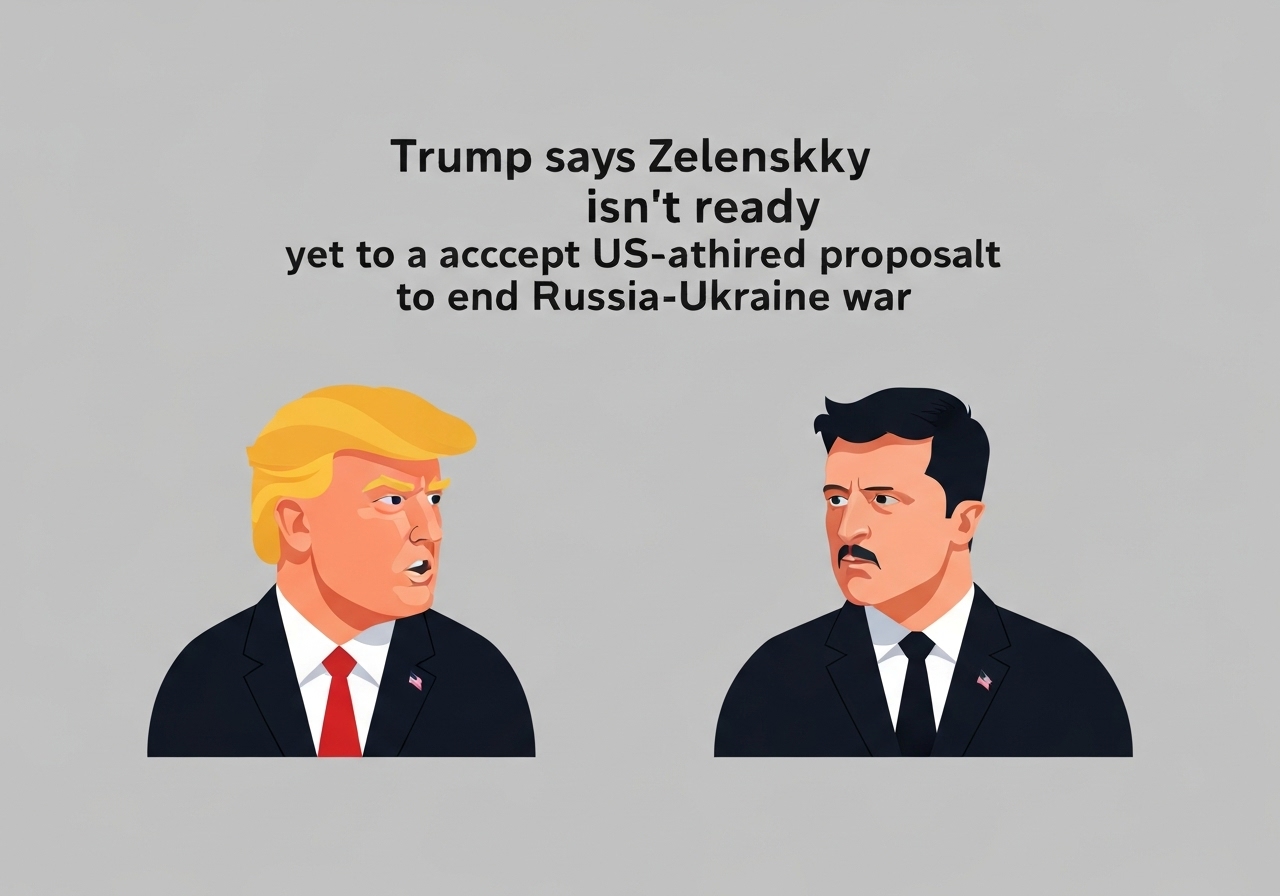
President Donald Trump said on Sunday that Ukrainian President Volodymyr Zelenskyy “isn’t ready” to approve a U.S.-authored peace proposal after three days of talks between American and Ukrainian negotiators in Florida concluded on Saturday. Trump told reporters he was disappointed that, as of a few hours earlier, Zelenskyy had not yet read the text, and suggested Kyiv was the remaining obstacle even as he asserted Moscow was amenable. The claim came as officials and experts emphasized that neither a formal Ukrainian sign-off nor public Russian approval has been confirmed, while fighting continued inside Ukraine. The administration said the proposal is intended to end a nearly four-year war that has cost many lives and shifted European security dynamics.
Key Takeaways
- Three days of U.S.-Ukrainian talks in Florida ended Saturday with negotiators trying to narrow differences over a U.S.-authored peace plan.
- Trump said Zelenskyy “hasn’t yet read the proposal” and that “his people love it,” but insisted the Ukrainian leader “isn’t ready” to accept it, a claim reported on Sunday.
- There is no public confirmation from Russian President Vladimir Putin that Moscow approves the White House plan; Putin recently called parts of an earlier draft unworkable.
- The White House released an updated national security strategy Friday that frames ending the war as a U.S. interest and says Washington seeks improved relations with Russia.
- Outgoing U.S. Ukraine envoy Keith Kellogg said efforts were in the “last 10 meters,” citing disputes over territory—primarily the Donbas—and the Zaporizhzhia Nuclear Power Plant.
- As talks wrapped, Russian missile, drone and artillery strikes killed at least four people overnight and Sunday, including attacks in Chernihiv, Kremenchuk and Kharkiv.
- Russia controls most of Donbas and has held the Zaporizhzhia plant since early in the invasion; the plant’s six reactors are shut down and require reliable power for cooling.
Background
The Russia-Ukraine war, now approaching four years, began with Moscow’s large-scale invasion and has since produced shifting front lines, large-scale displacement and targeted strikes on infrastructure. In 2022 Russia declared the annexation of four Ukrainian regions—including Donetsk, Luhansk, Zaporizhzhia and Kherson—moves Kyiv and its Western partners have denounced as illegal; that formal annexation took place roughly three years ago. U.S. administrations have varied in approach: the Trump administration repeatedly framed the conflict as costly to American taxpayers and has urged concessions to achieve a cease-fire rapidly.
Diplomatic efforts have alternated between multilateral sanctions and military assistance to Ukraine and intermittent negotiations that have yet to produce a lasting settlement. The White House’s new national security strategy explicitly lists ending the war as a core U.S. interest tied to restoring strategic stability with Russia, signaling a potential pivot toward renewed dialogue. At the same time, Kyiv and NATO partners stress that any negotiated outcome must preserve Ukrainian sovereignty and security guarantees.
Main Event
U.S. and Ukrainian negotiators spent three days in Florida working to reconcile differences over a U.S.-drawn proposal intended to end the war; the talks wrapped Saturday. On Sunday, Trump told reporters at an event that Zelenskyy had not yet read the proposal, saying aides in Kyiv liked it but suggesting the president himself was reluctant to sign. The remark followed a phone update Zelenskyy said he received from Ukrainian and American officials, which the Ukrainian leader described as “substantive” and consistent with Kyiv’s interest in negotiating in good faith.
Kremlin spokesman Dmitry Peskov, quoted by Russian state media, welcomed language in the U.S. national security strategy that favors dialogue over confrontation and suggested it could foster constructive cooperation on a settlement. That statement, however, does not equate to formal Russian acceptance of the specific U.S. proposal, and Russian President Vladimir Putin had recently described parts of an earlier draft as unworkable. U.S. officials caution that public statements from Moscow and private positions can diverge.
Keith Kellogg, Trump’s outgoing special envoy for Ukraine, said at the Reagan National Defense Forum that negotiations were in the “last 10 meters,” but stressed two sticking points: control of territory—primarily the Donbas region—and arrangements around the Zaporizhzhia Nuclear Power Plant. Kellogg, who leaves his post in January, was not at the Florida talks and framed the remaining issues as technical and political hurdles rather than insurmountable divides.
The diplomatic developments occurred against persistent battlefield violence. Overnight and Sunday strikes killed at least four people across Ukraine: a drone strike killed one person in Chernihiv; a combined missile and drone attack on Kremenchuk damaged infrastructure and knocked out power and water; and shelling in Kharkiv region killed three people and wounded 10. Ukrainian officials and allies say Russia has intensified attacks on energy and water infrastructure to undermine civilian resilience through the winter.
Analysis & Implications
If Kyiv were to formally accept a U.S.-crafted proposal, it would mark a dramatic shift in momentum toward a negotiated settlement—but only if the agreement preserves core Ukrainian security and territorial concerns. Accepting a plan perceived as too favorable to Moscow could provoke political backlash inside Ukraine and among Western backers that have conditioned support on restoration of sovereignty. The domestic political calculus in Kyiv is therefore central: leaders must weigh immediate relief from combat against long-term territorial and constitutional consequences.
For Washington, pushing a plan that Ukraine resists could complicate relations with both Kyiv and U.S. allies who have coordinated policy for years. The White House’s stated aim to reestablish strategic stability with Russia signals a diplomatic opening, but credibility with partners depends on transparent consultations and sensitive sequencing of concessions. If the administration seeks rapprochement with Moscow without securing durable safeguards for Ukraine, allies may view the shift as unilateral.
On the battlefield, the two outstanding technical issues named by U.S. negotiators—the Donbas territorial arrangements and guarding Zaporizhzhia’s safety—carry acute risks. Donbas control affects population movement, security lines and local governance; the Zaporizhzhia plant needs uninterrupted power and neutral oversight to prevent catastrophic nuclear incidents. Any deal must therefore include monitoring, guarantee mechanisms and contingency plans that are verifiable on the ground.
Comparison & Data
| Item | Detail |
|---|---|
| Conflict duration | Nearly four years |
| Annexation of four regions | Declared ~3 years ago by Russia |
| Recent civilian fatalities (overnight/Sun) | At least 4 people killed (Chernihiv, Kremenchuk, Kharkiv) |
| Zaporizhzhia NPP status | Under Russian control; six reactors shut down, requires power for cooling |
The table above places the diplomatic push in the context of a multi-year war and recent attacks on civilian infrastructure. Analysts say timing matters: winter pressure on energy and water systems increases urgency for a settlement, while active hostilities complicate the implementation of any immediate cease-fire or territorial arrangements.
Reactions & Quotes
Ukrainian President Volodymyr Zelenskyy said he had a substantive update from officials involved in the Florida talks and committed to continuing negotiations in good faith.
“Ukraine is determined to keep working in good faith with the American side to genuinely achieve peace.”
Volodymyr Zelenskyy (social media)
The White House published a revised national security strategy that frames ending the war as a U.S. interest; Kremlin commentary welcomed the document’s language favoring dialogue.
“There are statements there against confrontation and in favor of dialogue and building good relations.”
Dmitry Peskov, Kremlin spokesman (quoted by Tass)
President Trump framed the impasse as a reluctance on Kyiv’s part while asserting Russian acceptance, a claim that sharpens focus on what each capital will publicly endorse.
“I’m a little bit disappointed that President Zelenskyy hasn’t yet read the proposal… His people love it. But he isn’t ready.”
President Donald Trump (reporters’ exchange)
Unconfirmed
- Trump’s claim that Zelenskyy “hasn’t yet read the proposal” is reported by the president; Ukrainian officials confirm a phone update but have not publicly produced the document or a formal presidential rejection.
- Russian President Vladimir Putin has not issued a public endorsement of the specific U.S.-authored proposal; a Kremlin spokesman praised the tone of the U.S. strategy but that is not a formal approval of the plan’s terms.
- Reports that the proposal is “acceptable” to Moscow are mixed—Putin recently described parts of an earlier draft as unworkable, indicating divergence between Russian public statements and private negotiating positions.
Bottom Line
The Florida talks and the U.S. peace proposal mark a significant diplomatic push toward ending a nearly four-year war, but public statements from Washington, Kyiv and Moscow show substantive gaps remain. Acceptance by Ukraine is politically sensitive: Kyiv must balance immediate humanitarian relief and infrastructure repair against preserving territorial integrity and long-term security guarantees. Likewise, any perceived rush to a settlement without robust verification could unravel trust with Western allies who have supported Ukraine militarily and economically.
In the near term, negotiations will hinge on resolving territorial arrangements for Donbas and securing neutral, continuous safeguards for the Zaporizhzhia Nuclear Power Plant. Observers should watch for a formal written response from Kyiv, any explicit endorsement or rejection from Moscow, and how Western partners—especially the U.K., France and Germany—align publicly at Monday’s London meeting with President Zelenskyy.
Sources
- Associated Press — (news media): original reporting on the Florida talks and related statements.
- Tass — (Russian state media): coverage of Kremlin spokesman Dmitry Peskov’s comments on the U.S. national security strategy.
- The White House — (official): release of the administration’s updated national security strategy referenced by officials.