
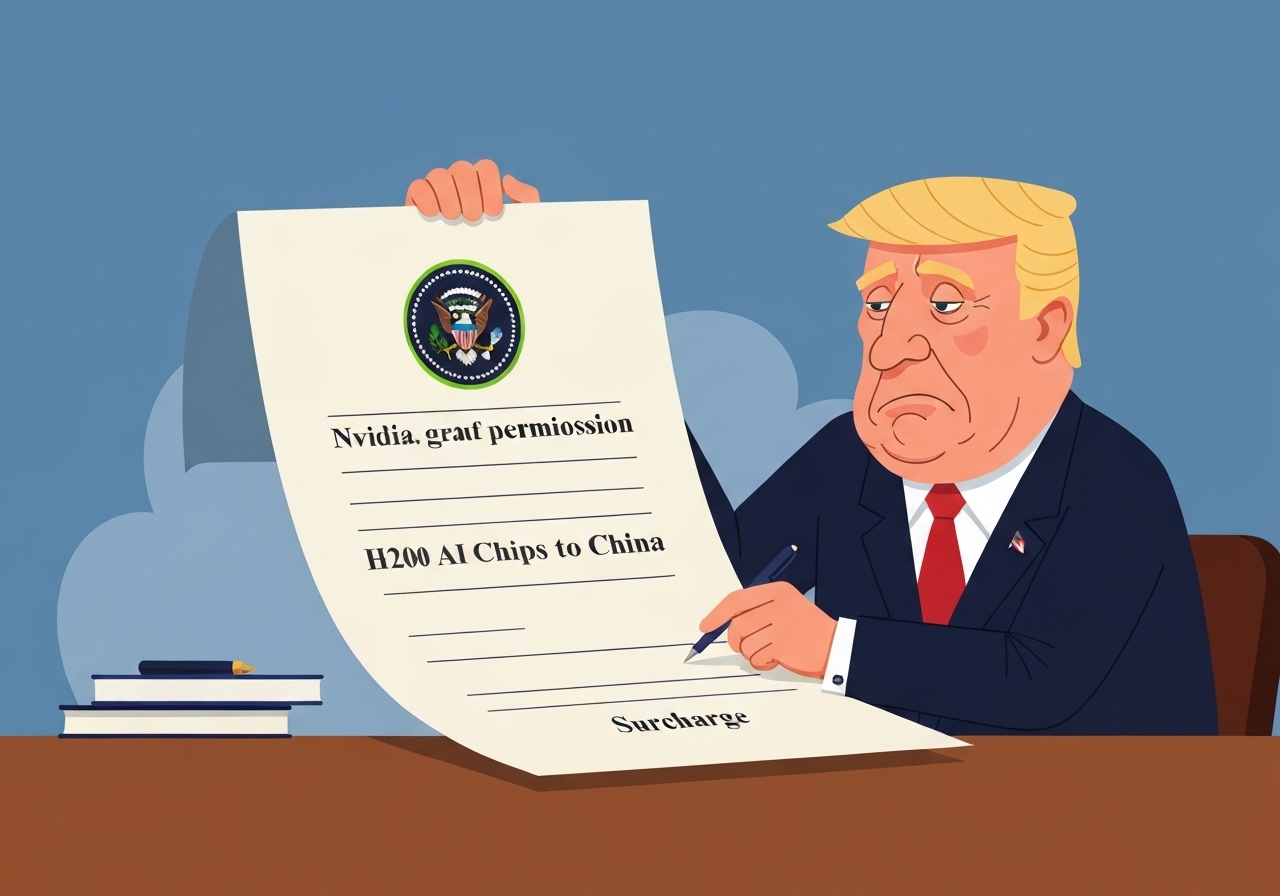
Lead: On Monday, President Donald Trump announced that Nvidia will be permitted to export its high-end H200 AI chips to approved customers in China, according to a Semafor report and the president’s social-media post. The move includes a 25% surcharge on those shipments and extends eligibility to other U.S. chipmakers, Trump said. Officials framed the decision as a compromise between strict export bans and unfettered trade, intended to keep U.S. technology dominant while reopening a lucrative market. It comes against a backdrop of earlier U.S. export restrictions and Chinese limits on some prior Nvidia products such as the H20.
Key Takeaways
- The White House announcement (reported by Semafor) allows Nvidia to ship H200 chips to “approved customers” in China and other countries, with a 25% surcharge on those sales.
- Other U.S. chipmakers will be eligible for similar permissions, expanding potential export scope beyond Nvidia alone.
- The change aims to balance national-security concerns and commercial interests after stricter export controls were enacted under the Biden administration.
- China previously blocked imports of less powerful Nvidia H20 chips; this measure is presented as an effort to satisfy Beijing while keeping controls.
- Despite restrictions, Chinese firms such as DeepSeek and Alibaba have developed advanced AI models, and Huawei has advanced domestic hardware efforts.
- Critics in Washington argue the earlier export limits slowed China and bought the U.S. time; some officials now question whether those limits achieved their strategic goals.
- The U.S. remains heavily dependent on Taiwan Semiconductor Manufacturing Company (TSMC) for advanced foundry capacity and faces Chinese leverage over rare earths and other critical materials.
Background
Since 2022 and especially under the Biden administration, the United States imposed stringent export controls aimed at preventing China from acquiring the most capable AI accelerators. Policymakers argued those controls would slow China’s progress in foundational AI systems and preserve a technology lead for U.S. firms. The measures targeted specific chips and manufacturing tools, narrowing what could be shipped to Chinese customers without licenses.
Over the same period, Chinese firms accelerated software and hardware work inside China to reduce reliance on imports. Companies like DeepSeek and Alibaba advanced large AI models, while Huawei intensified efforts to produce domestic accelerators and infrastructure. At the same time, U.S. policymakers have tried to shore up domestic supply chains, but rebuilding advanced-node capacity has been costly and slow, leaving U.S. firms dependent on TSMC and sensitive to material supply lines such as rare earth elements.
Main Event
The announcement on Monday—first reported by Semafor and relayed by President Trump via social media—says Nvidia may sell its H200 chips to approved buyers in China provided a 25% surcharge is applied to those shipments. Trump framed the move as opening a massive commercial opportunity for Nvidia while maintaining U.S. technological standards globally. He also noted that other U.S. chipmakers could seek similar permissions, signalling a wider policy adjustment rather than a one-off concession.
Administrations have long wrestled with how to limit dual-use technologies without ceding markets to foreign competitors. The new policy appears designed to thread that needle by retaining an export-control framework while granting conditional market access. Details on the approval process—who will qualify as an “approved customer,” what oversight will be imposed and how enforcement will work—have not been published in full.
China had previously blocked imports of certain Nvidia chips such as the less-powerful H20, a point U.S. officials cite when arguing that carefully calibrated exports could satisfy both market and security objectives. For Nvidia, the shift would re-open sales channels closed for months and potentially unlock significant revenue in one of the world’s largest AI markets. How quickly Chinese authorities will accept shipments under the new arrangement remains to be seen.
Analysis & Implications
Strategically, the decision recalibrates U.S. export policy from blanket restrictions toward conditional market access. That approach acknowledges both the commercial downside of prolonged isolation for U.S. suppliers and the limits of export controls when target countries accelerate domestic alternatives. Allowing sanctioned sales with a surcharge attempts to capture economic value while creating friction for adversarial military or surveillance uses.
Operationally, the policy will hinge on an effective approvals regime and enforcement: licensing criteria, end-use verification, and penalties for diversion. If those mechanisms are weak or under-resourced, restricted technology could still leak to unwanted end-users. Conversely, a robustly policed program could become a template for managing other high-tech exports to geopolitical rivals.
Economically, Nvidia stands to regain access to a major customer base, improving near-term revenue prospects and market share. For the broader U.S. industry, conditional access may slow the erosion of global influence in AI hardware markets. But the move also raises questions among allies and domestic security hawks about precedent and whether commercial imperatives are overriding long-term strategic containment goals.
Comparison & Data
| Chip | Relative capability | Previous U.S. export status | China import stance |
|---|---|---|---|
| H200 | High-end AI accelerator | Restricted under previous controls | Now permitted to approved customers with 25% surcharge |
| H20 | Mid-tier AI accelerator | Restricted | Reportedly blocked by Chinese authorities |
| Other U.S. chips | Varies by model | Case-by-case licensing | Varies; some previously allowed |
The table summarizes public characterizations of the chips and policy posture: H200 is described as a high-end accelerator that was previously restricted but is now being cleared for specific exports under new terms. The H20 has faced import blocks in China. These qualitative classifications do not substitute for technical benchmarks but help clarify how policy has shifted among product tiers and jurisdictions.
Reactions & Quotes
Administration and industry reactions have been mixed, reflecting the tradeoffs implicit in the decision. Supporters highlight regained market access and the chance to retain technology leadership; critics warn of enforcement and security risks.
“Nvidia will be allowed to ship the advanced chips to approved customers,”
President Donald Trump (social media post, summarized)
This statement—condensed from the president’s social-media announcement and reporting—frames the policy change and the conditional nature of exports. It underscores the administration’s public rationale of balancing commerce and security.
“A surcharge and approval regime could be a pragmatic way to preserve market share while applying controls,”
Industry analyst (commentary)
Industry observers have noted that a conditional-export path could blunt incentives for customers to switch to domestic suppliers immediately, preserving U.S. firms’ influence in global AI hardware ecosystems. They caution, however, that effectiveness depends on licensing clarity and enforcement capacity.
“Restrictions slowed China’s access but did not stop its domestic advances,”
Technology policy expert (paraphrased)
Experts point to evidence that Chinese software and hardware development continued despite U.S. curbs, reinforcing debates inside Washington about whether stricter controls produced the intended strategic advantage.
Unconfirmed
- Precise criteria for who qualifies as an “approved customer” and the timeline for license approvals have not been publicly released.
- Whether the Chinese government will accept H200 imports under the proposed terms and surcharge is not yet confirmed.
- Internal White House assessments that previous export curbs “failed” are reported by anonymous sources and remain subject to further verification.
Bottom Line
The administration’s decision to permit conditional H200 exports to China represents a significant policy shift that seeks to reconcile commercial and security objectives. For Nvidia and other U.S. vendors, it opens a major revenue opportunity but depends on a licensing and enforcement framework that has yet to be detailed publicly.
Geopolitically, the move signals a pragmatic turn: rather than a full decoupling, policymakers appear to prefer managed engagement that preserves U.S. technological norms while limiting abusive end uses. Watch for rapid clarifications on approval procedures, Chinese acceptance, and domestic political responses that will determine whether the policy achieves its stated balance.
Sources
- Semafor — News outlet; original exclusive reporting on the announcement and social-media post