
Lead
The Federal Reserve is widely expected to approve a quarter-point interest-rate cut at its Dec. 9-10 policy meeting, while indicating it may hold policy steady afterward. The decision will test Chair Jerome Powell’s ability to build consensus among a 19-member policy group that is unusually split over the move. Officials are wrestling with mixed signals: inflation remains elevated even as hiring softens and unemployment has risen. The outcome could shape market expectations and set the tone for the central bank after Powell’s term ends in May.
Key Takeaways
- The Fed’s policy committee comprises 19 members; only 12 vote on rate decisions at any given meeting, and several non-voting officials oppose another cut.
- Markets assign about an 89% probability of a December quarter-point cut, according to the CME FedWatch Tool.
- Some economists say as many as three officials could dissent, the largest number of dissenters in six years for a single cut.
- September’s unemployment rate rose to 4.4%, the third consecutive increase and a four-year high; ADP reported a loss of 32,000 jobs in November.
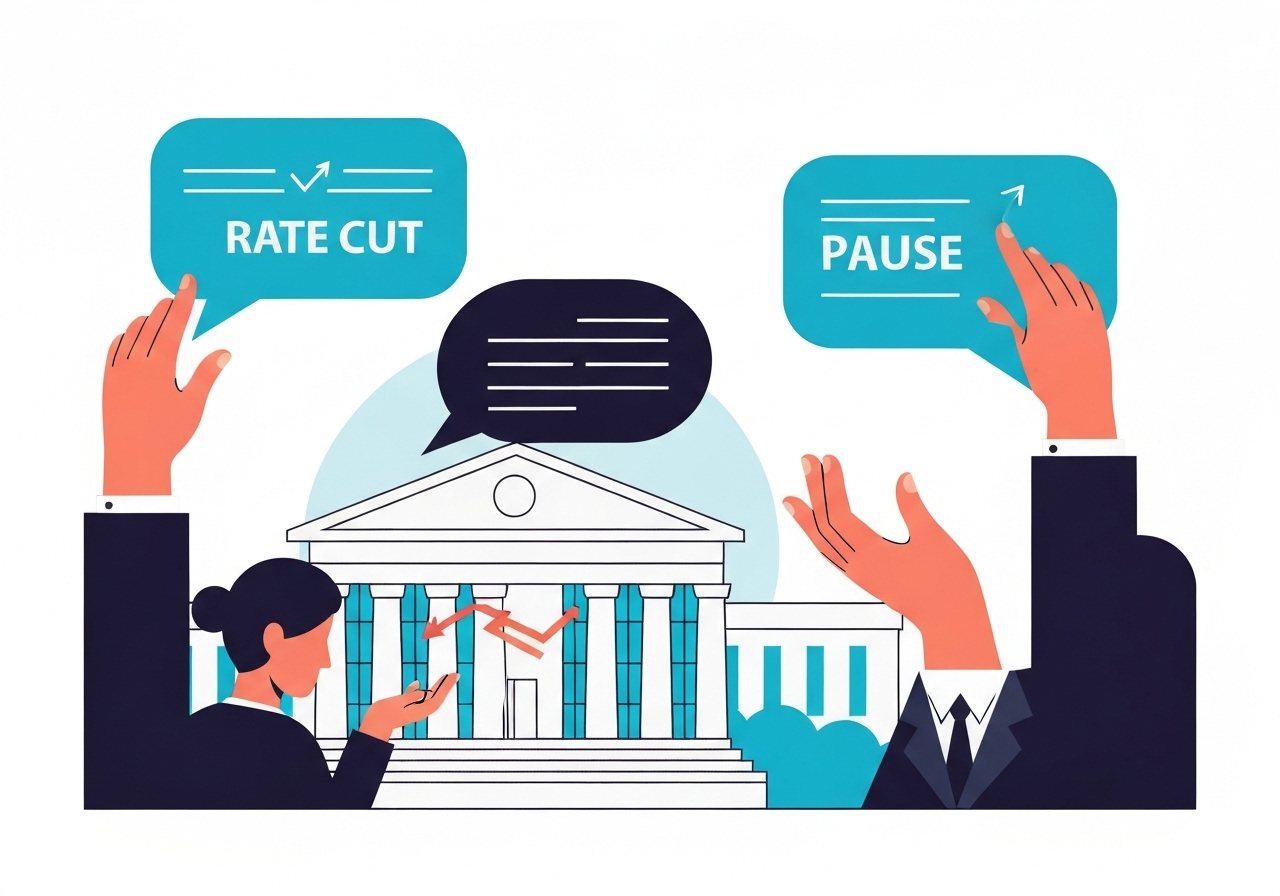
- Fed figures and commentary suggest officials are leaning toward a so-called “hawkish cut”: a rate reduction paired with language that signals a pause.
- Tensions are amplified by political pressure and the prospect that President Trump’s expected nominee, Kevin Hassett, would favor faster cuts.
Background
The Federal Reserve operates under a dual mandate from Congress to pursue price stability and maximum employment, a balancing act that has become more fraught as inflation and labor-market indicators point in different directions. Historically, the Fed has prized consensus and near-unanimous action; dissent has been rare on recent cuts, making any split this week notable. The committee includes both long-serving governors and regional bank presidents; at any meeting, 12 voting spots rotate among them. That structure can magnify the significance of each dissenting vote because non-voters still shape internal debate and public perceptions.
Recent economic data are mixed. Inflation remains higher than the Fed prefers, yet payroll reports and private measures show slowing hiring; ADP’s November estimate recorded a decline in private payrolls. The government shutdown slowed the release of some official data, complicating the committee’s readout of current conditions. Meanwhile, political dynamics are in play: Powell’s term expires in May, and officials and markets are considering how a successor might tilt policy priorities.
Main Event
At the December meeting, most Fed officials are expected to back a 25 basis-point reduction while some will argue for holding rates steady. Several policymakers signaled reluctance in late October, and a handful of officials — including Kansas City Fed President Jeffrey Schmid and St. Louis Fed President Alberto Musalem — are reported likely to dissent in favor of no cut. Fed Governor Stephen Miran is anticipated to dissent in the other direction, preferring a larger half-point reduction for a third consecutive meeting.
Chair Powell must marshal support across that ideological spectrum. New York Fed President John Williams publicly suggested the recent inflation uptick is temporary, a view that moved market odds toward a cut and underscored Powell’s influence as Williams is a voting member and close ally. Some officials caution that a divided vote — for example 8-4 or 7-5 — could weaken market confidence about the Fed’s path.
Financial markets have responded swiftly to commentary; traders priced out earlier uncertainty after Williams’ remarks and now place an 89% probability on a December cut based on the CME FedWatch Tool. Policymakers are mindful of this market sensitivity and of messaging risk: they may cut now while explicitly reserving the right to pause and reassess once backlogged employment and inflation releases arrive in January.
Analysis & Implications
A “hawkish cut” would attempt to thread a narrow needle: easing to support a cooling labor market while signaling vigilance on inflation. That approach aims to avoid reigniting price pressures while acknowledging near-term weakness in hiring. If the Fed pairs a cut with language stressing data dependence and a likely interlude before further easing, markets may interpret the move as cautious rather than dovish, tempering rate-cut expectations into 2026.
Significant dissent could have broader implications. A 7-5 or 8-4 split would be among the largest margins in recent years and could unsettle investors who look to the Fed for clarity. Policymakers themselves warn that such a visible fracture might make forward guidance less convincing and increase volatility in bond and equity markets, complicating the transmission of policy to the economy.
Politically, the meeting matters for the transition after Powell. President Trump’s anticipated nominee, Kevin Hassett, is widely expected to favor faster and larger reductions; such a tilt could lead to a looser policy stance over time if confirmed. That possibility introduces an element of forward-looking uncertainty: markets and firms must price not only the December move but also the potential for a policy regime change in mid-2026.
Comparison & Data
| Item | Value / Note |
|---|---|
| Committee size | 19 members (12 voting at a time) |
| Meeting dates | Dec. 9-10, 2025 |
| Market odds (CME) | ~89% chance of 25 bp cut |
| Unemployment (Sept.) | 4.4% |
| ADP private payrolls (Nov.) | -32,000 jobs |
These figures show the tension the committee faces: labor-market indicators have softened while market pricing strongly expects easing. The table highlights the timeline risk — with three months of delayed monthly data arriving ahead of the late-January meeting — meaning the Fed’s December decision could be provisional, contingent on the backlog of information coming in early next year.
Reactions & Quotes
“It’s just a really tricky time. Perfectly sensible people can reach different answers.”
William English, Yale School of Management (economist, former Fed staff)
English’s comment captures the committee’s internal divisions: a mix of credible arguments for both cutting and holding. He framed the debate as a clash of reasonable interpretations rather than a policy failure.
“You’re seeing the power of the chair.”
Nathan Sheets, Citi (chief global economist, former Fed staff)
Sheets used Powell’s influence to explain why market odds shifted after prominent Fed figures signaled support for easing; comments from senior Fed officials often move investor expectations quickly.
“What they may end up agreeing to do is cut rates now, but give some guidance … that signals that they’re on pause for a while after that.”
Kathy Bostjancic, Nationwide (chief economist)
Bostjancic summarized the likely communications strategy: a near-term cut accompanied by language designed to slow speculation about a rapid succession of further cuts.
Unconfirmed
- The appointment of Kevin Hassett as Powell’s successor is expected by many but has not been formally announced or confirmed by the Senate.
- The precise number of dissenting votes at the Dec. 9-10 meeting is uncertain until the public vote is recorded.
- Attribution of John Williams’ comments as coordinated with the chair is inferred by some analysts but has not been officially confirmed by Fed communications.
Bottom Line
The Fed is likely to approve a modest, quarter-point cut in December while signaling it may pause to evaluate incoming data. That outcome would acknowledge softening labor-market indicators without abandoning vigilance on inflation, attempting to stabilize markets while preserving optionality. A visible split among policymakers would raise the stakes for the Fed’s communications and could introduce additional market volatility, especially if investors read dissent as a sign of policy drift.
Watch the late-January meeting and the backlog of jobs and inflation releases that will follow December’s action. Those data will be pivotal in deciding whether a one-off cut suffices or whether further loosening becomes necessary; until then, the Fed appears poised to move cautiously and emphasize data dependence.
Sources
- Associated Press (news report)
- CME Group — FedWatch Tool (market odds)
- ADP (private payroll data)
- U.S. Bureau of Labor Statistics (official employment statistics)
- Federal Reserve Bank of New York (official speeches and commentary)