
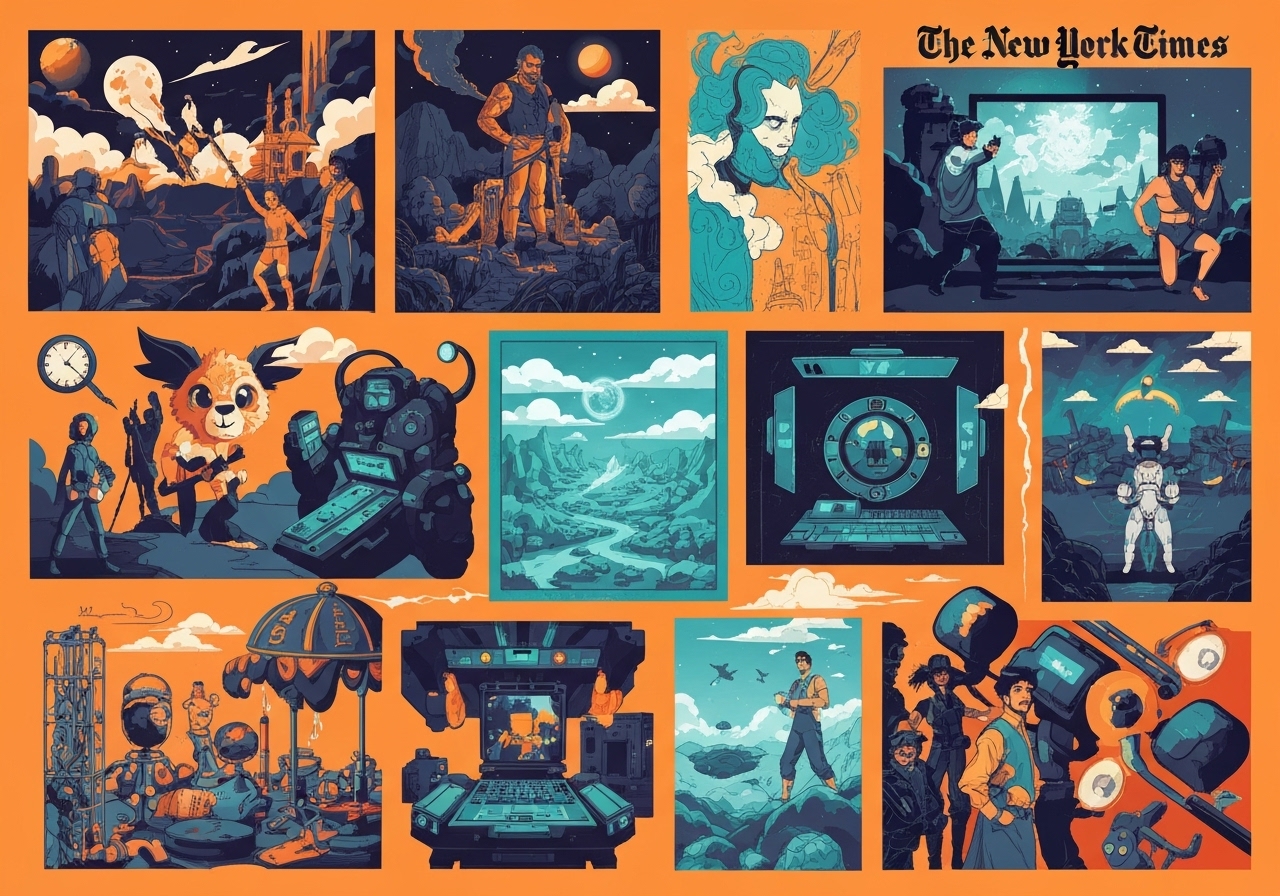
— In a year reviewers described as chaotic, a year-end roundup by Yussef Cole highlights the 10 most notable games of 2025, emphasizing personal narratives, a strong mystery resurgence and standout indie work. The list spans intimate autobiographical projects and inventive experiments that reframe familiar mechanics, with several titles offering solace or sharper perspective rather than pure escapism. Two examples featured prominently are Artis Impact, a pixel-art role-playing project made by a single Malaysian developer, and Baby Steps, a deliberately awkward control experiment whose image is credited to Devolver Digital. The selection argues that smaller, specific games can capture big cultural and emotional moments.
Key Takeaways
- Year and source: The roundup was published Dec. 9, 2025, by Yussef Cole in The New York Times and spotlights ten games across genres.
- Genre trends: Coming-of-age narratives and detective-style mystery games were unusually prominent among critics’ favorites in 2025.
- Indie prominence: Artis Impact was created almost entirely by one Malaysian developer and is noted for pixel art and a compact RPG structure.
- Thematic range: Many top picks mix nostalgia with contemporary concerns, offering both comfort and critique.
- Design experiments: Baby Steps forces players to control each leg independently, making movement intentionally awkward as a gameplay premise.
- Visual & tonal contrast: Titles range from bleak, dystopian settings to light, self-aware comedy and meta-commentary on game design.
Background
2025’s cultural landscape—marked by political turbulence and pervasive uncertainty—helped shape how critics and players approached games this year. Rather than seeking only spectacle, many turned to titles that explored personal identity, memory, and quiet acts of care. Historically, games have trended between blockbuster spectacle and artisanal indies; this year the balance shifted toward smaller teams and singular creative voices. That shift reflects broader industry dynamics: accessible development tools, platform storefronts that amplify indie releases, and an audience hungry for novel emotional experiences. The result is a cohort of games that read like short stories or films—compact, specific and resonant.
At the same time, mystery and detective mechanics returned in force, with several designers using fragmented narratives to engage players in piecing together opaque events. Nostalgia also appeared as a design tool: some creators used retro aesthetics to evoke comfort, while others employed it to critique contemporary trends. Economic pressures on large studios have accelerated interest in lower-budget projects that can take creative risks. Meanwhile, coverage from major outlets, including The New York Times, helped surface these titles to wider audiences, amplifying the cultural conversation around them.
Main Event
Artis Impact stands out as an example of what a single creator can accomplish. Built with finely crafted pixel visuals, the game follows a young, magical-hero figure and a sardonic robot companion through a cityscape scarred by conflict between humans and bestial “AI” that emit distorted static before being felled by elegant sword strikes. Between combat beats the protagonist performs ordinary tasks—cooking herbal soup, taking naps, sweeping a corner store—that soften the dystopia and add domestic texture. The developer mixes comic-book paneling and punchy animations to vary pacing: dense dialogue scenes play against swift action sequences and self-aware genre riffs. Critics flagged its ability to evoke both alienation and wry humor without losing narrative clarity.
Baby Steps takes a very different route: it is a design statement about the assumed ease of character movement in 3D games. Players manipulate each leg separately, so every step demands care; runs, trips and comical falls are frequent by design. That choreographed awkwardness forces reflection about how interface and embodiment shape play and meaning. Reviewers described it as an intentionally absurd meditation on control and frustration, turning a basic locomotion mechanic into the central expressive element. The image accompanying coverage of Baby Steps was credited to Devolver Digital.
Across the full top 10, other editors’ selections emphasize narrative specificity—coming-of-age arcs, intimate autobiographical details and detective stories that require close attention. The pieces together form a mosaic of approaches rather than a single dominant aesthetic. Several entries were praised for balancing formal experimentation with accessible hooks, allowing a broad audience to engage with unusual ideas. That balance helped the list gain traction beyond core gaming outlets.
Analysis & Implications
The prominence of small, auteur-driven projects suggests a maturing mid-tier for game development, where financial viability and creative risk coexist. Advances in middleware, publishers willing to fund modest budgets and digital storefront curation all lower the threshold for inventive teams to reach players. If this continues, we should expect a steady pipeline of compact, idea-driven games that pursue distinct voices rather than franchise formulas. That trend can diversify the market but also raises questions about discoverability and long-term sustainability for individual creators.
Resurgence in mystery and detective formats signals an appetite for participatory narrative work that rewards close reading and revisitation. These games often require players to assemble fragmented clues and recontextualize events, which dovetails with social media cultures that prize theorycraft and community discussion. The upside is deeper player engagement and extended shelf life through player-driven analysis; the downside is that very opaque design can alienate casual players if not balanced with accessible entry points.
Economically, larger studios may respond by either imitating distinctive indie mechanics at scale or by doubling down on spectacle to maintain mass-market share. Both outcomes are visible: some publishers acquire indie teams to integrate their sensibilities, while AAA products increasingly add narrative-lite modes to broaden reach. For players and critics, the immediate implication is richer choice—more works that attend to mood, form and personal detail rather than solely to production polish.
Comparison & Data
| Title | Creator | Aesthetic | Core Mechanic |
|---|---|---|---|
| Artis Impact | Single Malaysian developer | Pixel art, comic-panel scenes | RPG exploration, melee combat, life-sim moments |
| Baby Steps | Small development team (credited imagery: Devolver Digital) | Minimalist, physics-driven | Independent leg control, deliberate locomotion |
The table isolates two representative entries to show how different design priorities—narrative-driven RPG versus experimental control scheme—can both earn critical attention. While Artis Impact foregrounds crafted worldbuilding and tonal shifts, Baby Steps foregrounds mechanical provocation. Neither approach is inherently superior; together they illustrate the year’s pluralism. This diversity is a useful corrective to market homogeneity and a signal of where innovation is occurring.
Reactions & Quotes
“This year’s standouts are small, specific works that reflect broader cultural anxieties without grandstanding.”
Yussef Cole / The New York Times (critic)
“We want players to feel the weight and absurdity of every motion — that’s the entire point of the control design.”
Baby Steps developer (summary of developer commentary)
“Making a rich pixel world alone was about compressing a lifetime of ideas into a focused, playable moment.”
Artis Impact creator (developer interview summary)
Unconfirmed
- Complete rankings and sales figures for the full top-10 list beyond the highlighted examples were not provided in the accessible excerpt and remain to be confirmed.
- Publisher attribution for every listed title (beyond image credits) was not fully detailed in the preview and should be verified from official release notes.
Bottom Line
2025’s best-regarded games, as sampled by this roundup, underline an appetite for specific, voice-driven experiences—titles that trade mass spectacle for intimacy, experiment and narrative focus. Indie creators and small teams played an outsized role in shaping critical conversation, demonstrating that distinct perspectives can cut through a crowded market. Players and observers should watch how platforms and publishers either support or absorb these practices in the year ahead.
For consumers, the takeaway is practical: look beyond headline releases to find inventive work that rewards close attention. For the industry, the test will be whether financial and distribution systems adapt to sustain smaller creators without forcing premature homogenization. Either way, 2025’s headline picks suggest a healthier creative ecology for games that value specificity and formal risk.