
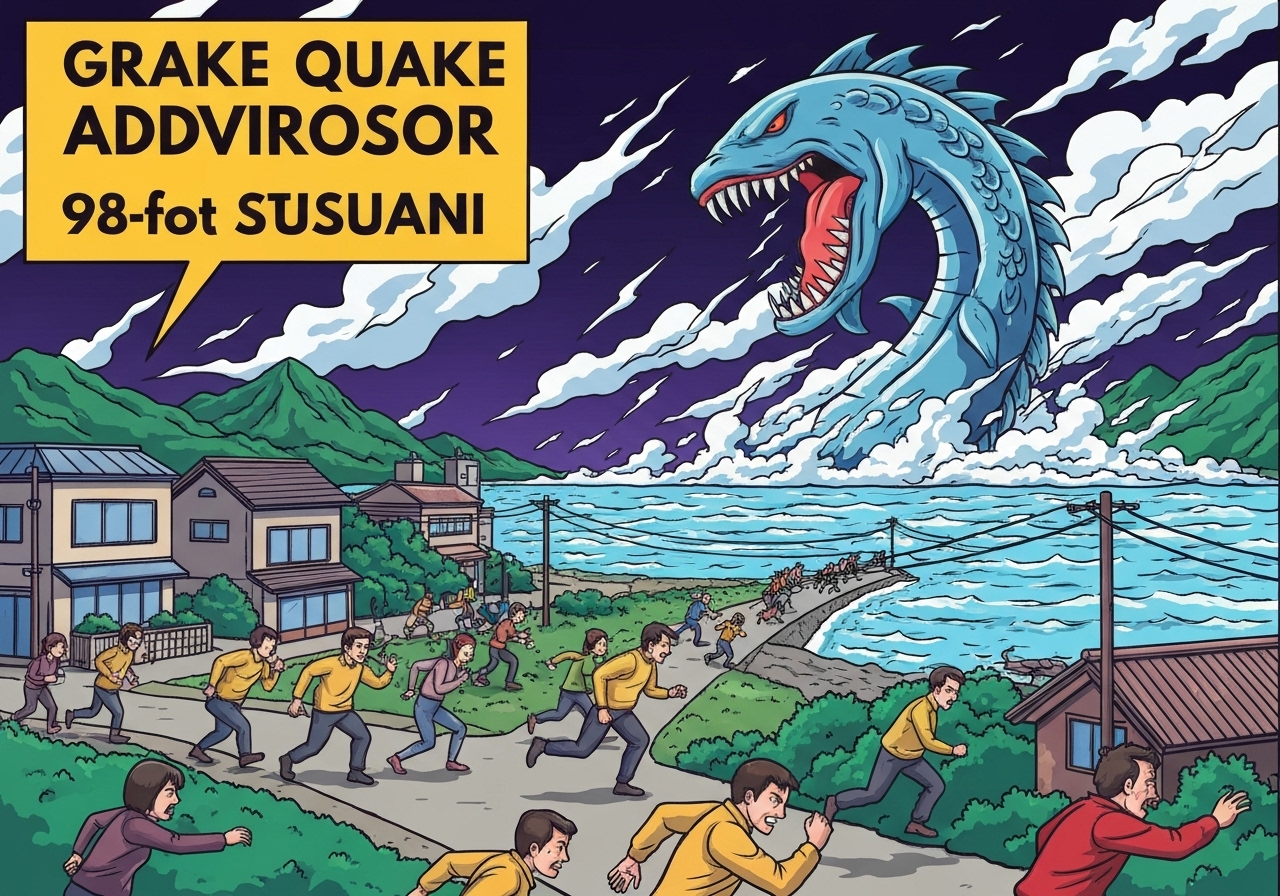
Lead: A magnitude 7.5 earthquake struck off the eastern coast of Aomori on Dec. 8, 2025, prompting Japan to issue a nationwide megaquake advisory on Dec. 9. Authorities reported 34 mostly mild injuries and localized damage to roads and buildings, and warned an offshore megaquake could produce a tsunami up to 98 feet high and cause widespread loss of life. Officials stressed the advisory is not a precise prediction but said there is an elevated risk of a larger shock in the coming days. Residents along vulnerable coastlines were urged to prepare emergency kits and be ready to evacuate immediately.
Key takeaways
- The initial quake: magnitude 7.5 struck off Aomori on Dec. 8, 2025, producing reports of 34 mostly minor injuries and some infrastructure damage.
- Megaquake advisory scope: the advisory covers 182 municipalities from Hokkaido to Chiba Prefecture, spanning much of Japan’s northeastern and eastern Pacific coast.
- Worst-case government estimate: an offshore Hokkaido–Sanriku megaquake could trigger a tsunami up to 98 feet, kill as many as 199,000 people, and destroy up to 220,000 buildings.
- Economic and health impacts: estimated economic losses of up to 31 trillion yen (≈$198 billion) and up to 42,000 people at risk of hypothermia in winter conditions.
- Probability and timing: officials say the advisory is not a prediction and estimate roughly a 1% chance of a magnitude 8 or larger event, while noting an increased risk window over the next week.
- Historical context: authorities referenced the 9.0 Tohoku quake on March 11, 2011 — which followed a 7.3 foreshock two days earlier — and the damaging Nankai Trough estimates from 2013 and the separate 2024 advisory.
Background
Japan sits above multiple converging tectonic plates, including the Pacific Plate where the Japan Trench and Chishima Trench produce large, infrequent earthquakes and tsunamis. The Japan Trench runs off the eastern coast of Honshu from Chiba to Aomori, while the Chishima Trench extends along Hokkaido’s eastern coast toward the northern islands and the Kurils. These subduction-zone trenches were central to the 2011 Tohoku disaster, which produced a magnitude 9.0 quake, tsunamis exceeding 50 feet in places and the Fukushima Daiichi nuclear accident.
Japan’s disaster-preparedness institutions maintain scenario-based damage estimates for multiple trenches and troughs. In 2013, the government modeled a worst-case Nankai Trough event (magnitude ~9.1) with potential deaths up to 323,000, destruction of more than 2 million buildings and economic damage exceeding 200 trillion yen. Last year’s (August 2024) inaugural Nankai Trough advisory highlighted gaps in public understanding after scientific language triggered broad confusion and precautionary buying across parts of the country.
Main event
The Dec. 8, 2025 magnitude 7.5 temblor occurred off the eastern coast of Aomori, near zones that have produced major earthquakes historically. Local authorities reported road collapses and structural damage in parts of Tohoku, and emergency services responded to dozens of calls. Most injuries—34 in total—were described as mild; no immediate reports of mass casualties were confirmed in the first 24 hours.
Government agencies activated a megaquake advisory on Dec. 9, citing models that show an offshore rupture in the Hokkaido–Sanriku segment could generate a tsunami as high as 98 feet and cause catastrophic damage if it were to occur. Officials emphasized that the advisory is intended to raise preparedness rather than forecast an imminent event, while noting a window of slightly elevated probability for a larger shock in the short term.
Local municipalities began checking relief-stockpiles, inspecting emergency equipment and updating evacuation information on municipal websites. Cities such as Iwaki in Fukushima urged residents to sign up for emergency email alerts; Oarai in Ibaraki checked wireless comms gear. Coastal towns reopened or closed public facilities and reviewed shelter capacity to handle winter evacuees.
Analysis & implications
The advisory illustrates the tension between scientific caution and public response. Officials must balance presenting probabilistic seismology—often low-probability but high-consequence scenarios—against the risk of inducing panic or complacency. Japan’s experience since 2011 has sharpened emergency planning, but public comprehension of probabilistic advisories remains uneven, as seen after last year’s Nankai warning.
Economically, a major offshore rupture in Hokkaido–Sanriku could inflict immediate and long-term losses: the government’s 31 trillion yen (≈$198 billion) estimate covers direct destruction to 220,000 buildings and cascading supply-chain effects. Winter seasonality raises additional humanitarian risks; models project tens of thousands vulnerable to hypothermia if evacuation and sheltering are prolonged.
Politically and administratively, the advisory will test coordination among national agencies, prefectural governments and municipal responders. Communication clarity—plain-language guidance on when to evacuate, where to go and how long to shelter—will shape public behavior and the ultimate human toll. Internationally, heightened alert in Japan could affect shipping, regional port operations and the flow of goods, prompting contingency planning across East Asia.
Comparison & data
| Event / Model | Magnitude | Estimated deaths | Tsunami height | Economic loss |
|---|---|---|---|---|
| Dec. 8, 2025 quake (observed) | 7.5 | — (34 injuries reported) | Localized coastal surges | Localized damage |
| Hokkaido–Sanriku worst-case (govt) | ~9.0 (scenario) | Up to 199,000 | Up to 98 ft | Up to 31 trillion yen (~$198B) |
| 2011 Tohoku actual | 9.0 | ~20,000 | 50+ ft in places | Major long-term economic impacts |
| 2013 Nankai Trough model | ~9.1 | Up to 323,000 | >33 ft | >200 trillion yen (~$1.28T) |
The table summarizes observed figures and modeled scenarios to clarify scale. The government’s scenario estimates are designed for long-term planning rather than short-term prediction; they combine structural loss, casualty modeling and seasonal vulnerability assumptions.
Reactions & quotes
Local residents described strong, frightening shaking and immediate concern for children and elderly neighbors. Eyewitness accounts underscore why authorities emphasize immediate preparedness for coastal residents.
“The tremor was something that we’ve never experienced. It lasted maybe for about 20 seconds,”
Daiki Shimohata, civil servant in Hashikami (AFP)
National officials framed the advisory as a preparedness measure, urging calm while telling people to ready emergency supplies and review evacuation routes. Authorities repeatedly emphasized the advisory is not a time-specific forecast.
“This advisory is not a prediction. We call on residents to be cautious and prepared while continuing daily activities,”
Tsukasa Morikubo, Cabinet official for disaster prevention
Unconfirmed
- No scientific method can predict the exact timing and location of a magnitude 8+ quake; the advisory reflects modeled elevated risk but not a deterministic forecast.
- The worst-case casualty and damage figures are scenario-based estimates, not confirmed outcomes for any specific imminent rupture.
- Exact tsunami heights at particular towns and the timing of any secondary shocks remain uncertain until/if a larger rupture occurs.
Bottom line
Japan’s Dec. 9 megaquake advisory following the Dec. 8 magnitude 7.5 event is a precautionary step grounded in historical precedent and model-based risk assessment. The immediate observed impact from the 7.5 quake was limited—34 mostly mild injuries and localized damage—but authorities emphasize preparation because of the disproportionate consequences a larger offshore rupture could bring.
For residents in affected coastal municipalities, the prudent actions are clear: prepare an emergency bag, confirm evacuation routes and shelter plans, and monitor official channels for actionable instructions. National authorities and local governments must pair scientific caution with clearer public communication to reduce confusion and ensure measured, effective public response.