
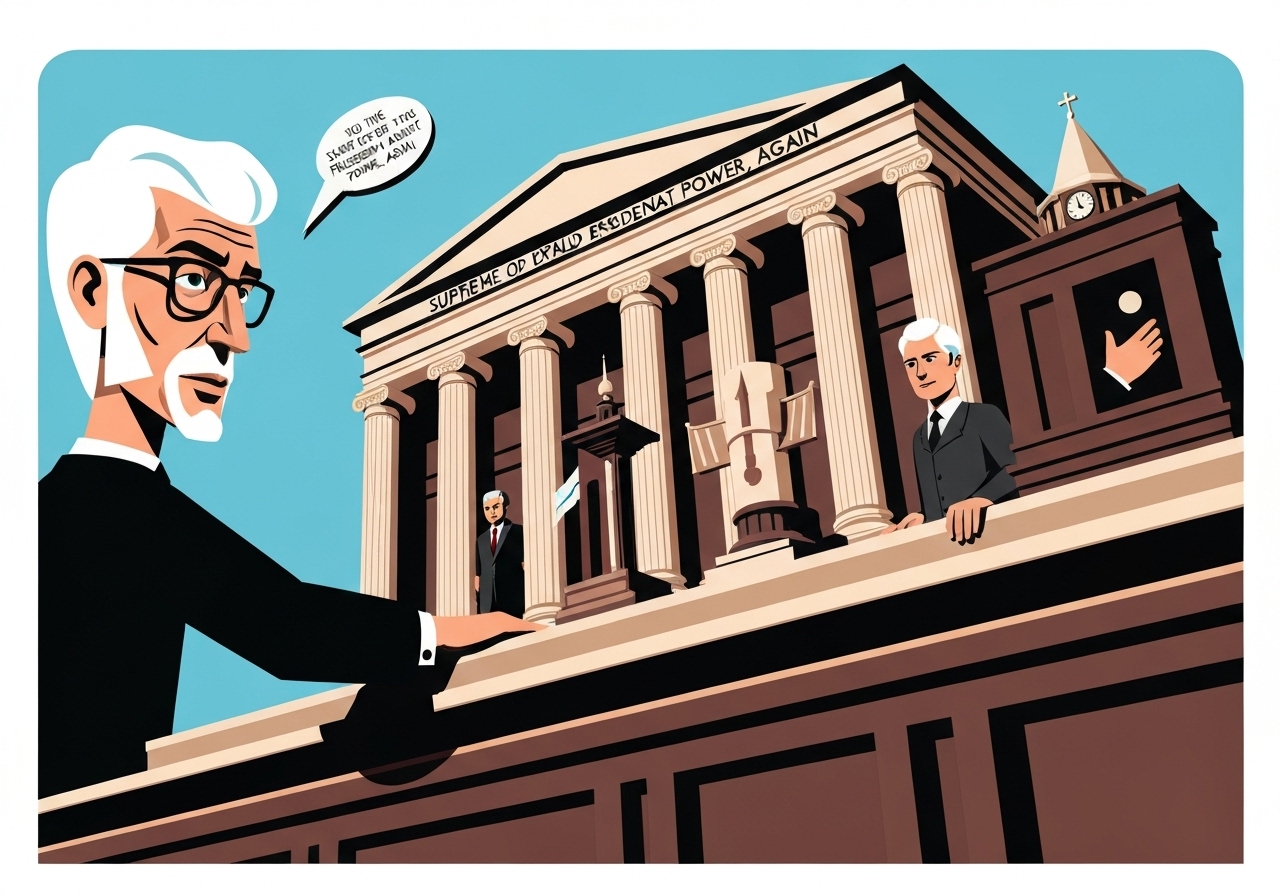
Lead: On December 8, 2025, the Supreme Court heard oral argument in Trump v. Slaughter, a case testing whether Congress may impose ‘for cause’ limits on a president’s ability to remove commissioners of independent agencies. The argument focused on whether longstanding statutory protections that limit removal by the president can survive a robust ‘unitary executive’ theory favored by several conservative justices. If the Court’s questioning is predictive, a majority appears inclined to erode or eliminate those limits, shifting substantial regulatory and enforcement discretion toward the presidency. The outcome would reshape how more than two dozen multi-member federal agencies operate and how regulations are enforced.
Key Takeaways
- The Court heard argument on December 8, 2025 in Trump v. Slaughter, which challenges ‘for cause’ removal protections for commissioners of agencies such as the Federal Trade Commission.
- President Donald Trump fired FTC Commissioner Rebecca Slaughter on March 18; that firing is central to the case now before the Court.
- Historically, decisions in 1926 (Myers) and 1935 (Humphrey’s Executor) established competing frameworks for appointment and removal power; Chief Justice Roberts’s 2020 Seila Law opinion narrowed Congress’s authority to limit removal in certain single‑headed agencies.
- Several justices appeared receptive to a robust unitary‑executive argument that would vest broad removal and regulatory authority in the president, potentially undermining protections across the civil service and independent commissions.
- A majority ruling for the government could expose administrative judges’ decisions and many civil‑service protections to political removal, affecting immigration, labor, and competition enforcement.
- The Court previously paused lower‑court orders blocking other recent firings (National Labor Relations Board, Merit Systems Protection Board), signaling a willingness to allow immediate executive action while the legal issues proceed.
- Solicitor General John Sauer framed his argument in terms of individual liberty and presidential control, a stance that drew sharp pushback from liberal justices concerned about separation of powers.
Background
From the founding, Congress has used its legislative powers under Article I to create executive departments and agencies staffed under statutory terms. Those statutes sometimes include qualifications or removal restrictions for officers who exercise regulatory or adjudicative authority. The Constitution gives the president the appointment power under Article II, but it does not explicitly address removal; the Supreme Court has read removal authority into the executive role while allowing some statutory limits.
Two landmark cases shape the arc of removal doctrine: Myers v. United States (1926), which endorsed a broad presidential removal power as incidental to appointment, and Humphrey’s Executor (1935), which limited that power for multi‑member independent agencies exercising quasi‑legislative or quasi‑judicial functions. In Seila Law (2020), Chief Justice Roberts carved out a line that made it harder for Congress to protect single‑headed agencies from removal by the president, but left multi‑member independent commissions—like the FTC—less clearly affected.
Main Event
At oral argument in Trump v. Slaughter, counsel for the government pressed a theory that the president’s removal authority should be virtually unfettered, including over officials of independent commissions. Solicitor General John Sauer argued that once statutory power is delegated to an agency, the president must retain ultimate control over who executes it—an argument that, if accepted broadly, would transfer regulatory power into the presidential office.
Justices skeptical of that position—principally Justices Elena Kagan, Sonia Sotomayor and Ketanji Brown Jackson—pressed Sauer on the practical consequences, warning that unleashing removal authority would allow wholesale political control over agencies Congress designed to be insulated from partisan swings. Justice Sotomayor warned the Court was proposing a restructuring of government functions if it erased statutory protection for multi‑member commissions.
The dispute is not abstract: the government stayed lower‑court injunctions that had blocked the administration’s firings of officials at the National Labor Relations Board and the Merit Systems Protection Board, and it has permitted the administration to remove FTC Commissioner Rebecca Slaughter after her March 18 dismissal. The Court is also considering a related petition from Lisa Cook of the Federal Reserve Board, a matter the majority treated differently on the emergency docket.
Analysis & Implications
If the Court upholds the government’s position, Congress’s ability to craft statutory protections that buffer agency decision‑makers from political pressure will be substantially weakened. That would make regulatory rulemaking, enforcement priorities, and adjudications more directly subject to the president’s preferences, with implications for antitrust enforcement, consumer protection, labor rules, immigration adjudication, and financial oversight.
A ruling favoring unreviewed presidential removal authority would also raise separation‑of‑powers concerns: Congress passed statutes relying on precedents that assumed some limits on removal authority. Overturning or hollowing those precedents would transfer to the White House discretion that Congress long assumed it retained—unless Congress can secure veto‑proof majorities to rewrite statutes, an unlikely political remedy in the near term.
The decision could cascade into civil‑service protections beyond named commissioners. Administrative law judges and career staff who make or implement decisions under statutory schemes could be subject to heightened political oversight, chilling independent fact‑finding and rule interpretations. That shift is especially consequential in areas where agency expertise is central to policy outcomes, such as workplace safety, consumer finance, and immigration adjudication.
Comparison & Data
| Decision/Era | Effect on Removal Power |
|---|---|
| Myers v. United States (1926) | Broad presidential removal power recognized for executive officers. |
| Humphrey’s Executor (1935) | Permitted Congress to limit removal for multi‑member independent agencies. |
| Seila Law (2020) | Narrowed Congress’s ability to protect single‑headed agencies from removal. |
| Trump v. Slaughter (2025, argued Dec. 8) | Could further curtail ‘for cause’ protections for commissioners of independent agencies. |
The table above summarizes how the Court’s doctrine has shifted across a century. If Trump v. Slaughter produces a holding that extends Seila Law logic to multi‑member commissions, statutory ‘for cause’ provisions that have governed dozens of agencies would be vulnerable to constitutional attack.
Reactions & Quotes
Officials and legal observers offered sharp responses during and after oral argument, reflecting the stakes beyond a single personnel dispute.
Justice Sonia Sotomayor cautioned that the government’s position could mean “restructuring the entire government,” a phrase she used to highlight the scale of potential institutional change.
Justice Sonia Sotomayor, Supreme Court
That intervention captured the concern that a ruling for the government would not be limited to a single agency but could reshape how Congress delegates authority and protects officials across the executive branch.
Solicitor General John Sauer argued that the power to remove is central to presidential control, saying in argument that “the one with the power to remove is the one that they have to fear and obey.”
U.S. Solicitor General John Sauer (argument)
Sauer framed his position in liberty terms and presidential accountability, a framing that some conservatives on the Court appear to accept as a limiting principle for executive authority.
Several liberal justices pressed for limiting principles to preserve statutory independence for agencies that exercise quasi‑legislative and quasi‑judicial duties.
Justices Kagan, Sotomayor, K. B. Jackson (questions)
Unconfirmed
- It is not yet confirmed which justice will author the majority opinion; observers expect Chief Justice Roberts but the assignment is not official until the opinion is released.
- Whether the Court’s eventual holding will extend to all civil‑service statutes nationwide is unresolved; the oral argument suggested breadth but the final opinion could be narrower.
- Claims that every administrative or adjudicative decision will immediately be subject to presidential override remain speculative until the Court issues a written ruling and lower courts interpret it.
Bottom Line
Trump v. Slaughter is about more than one firing: it tests whether Congress may continue to legislate protections that buffer certain officials from political removal, and whether administrative independence will survive in practice. A decision for the government could concentrate regulatory and adjudicative authority in the presidency, with widespread consequences for rulemaking, enforcement, and administrative adjudication.
Watch for the Court’s opinion and for follow‑on litigation: a broad ruling favoring unfettered removal could trigger immediate challenges to statutes across sectors, force Congress to consider remedial legislation (difficult under current polarization), and shift how agencies recruit and retain career experts. For now, the December 8, 2025 oral argument makes clear that the future of independent agencies hangs on how the justices write their opinion.
Sources
- The Bulwark — media analysis and original report on oral argument (press/analysis).
- Federal Trade Commission (FTC) — official agency site with background on commission structure (official agency).
- SCOTUSblog — court‑focused reporting and docket coverage (independent court reporting).