
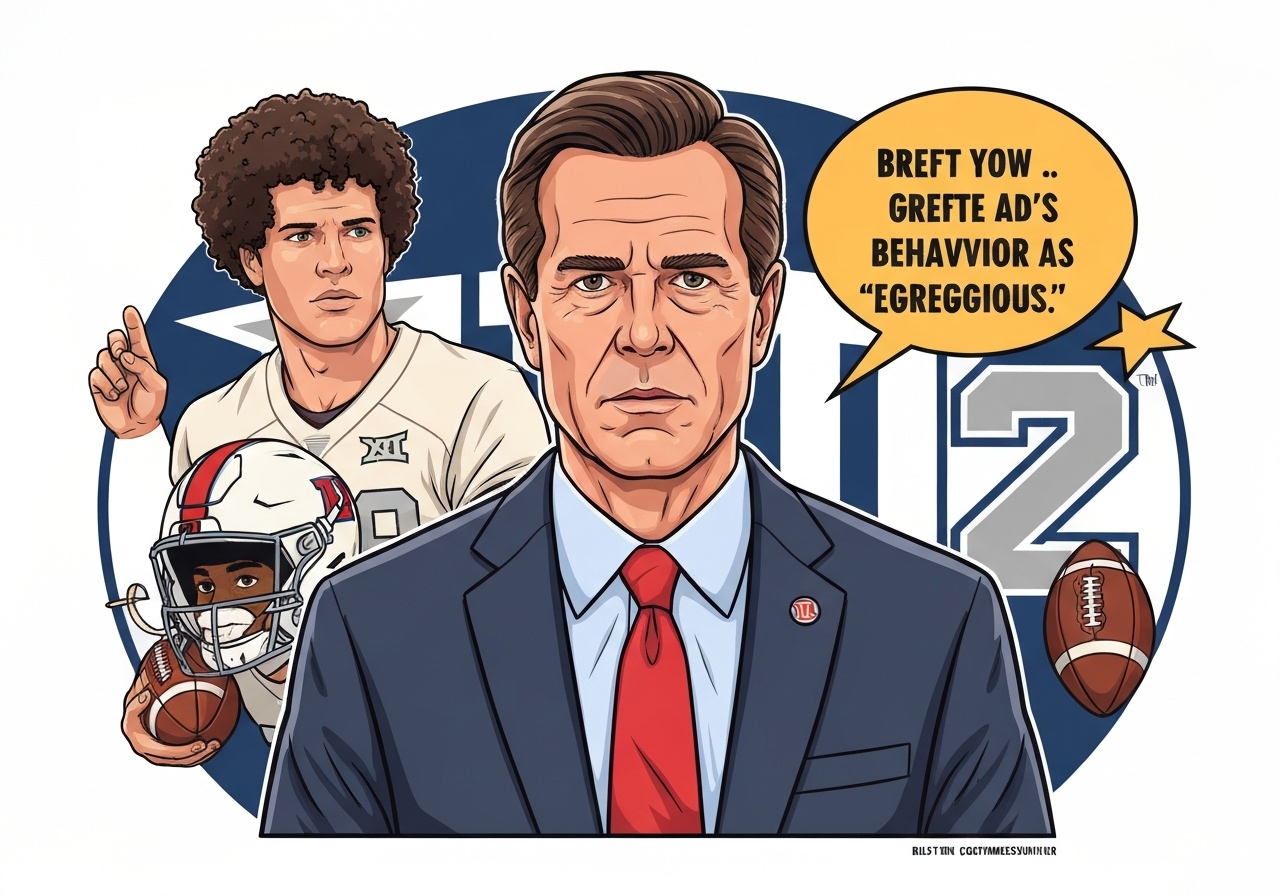
On Dec. 9, 2025 at the Sports Business Journal Intercollegiate Athletics Forum, Big 12 commissioner Brett Yormark sharply criticized Notre Dame athletic director Pete Bevacqua, calling Bevacqua’s public attacks on the Atlantic Coast Conference “egregious.” The clash followed Notre Dame’s omission from the College Football Playoff despite Miami securing a CFP berth with a head-to-head win over the Fighting Irish. Bevacqua had accused the ACC of bias on social media and in media appearances, and the dispute has strained the long-standing relationship between Notre Dame and the conference. Yormark defended the CFP process and noted the ACC’s role in supporting Notre Dame during the pandemic.
Key Takeaways
- Brett Yormark publicly rebuked Notre Dame AD Pete Bevacqua on Dec. 9, 2025, calling Bevacqua’s conduct “egregious” at a Sports Business Journal event.
- Notre Dame was left out of the 2025 College Football Playoff in favor of Miami, which had a head-to-head victory over the Irish — a factor the CFP chair cited.
- Bevacqua alleged an ACC-led social media campaign targeting Notre Dame; the claim has not been independently verified.
- All Notre Dame varsity sports except football and men’s hockey compete in the ACC; football has a scheduling partnership with at least five ACC opponents annually since 2014.
- Yormark noted the ACC provided a 10-game schedule for Notre Dame in 2020 during COVID-19; Notre Dame went 9-0 in ACC play that season and was the No. 4 CFP seed.
- Yormark also pointed to BYU — an 11-2 Big 12 team excluded from the CFP after two losses to No. 4 Texas Tech — as another example of the committee applying head-to-head criteria.
Background
The College Football Playoff selection for the 2025 season placed Miami ahead of Notre Dame after Miami beat the Irish head-to-head, a decisive detail the CFP chair publicly referenced when explaining the committee’s rationale. Notre Dame’s football program occupies an unusual position in modern college athletics: the school’s non-football varsity teams are full ACC members, while the football team remains independent but participates in a scheduling agreement with the conference that began in 2014.
Tensions between Notre Dame and the ACC have ebbed and flowed for more than a decade, accelerated by the pandemic-era scheduling accommodations in 2020. That season the ACC and Notre Dame arranged a 10-game league slate; Notre Dame finished 9-0 in ACC play and earned a CFP berth as the No. 4 seed but lost in the semifinal to Alabama. Those events are frequently cited by both sides when discussing obligations and expectations within the relationship.
Main Event
On Dec. 9, 2025, Yormark addressed reporters and attendees at the Sports Business Journal forum and criticized Bevacqua’s public comments about the ACC. Yormark said Bevacqua was “totally out of bounds” and that he would say the same to Bevacqua face to face. The commissioner framed his criticism around gratitude for the ACC’s actions in 2020 and the need for restraint from high-profile administrators following controversial CFP decisions.
Bevacqua, responding to Notre Dame’s CFP omission earlier in the week, accused the ACC of favoring Miami in social media and league programming — an allegation he raised in a news conference and in multiple media appearances. ACC commissioner Jim Phillips issued a statement on Monday affirming the league’s commitment to all 17 football-playing member schools, signaling institutional pushback to Bevacqua’s public accusations.
Yormark also invoked the CFP chair, Hunter Yurachek, saying the chair had made transparent the committee’s logic: as Notre Dame and Miami’s résumés became similar, head-to-head competition would factor into the choice. Yormark contrasted Notre Dame’s situation with Big 12 member BYU, which finished 11-2 and was excluded after two losses to No. 4 Texas Tech, illustrating how the committee applied consistent criteria across conferences and independents.
Analysis & Implications
The dispute highlights several institutional frictions in modern college football governance: the hybrid membership model Notre Dame occupies, the growing importance of narrative and perception on social media, and the CFP committee’s reliance on both quantitative results and qualitative judgment. Administrators publicly critiquing one another risks damaging collaborative mechanisms that underpin scheduling, revenue sharing and crisis responses, particularly when programs straddle conference lines.
Yormark’s blunt public response serves multiple functions: defending the perceived integrity of the CFP process, reminding peers of interdependence forged during the COVID-19 crisis, and signaling that conference leaders expect internal grievances to be raised through private channels where possible. That posture may temper future public disputes but could also harden lines if parties feel their concerns are dismissed.
For Notre Dame, the reputational cost of public accusations could have practical consequences if it complicates scheduling negotiations or goodwill in conference dealings. Conversely, if Bevacqua’s allegations of targeted social-media activity gain evidence, they could prompt conferences and the CFP apparatus to adopt clearer rules or monitoring around coordinated digital advocacy and league communications.
Comparison & Data
| Team | 2025 Record | Key Result |
|---|---|---|
| Notre Dame | — (CFP omitted) | Lost head-to-head to Miami |
| Miami | — (CFP selected) | Head-to-head win vs. Notre Dame |
| BYU | 11-2 | Two losses to No. 4 Texas Tech; CFP omitted |
The simplified table above isolates the immediate comparative facts cited by administrators: Miami’s head-to-head victory over Notre Dame and BYU’s record with losses to a top-ranked Texas Tech. While not an exhaustive dataset of CFP metrics such as strength of schedule or advanced rankings, it underscores why head-to-head results became a focal tiebreaker for the committee in close evaluations.
Reactions & Quotes
“I think Pete’s, his behavior has been egregious,”
Brett Yormark, Big 12 commissioner (Sports Business Journal forum, Dec. 9, 2025)
Yormark framed his rebuke around gratitude for prior conference support and consistency in CFP criteria.
“The conference stands behind its efforts to support and advocate for all 17 of our football-playing member institutions,”
Jim Phillips, ACC commissioner (official statement)
Phillips’ statement signaled institutional defense of ACC processes after Bevacqua’s public accusations.
“I don’t see the logic of the ACC’s attack on us,”
Pete Bevacqua, Notre Dame athletic director (news conference, Dec. 9, 2025)
Bevacqua’s comments focused on perceived coordinated messaging and the damage he believes it inflicted on the Notre Dame–ACC relationship.
Unconfirmed
- Bevacqua’s claim that the ACC orchestrated a sustained, targeted social media campaign against Notre Dame has not been independently confirmed by an external audit or public evidence.
- Any suggestion that the CFP committee applied different criteria for Notre Dame versus other programs beyond publicly stated factors remains unverified.
Bottom Line
The episode is less about a single CFP decision than about institutional relationships and how leaders manage disputes in a highly public environment. Yormark’s criticism reflects broader anxieties among conference executives about public attacks that could undermine cooperative arrangements forged during crises such as the COVID-19 pandemic.
For stakeholders — conference officials, athletic directors and the CFP itself — the incident underscores a need for clearer communication channels and perhaps new guardrails around how allegations about league behavior are raised and investigated. Absent new evidence, the committee’s stated reliance on head-to-head results and transparent reasoning will remain the principal explanatory framework for this CFP decision.