
Lead
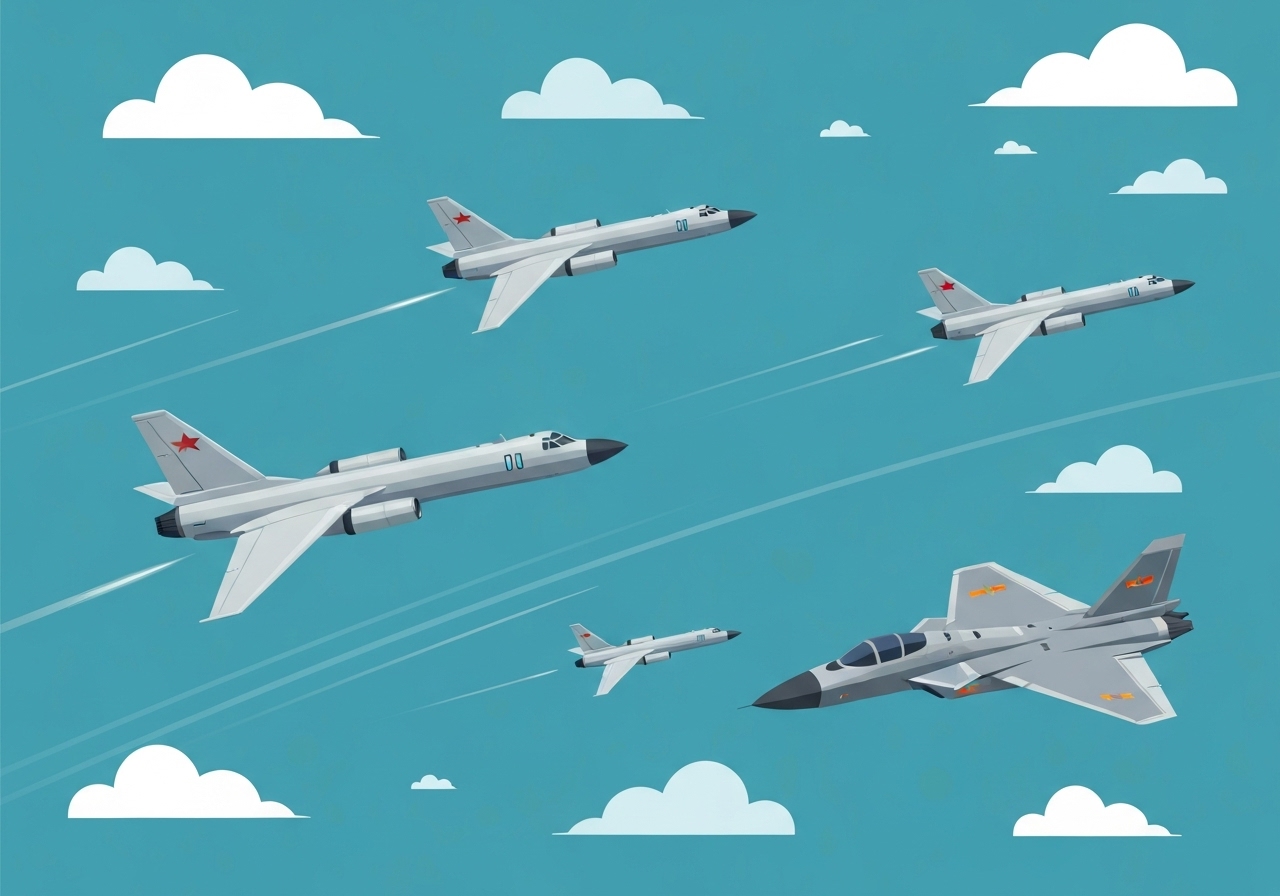
Late Tuesday, Japan scrambled fighter jets after two Russian Tu-95 strategic bombers rendezvoused with two Chinese H-6 bombers and were escorted by Chinese J-16 fighters on a long-distance patrol near Okinawa and Miyako islands. The Japanese Defence Ministry said the aircraft conducted a round-trip between Okinawa and Miyako, with separate Russian activity detected in the Sea of Japan. Tokyo called the operation a serious national security concern and said its jets carried out air defense identification measures. Moscow later described the joint sortie as an eight-hour operation, while Seoul reported related activity entering its air defence identification zone.
Key Takeaways
- Two Russian Tu-95 strategic bombers and two Chinese H-6 bombers conducted a linked mission near Japan on Dec. 9, according to Japan’s Defence Ministry.
- Four Chinese J-16 fighters escorted the bomber pairing on a round trip between Okinawa and Miyako; the Miyako Strait is classed as international waters.
- Japan also detected a Russian A-50 early-warning aircraft and two Su-30 fighters operating in the Sea of Japan at the same time.
- Russian authorities told domestic media the joint flight lasted about eight hours; Japan characterized the operation as a show of force against its territory.
- South Korea reported that seven Russian and two Chinese aircraft entered its air defence identification zone during related activity on Dec. 9.
- Tensions follow a recent Japanese statement by Prime Minister Sanae Takaichi on defending against any Chinese moves on Taiwan that might threaten Japan’s security.
Background
China and Russia have deepened military cooperation in recent years, conducting combined exercises from missile-defence drills on Russian soil to joint live-fire naval maneuvers in the South China Sea. Those operations have been framed publicly as strengthening strategic ties and improving interoperability, while observers view them as a signal to regional rivals. Japan and China have an increasingly fraught relationship centered on maritime rights, airspace incidents and the strategic uncertainty surrounding Taiwan. Tokyo has steadily increased surveillance and patrol missions near disputed areas and reinforced air-defence procedures in response to expanded Chinese and Russian activity.
Geography and international law shape routine encounters: the Miyako Strait, between Okinawa and Miyako islands, is international waters and a key transit route between the East China Sea and the Pacific. Japan maintains an air defence identification zone (ADIZ) and routinely scrambles jets to identify and shadow foreign military aircraft near its periphery. South Korea, sharing proximity to the Sea of Japan and East China Sea, also monitors and sometimes intercepts aircraft entering or approaching its ADIZ, creating overlapping operational areas for regional militaries.
Main Event
According to the Japanese Defence Ministry, two Tu-95 bombers flew from the Sea of Japan toward the East China Sea to meet two H-6 bombers, then conducted a coordinated long-distance flight in Pacific airspace late on Tuesday. Four J-16 fighters joined the formation for the segment between Okinawa and Miyako, while Japanese fighters were dispatched to monitor and enforce identification measures. Separately, Japan reported detecting a Russian A-50 airborne early-warning aircraft accompanied by two Su-30 fighters in the Sea of Japan—activity the ministry said occurred simultaneously.
Japan’s Defence Minister Shinjiro Koizumi posted on X that the operations were “clearly intended as a show of force against our nation,” calling them a serious national security concern and saying Japanese aircraft “strictly implemented air defence identification measures.” Moscow’s state news outlets quoted the Russian Defence Ministry saying the combined sortie lasted eight hours; the ministry characterized it as a routine patrol and bilateral training. South Korea’s military reported seven Russian and two Chinese aircraft entered its ADIZ during the same period, underscoring the wider regional footprint of the operation.
Beijing and Moscow have so far presented the mission as joint training or patrol activity; Beijing disputed recent Japanese claims that Chinese carrier-based fighters aimed radar at Japanese planes a day earlier. Tokyo, however, has framed the sequence of events alongside political statements from Japanese leaders about potential responses to threats to Taiwan, heightening diplomatic sensitivity.
Analysis & Implications
The combined Russian-Chinese sortie increases the frequency and complexity of air operations near Japan, testing Tokyo’s surveillance and response posture. Coordinated missions of long duration and mixed aircraft types—strategic bombers, escorts and early-warning planes—allow both sides to rehearse command-and-control, logistics and cross-domain integration. For Japan, such activity raises concerns not only about immediate airspace breaches but also about the erosion of predictable behavior patterns that underpin regional crisis management.
Strategically, the operation signals closer Russia-China alignment at a time when both face separate frictions with the West and regional states. For Beijing, partnering with Moscow complicates Tokyo’s deterrence calculus and amplifies pressure around Taiwan and maritime claims. For Moscow, the appearance of Russian bombers operating with Chinese assets projects reach and relevance in East Asian security dynamics despite Russia’s commitments elsewhere.
The incident also has alliance implications. Increased Chinese-Russian activity near Japan will likely prompt Tokyo to intensify coordination with the United States and other partners on air policing, intelligence sharing and presence operations. That could produce a security spiral if Tokyo and its allies increase patrols and exercises in response, potentially leading to more frequent intercepts and a higher risk of miscalculation during close encounters.
Comparison & Data
| Aircraft | Reported count | Location |
|---|---|---|
| Tu-95 (Russia) | 2 | Sea of Japan & East China Sea |
| H-6 (China) | 2 | East China Sea / Pacific corridor |
| J-16 (China) | 4 | Between Okinawa and Miyako |
| A-50 (Russia) | 1 | Sea of Japan |
| Su-30 (Russia) | 2 | Sea of Japan |
| Reported aircraft entering ROK ADIZ | 7 Russian, 2 Chinese | Republic of Korea ADIZ |
The table summarizes official counts reported by regional defence ministries and media. While numbers of individual sorties can vary across sources, the pattern of combined strategic-bomber sorties escorted by fighters and early-warning aircraft is consistent with recent Sino-Russian joint operations.
Reactions & Quotes
Tokyo framed the flights as a direct challenge to its security posture and emphasized defensive measures taken by Japan’s Air Self-Defense Force prior to and during the operation.
“These joint operations were clearly intended as a show of force against our nation, which is a serious concern for our national security.”
Shinjiro Koizumi, Japanese Defence Minister (official statement)
Moscow’s defence apparatus described the mission differently, presenting it as routine bilateral training and highlighting its duration.
“The long-distance joint flight lasted approximately eight hours as part of regular patrol activities.”
Russian Defence Ministry (reported by Russian news agencies)
Seoul stressed monitoring and said several Russian and Chinese aircraft entered its ADIZ, prompting close tracking by South Korean forces amid regional coordination challenges.
“Our forces tracked multiple Russian and Chinese aircraft entering the Republic of Korea’s ADIZ and maintained surveillance to ensure safety and sovereignty.”
Republic of Korea military (official statement)
Unconfirmed
- Whether the joint sortie had specific targeting orders aimed at influencing Japanese decision-making beyond signaling remains unconfirmed by independent sources.
- Claims that Chinese carrier-based fighters aimed radar at Japanese aircraft the day before are disputed by Beijing and not independently verified in open-source reporting.
- The extent of real-time operational command integration between Russian and Chinese forces during the flight—beyond deconflicted routing and timing—has not been publicly confirmed.
Bottom Line
The Dec. 9 joint flight by Russian and Chinese aircraft near Japan represents a notable escalation in visible military cooperation in East Asia and a direct test of Japan’s air surveillance and response systems. The mix of strategic bombers, escorts and an early-warning plane demonstrates an integrated mission profile that complicates regional monitoring and raises the stakes for intercept procedures.
For Tokyo and its partners, the immediate priorities will be sustaining robust surveillance, improving real-time information sharing with allies and calibrating responses to avoid miscalculation. Over the coming months, expect more frequent Sino-Russian combined operations and heightened diplomatic friction unless confidence-building measures or clearer operational norms are negotiated.
Sources
- CNN (international news report summarizing regional coverage)
- Reuters (international news agency reporting on Japanese Defence Ministry statements)
- Japanese Defence Ministry (official)
- Russian Ministry of Defence (official)
- Republic of Korea Ministry of National Defense (official)