
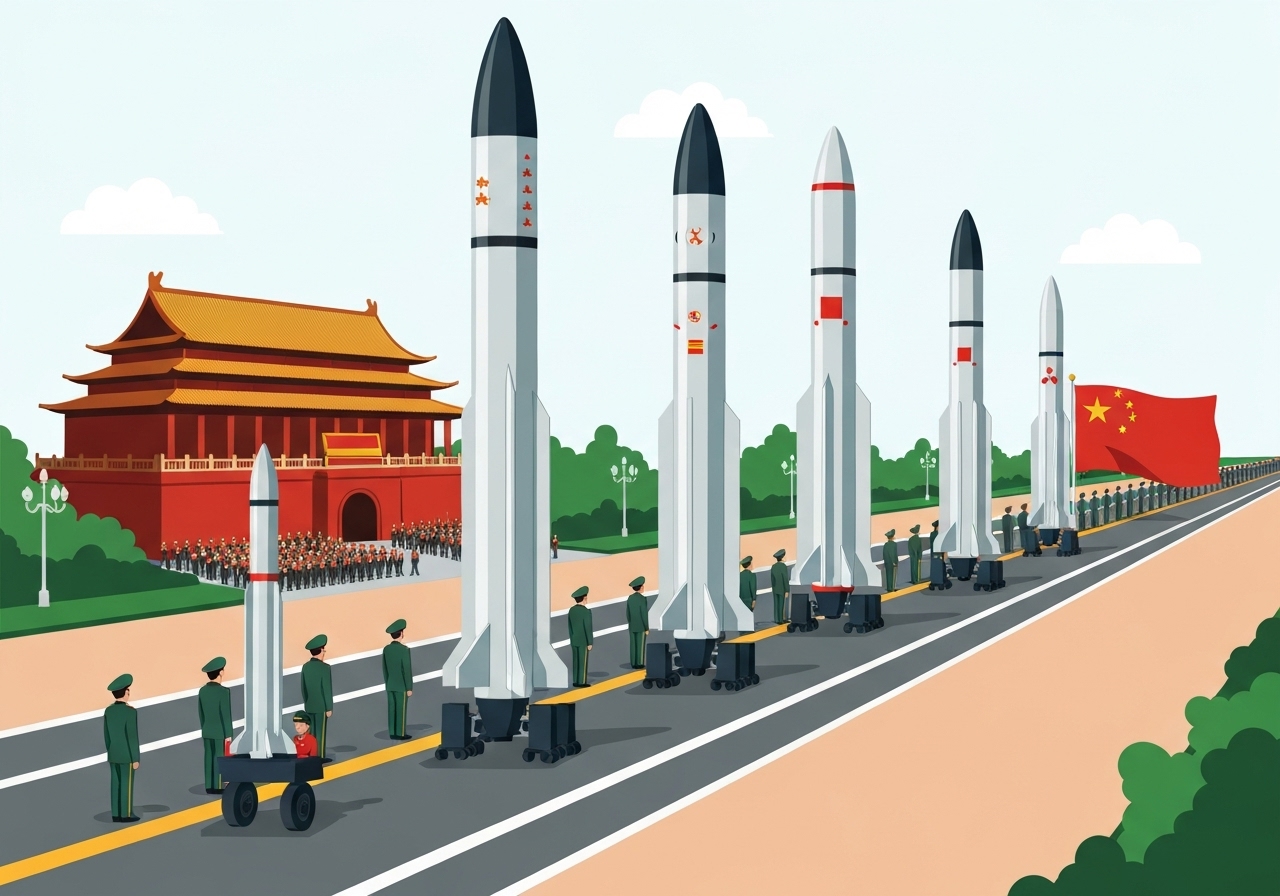
Who: China; When: Sept. 3, 2025; Where: Beijing World War II anniversary parade; What: two new large intercontinental ballistic missile (ICBM) designs — DF-5C and DF-61 — were publicly displayed; Result: the show reinforced U.S. estimates that Beijing is rapidly enlarging its nuclear forces toward roughly 1,000 warheads by 2030.
Key Takeaways
- Beijing rolled out the DF-5C and DF-61 ICBM designs during the Sept. 3 parade in central Beijing.
- The parade included air-launched, sea-launched and ground-based nuclear-capable systems on public display.
- The DF-5C is identified as a liquid-fueled intercontinental missile in parade materials.
- The U.S. Pentagon estimates China’s warhead stockpile could reach about 1,000 by 2030.
- The public display is intended to signal military modernization and strategic deterrence priorities.
- Open-source analysts note that parade displays do not necessarily indicate immediate operational deployment.
Verified Facts
On Sept. 3, 2025, state-organized parade units moved a variety of strategic systems through Beijing to mark the World War II anniversary. Parade footage and official coverage showed large road-mobile and road-launched platforms carrying missiles labeled DF-5C and DF-61; the DF-5C was described in parade captions as a liquid-fueled intercontinental strategic missile.
The public presentation included examples of systems that are air-launched, sea-launched and ground-based, indicating a cross-domain emphasis in China’s strategic forces. Those categories were visible in the procession and in state media descriptions of the event.
U.S. defense officials have repeatedly warned that China is expanding its nuclear capacity. A Pentagon estimate cited last year projects China’s warhead total could approach 1,000 by 2030, a projection referenced by analysts assessing the parade’s significance. (See sources below for links to the Pentagon estimate and coverage.)
| Missile | Type (as shown) |
|---|---|
| DF-5C | Liquid-fueled intercontinental ballistic missile (ICBM) |
| DF-61 | New large ICBM design (parade display) |
Context & Impact
The visible parade display serves both domestic and international messaging purposes. Domestically, it reinforces narratives of military modernization and national strength for Chinese audiences. Internationally, it signals Beijing’s intent to continue enlarging and diversifying its strategic forces.
Analysts say the combination of new large ICBM designs and other strategic platforms could complicate regional stability and arms control debates. An increase toward the Pentagon’s projected warhead count would alter force balances and increase pressure on diplomatic forums addressing nuclear arms transparency and restraint.
Policy implications include potential responses by regional states and the United States, ranging from diplomatic protests and calls for clarification to adjustments in missile defense posture and extended deterrence planning. The display also renews interest in arms control confidence-building measures and verification tools.
Official Statements
The Chinese parade was presented as a demonstration of modernized forces and historical remembrance.
Chinese state media
The Pentagon has noted China’s rapid nuclear expansion and published estimates of future warhead totals.
U.S. Department of Defense
Unconfirmed
- Precise operational status and warhead counts attached to the DF-5C and DF-61 units on display.
- Whether the new designs will be deployed immediately, phased into service, or used primarily for strategic signaling.
- Specific timelines for the manufacture and fielding of additional warheads beyond public estimates.
Bottom Line
The Sept. 3 Beijing parade openly showcased two large ICBM designs and a broad mix of strategic systems, reinforcing assessments that China is accelerating nuclear-capacity growth. While parade displays are a clear signal of intent, independent confirmation of deployment timelines and exact stockpiles remains limited; the development nonetheless raises strategic and policy questions for regional security and arms control.