
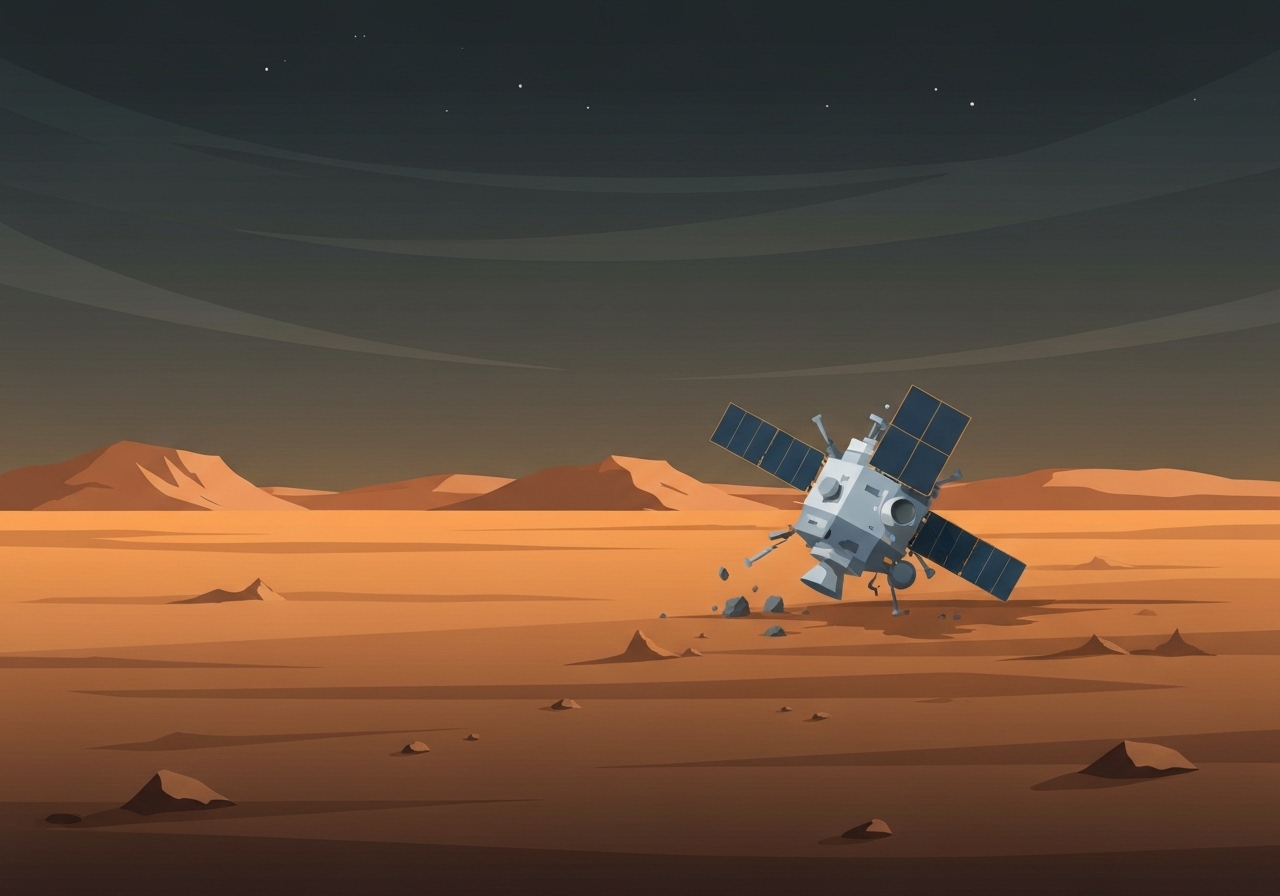
On Dec. 6, 2025, NASA lost radio contact with the MAVEN orbiter while it passed behind Mars; when the spacecraft reappeared from occultation, ground teams could not reestablish a link. The agency announced on Dec. 9 that engineers are actively searching for any signal and investigating the communications anomaly. MAVEN has been in Mars orbit since September 2014 and plays both a science role—studying the upper atmosphere and atmospheric escape—and an operational role as a UHF relay for surface rovers. The interruption raises immediate concerns for ongoing science measurements and for data relay services used by surface missions.
Key Takeaways
- MAVEN lost contact on 6 December 2025 during a routine occultation behind Mars and failed to reconnect when it re-emerged.
- NASA made the loss public on 9 December 2025 and described the event as an anomaly under active investigation.
- MAVEN arrived at Mars in September 2014 after a 2013 launch and has operated for over 11 years, returning atmospheric and space-weather data.
- The orbiter is one of seven active spacecraft observing Mars and also serves as a UHF relay for the Curiosity and Perseverance rovers.
- Key scientific contributions from MAVEN include measurements of atmospheric escape, mapping Martian winds, identifying a magnetic tail and observing proton aurora and sputtering processes.
- All systems were reported to be nominal before occultation, indicating the loss was abrupt rather than preceded by gradual degradation.
- Loss of MAVEN’s communications could temporarily hamper relay capacity and some atmospheric monitoring, pending recovery or mitigation steps.
Background
MAVEN (Mars Atmosphere and Volatile Evolution) launched from Earth in 2013 and entered Martian orbit in September 2014 with a primary mission to measure the composition, structure and dynamics of Mars’s upper atmosphere and ionosphere. The mission has aimed to quantify current rates and mechanisms of atmospheric loss to help explain how Mars transformed from a wetter, warmer world to the cold, dry planet observed today. MAVEN’s instruments observe solar-wind interactions and the processes that strip light gases from the atmosphere.
Beyond pure science, MAVEN carries a UHF radio used in NASA’s Mars relay network to receive data from surface assets such as Curiosity (active since 2012) and Perseverance (landed 2021). Over its mission life MAVEN has provided data that informs climate and evolution models and has supported operations for landed missions, making it both scientifically and operationally valuable. The spacecraft has routinely performed occultation passes behind Mars as part of its orbit; these natural blocking events are standard and normally present no communications risk when handled by the operations team.
Main Event
According to NASA statements, MAVEN’s telemetry indicated nominal system performance leading into the occultation on 6 December 2025. During the expected behind‑Mars pass ground teams lost contact, and when the orbiter should have come back into view controllers were unable to establish the scheduled downlink. The gap was noticed immediately and triggered standard anomaly procedures.
By 9 December 2025 NASA publicly confirmed the outage and said engineers were attempting to locate any signal from the spacecraft and to reconstruct events preceding the loss. Ground teams are analyzing pre‑occultation telemetry, orbit and timing data and command logs to determine whether the problem originated in orbit, with onboard hardware or software, or in the ground segment. Early public updates emphasize active investigation but give no definitive root cause.
Because MAVEN is in a near‑polar orbit that regularly traverses Mars’ nightside and dayside, controllers can schedule multiple communication opportunities; that scheduling guides how quickly attempts to recontact can be made. In parallel to signal search, teams will evaluate whether mission plans or relay assignments for surface rovers must be adjusted if the outage persists. Contingency options include reassigning relay duties to other orbiters and switching some science observations to peer spacecraft.
Analysis & Implications
Operationally, MAVEN’s sudden loss underscores how dependent Mars surface operations are on a multi‑vehicle relay architecture. NASA currently counts seven active orbiters at Mars; losing one relay node increases the load on remaining spacecraft and may force temporary reductions in bandwidth for rover telemetry and science downlinks. In the near term, priority traffic—telemetry needed for rover health and critical science packets—would be scheduled first, while lower‑priority transfers could be delayed.
Scientifically, MAVEN has delivered unique upper‑atmosphere and solar‑wind interaction measurements for over a decade. Interruptions in that data stream would create gaps in long‑baseline observations of atmospheric escape rates and of transient events such as dust storms that loft water vapor high enough to be lost to space. Those gaps would slow progress on models that reconstruct Mars’ climatic evolution and could limit near‑term studies of space weather impacts on planetary atmospheres.
From an engineering and programmatic perspective, investigators will be looking for lessons that can be applied to other long‑duration missions: whether the anomaly stems from hardware aging, radiation effects, software faults, or procedural issues in ground operations. Identifying a root cause will inform redundancy planning, command sequencing, and fault detection strategies for both orbiters and future interplanetary assets. If recovery requires a software patch or an atypical command sequence, engineers may be able to restore service; if hardware failure is the culprit, the mission might enter permanent loss.
Comparison & Data
| Orbiter | Launch / Arrival | Primary Role | Status (Dec 2025) |
|---|---|---|---|
| MAVEN | 2013 / Sep 2014 | Upper atmosphere science, UHF relay | Communications anomaly |
| Mars Reconnaissance Orbiter (MRO) | 2005 / 2006 | Imaging, relay | Active |
| Mars Odyssey | 2001 / 2001 | Mapping, relay | Active |
| Mars Express | 2003 / 2003 | European science platform | Active |
| Trace Gas Orbiter (TGO) | 2016 / 2016 | Atmospheric composition, relay | Active |
| Mars Orbiter Mission (MOM) | 2013 / 2014 | Technology demonstrator, observation | Active |
| Hope (Emirates Mars Mission) | 2020 / 2021 | Atmospheric dynamics | Active |
The table places MAVEN among six other long‑lived orbiters that together form Mars’ current observational and relay network. If MAVEN remains offline for an extended period, the other orbiters contain the capacity to absorb much of its relay traffic, but some scheduling tradeoffs and temporary science impacts are likely. Historical longevity of these platforms—some operating for well over a decade—also shows that mission teams frequently manage spacecraft through aging and anomalies, though recovery is not guaranteed.
Reactions & Quotes
NASA issued a concise public statement describing ongoing investigation efforts and indicating the operations team is working the anomaly.
“The spacecraft and operations teams are investigating the anomaly to address the situation.”
NASA (official statement)
Media coverage and mission pages emphasized that MAVEN was operating normally prior to the pass and highlighted the orbiter’s decade of scientific results.
“All systems had been working normally before MAVEN passed behind Mars.”
ScienceAlert (media report)
Unconfirmed
- No official cause has been confirmed; it is unclear whether the anomaly stems from onboard hardware failure, software fault, or a ground‑segment issue.
- There is no public confirmation that the spacecraft entered a safe or fault-protected mode after loss of contact.
- Reports have not yet confirmed the extent to which MAVEN’s outage has affected scheduled relay windows for Curiosity and Perseverance.
Bottom Line
MAVEN’s unexpected loss of contact on 6 December 2025 represents both a technical and programmatic challenge: technically, because engineers must locate and diagnose a sudden communications failure; programmatically, because the spacecraft provides unique scientific measurements and essential relay services. NASA’s public updates through 9 December 2025 stress active investigation but stop short of a root‑cause explanation, leaving the outcome open to a range of possibilities from recoverable software/state faults to permanent hardware loss.
In the short term, mission teams and the broader Mars community will prioritize keeping surface assets operational by reallocating relay tasks among the remaining orbiters and adjusting science priorities as needed. Over the longer term, this event will likely feed into lessons learned about redundancy, aging hardware, and fault management for long‑duration interplanetary missions.
Sources
- ScienceAlert (news media report summarizing NASA statements)
- NASA MAVEN mission page (official mission/agency site)