
Lead
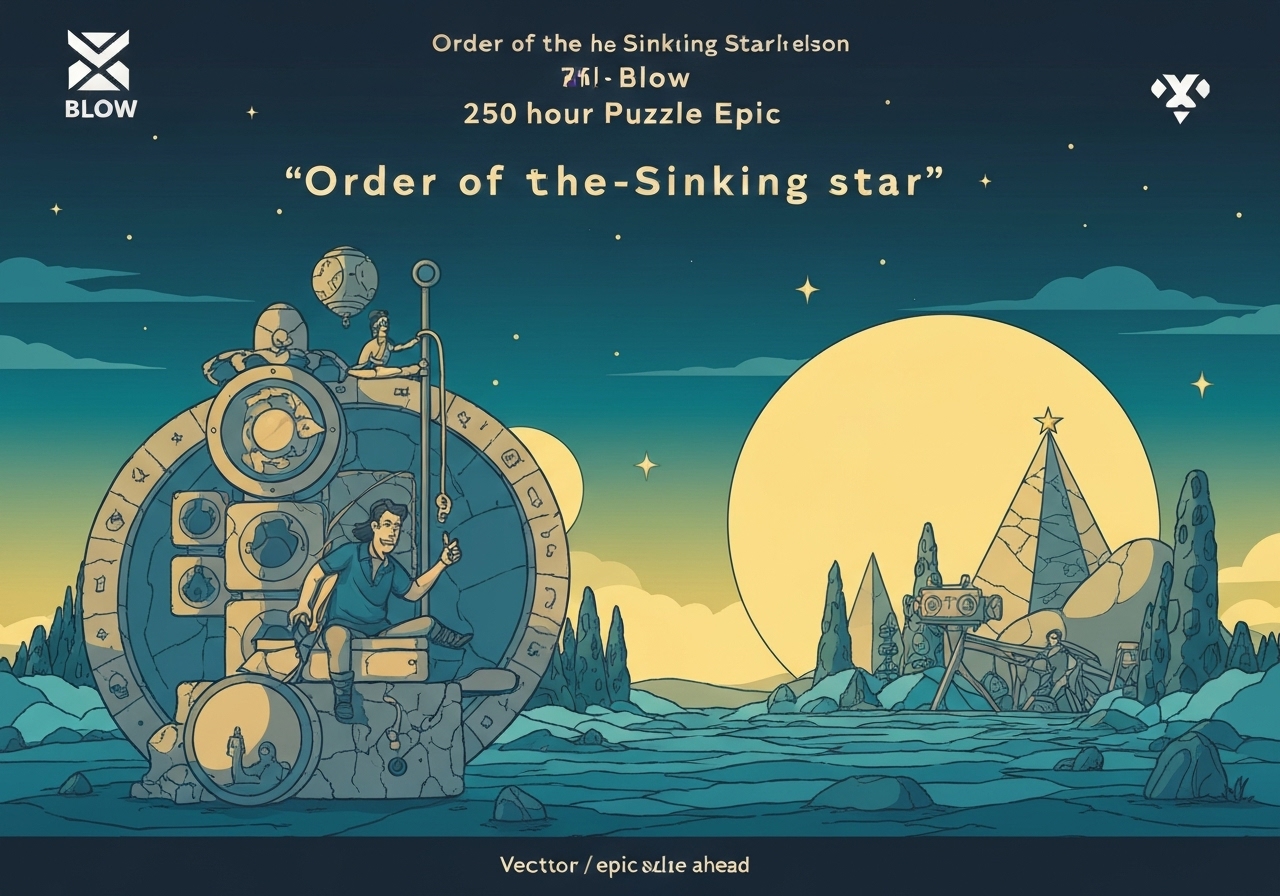
Jonathan Blow, the designer behind Braid and The Witness, revealed a new puzzle game, Order of the Sinking Star, during The Game Awards 2025. The isometric, grid‑based title promises roughly 1,000 discrete puzzles and an estimated 250 hours of playtime for a typical run (up to 500 hours for completionists). The game layers multiple movement and interaction mechanics across a branching overworld and is being built by a larger team than Blow’s prior projects. Blow also said the project will showcase a proprietary engine and language that he plans to release as open source after launch.
Key Takeaways
- Announcement: Order of the Sinking Star revealed at The Game Awards 2025 by Jonathan Blow.
- Scope: Developer estimates ~1,000 individual puzzles and about 250 hours to complete; completionists may spend 500 hours.
- Design: Grid‑based isometric puzzles in a branching overworld that unlocks new regions as players solve rooms.
- Mechanics: Characters have distinct interactions (e.g., a thief who pulls objects, a wizard who swaps places with objects in line‑of‑sight).
- Complexity: Puzzles stack mechanics — mirrors teleport objects based on distance, hostile adjacent enemies, beams that phase through walls, and clone control via mirrors.
- Tools: Rewind feature returns players to earlier steps to encourage experimentation rather than full restarts.
- Technology: Built on a new proprietary engine and programming language, intended to be open‑sourced shortly after release.
- Release window: Targeted for 2026 on PC, other platforms to follow at an unspecified later date.
Background
Jonathan Blow first gained broad recognition with Braid (2008) and more widely with The Witness (2016), both titles known for conceptual puzzle design and minimal hand‑holding. Those games established Blow’s approach of teaching players through carefully staged encounters rather than explicit tutorials; Order of the Sinking Star continues that lineage while expanding scale and team size. Puzzle design has diversified since 2016, with recent experiments such as roguelike deckbuilding hybrids showing new directions for the genre.
Blow has described this project as more ambitious on paper than his previous work, citing both an expanded team and a bespoke engine and language. The decision to open‑source the engine after release echoes broader industry debates over tools, modding, and community development. At the same time, the sheer size—1,000 puzzles and hundreds of hours—raises both design and accessibility questions that the team will need to address.
Main Event
The demo shown at The Game Awards presented a grid‑based, isometric adventure built around rooms that act as standalone puzzles embedded in a larger overworld. Early puzzles act as micro‑tutorials: simple block‑pushing mazes introduce character roles like the thief (who pulls objects) and the wizard (who swaps positions with objects in his line of sight). The game teaches mechanics by example rather than text, letting players infer rules from short, contained challenges.
As the demo progressed, designers layered mechanics to create compound problem spaces. Examples shown include mirrors that teleport a character or object across a gap equal to the mirror’s distance, enemies that kill if you move to adjacent squares, and energy beams that allow phasing through walls. Rooms grow in size and complexity, frequently requiring players to plan multiple moves ahead and to combine character abilities in sequence.
One room chained character‑switching gates with object manipulation: the wizard’s swap rule could trap him behind a locked gate unless another character pulled a block into position from across the map. Another puzzle used mirror chains to create simultaneous clones, forcing players to coordinate multiple avatars at once. The overworld is non‑linear: players can head in cardinal directions to attempt connected clusters of puzzles, and completing certain puzzles opens new map sections.
Analysis & Implications
Scale is the defining variable for Order of the Sinking Star. A thousand puzzles and an average playtime of 250 hours make this project atypically large for a studio known for tightly authored experiences. That breadth gives players freedom to approach content in many sequences, but it also elevates the challenge of sustaining a coherent learning curve across an expansive map. Blow and the team appear aware of this tension and are weighing gentle guidance mechanics.
Gameplay complexity builds from combinatorics: distinct character rules multiplied by environmental interactions can produce a very high solution space. The rewind tool mitigates frustration by enabling iterative exploration rather than repeated restarts; however, player retention could hinge on how well the game preserves and signals prior knowledge after long breaks. Visual cues in room design—intended to be instructive—will become critical for both onboarding and long‑term comprehension.
On a broader level, the plan to open‑source the game engine and language could have lasting effects if the tools are accessible to creators. Making the engine public may encourage modding, academic analysis of puzzle design, or community‑built levels, expanding the title’s lifespan. Conversely, releasing tooling raises questions about support, documentation, and community governance that the team will need to address post‑launch.
Comparison & Data
| Title | Approx. Playtime | Notable Puzzle Count |
|---|---|---|
| Braid (Blow) | ~6–10 hours | Dozens |
| The Witness (Blow) | ~20–50 hours | ~650 puzzles (varied) |
| Order of the Sinking Star | ~250 hours (typical), up to 500 | ~1,000 puzzles (developer estimate) |
The table contextualizes how Order of the Sinking Star scales relative to Blow’s prior work: it is an order(s) of magnitude larger by both time and stated puzzle count. That places it closer in ambition to long‑form RPGs in terms of sheer hours, while retaining puzzle‑centered design. The comparison highlights the logistical and design demands of delivering consistent quality across a far larger content base.
Reactions & Quotes
IGN’s coverage and the demo emphasized both the inventive mechanical combinations and the potential for players to feel overwhelmed by a sprawling map. The reception among observers at the reveal mixed admiration for the design ambition with caution about accessibility.
“We’re aiming to offer around 1,000 puzzles and a playtime near 250 hours for a typical run,”
Jonathan Blow, game director (The Game Awards 2025 reveal)
Blow also spoke to guidance—he’s considering hint systems or limited nudges but is cautious about creating a crutch. The design leans on environmental cues to teach rules implicitly.
“We want the rooms themselves to teach you, but we’re discussing subtle hints to help players who get stuck,”
Jonathan Blow, post‑reveal comment
Hands‑on impressions highlighted the rewind tool and the satisfaction of solving multi‑layer puzzles; players noted both the elegance of emergent solutions and concern that the overworld’s scale may intimidate some audiences.
“The layering of mechanics makes for gratifying solutions, but the map can feel overwhelming at a glance,”
IGN hands‑on reporter
Unconfirmed
- Exact platforms beyond PC and their release windows are not yet confirmed; console and other platform timing remains unspecified.
- Details of the open‑source license, documentation, and timeline for the engine and language release are still to be announced.
Bottom Line
Order of the Sinking Star is an ambitious expansion of Jonathan Blow’s puzzle design philosophy, marrying the teach‑by‑example approach of his earlier games with a dramatically larger scope. The combination of distinct character rules, layered environmental mechanics, and a branching overworld promises deep, emergent puzzle experiences for players who enjoy multi‑step planning and systems thinking.
At the same time, the game’s scale is its central risk: designers must balance player guidance, retention of learned mechanics, and map readability to prevent frustration. How Blow’s team implements optional hints, visual cues, and save/progression clarity will likely determine whether the project feels inviting or intimidating to a broad audience.
For now, the key facts are clear: announced at The Game Awards 2025, ~1,000 puzzles, ~250 hours typical playtime, targeted for PC in 2026, and an engine that Blow intends to open‑source after launch. Further details—platform timing, tooling license, and final scope—remain to be confirmed as the team moves toward release.