
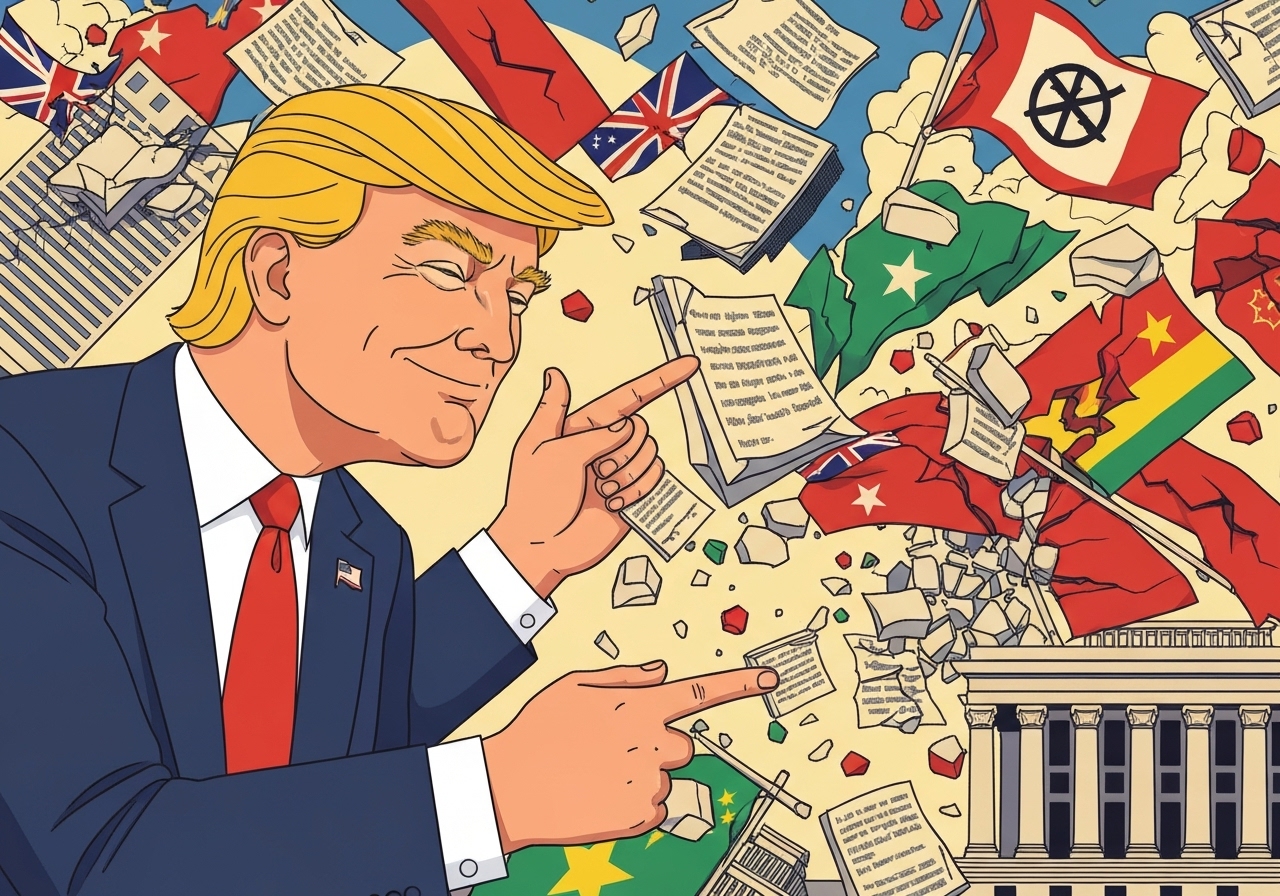
President Donald Trump has publicly promoted a string of diplomatic achievements in recent months, claiming to have helped resolve eight international disputes in eight months while accepting the FIFA Peace Prize on Dec. 5, 2025 in Washington, D.C. Some agreements have held, but several have weakened or collapsed, and analysts say the president’s role and the durability of the outcomes are often disputed. Experts distinguish short-term ceasefires and publicity-driven signings from durable peace processes that address root causes. The mixed record has raised questions about whether headline ceremonies and medals reflect lasting stability on the ground.
Key Takeaways
- Trump has repeatedly claimed credit for resolving eight conflicts within eight months; those claims are widely reported but contested by analysts and some foreign leaders.
- The president accepted the inaugural FIFA Peace Prize at the World Cup 2026 draw on Dec. 5, 2025 in Washington, D.C., receiving a gold medal for his peace efforts.
- Several agreements cited by the administration—such as a Cambodia–Thailand accord in late October 2025 and a Rwanda–DRC signing in December 2025—saw fighting resume even after ceremonies.
- Serbia and Kosovo’s normalization accord from 2020, reached during Trump’s first term, remains among the more durable outcomes cited by observers.
- Critics say many of the announced deals are ceasefires or initial frameworks, not comprehensive settlements addressing underlying disputes (experts emphasize the difference).
- Claims that the U.S. military struck Iranian nuclear sites and that Mr. Trump brokered an Israel–Iran agreement are reported in some accounts but remain contested and context-dependent.
- India–Pakistan tensions featured in administration statements; Prime Minister Narendra Modi publicly disputed U.S. claims of a brokered settlement, and subsequent U.S.–India trade measures drew criticism.
Background
President Trump has sought international acclaim for a high-profile string of agreements and pauses to hostilities, linking public ceremonies and awards to a narrative of peacemaking. The administration frames these actions as pragmatic interventions that produce rapid results and public commitments. That approach contrasts with conventional diplomacy, which typically emphasizes protracted negotiations, confidence-building measures and multilateral verification.
Many of the referenced disputes are long-running and multilayered: territorial claims years in the making (e.g., Thailand–Cambodia), complex regional rivalries (Rwanda–DRC), and protracted conflicts with deep political and societal roots (Israel–Gaza). Some earlier moves from the Trump administration, notably normalization between Israel and several Arab states in his first term, are widely acknowledged as significant, but observers caution that recognition and trade opening do not erase deeper regional frictions.
Main Event
The December 2025 ceremony in Washington, where Mr. Trump accepted the FIFA Peace Prize, came amid a flurry of announcements touting diplomatic progress. Administration statements credited the White House with facilitating agreements that ranged from ceasefires to normalization pacts. At times, signing ceremonies were staged in Washington with broad media coverage and photographed handshakes; at others, accords were announced with limited disclosure of verification and implementation mechanisms.
In several cases, the optimism of those events proved short-lived. The Kuala Lumpur-brokered Thailand–Cambodia accord, hailed in late October 2025 as a breakthrough, was followed by renewed skirmishes about a month later and again weeks afterward. In central Africa, a deal between Rwanda and the Democratic Republic of the Congo that was reached over the summer was not formally signed until December; fighting reportedly continued even as leaders met for a signing ceremony in Washington.
On the Middle East front, administration briefings highlighted a Gaza ceasefire and the release of Israeli hostages as major accomplishments. Officials framed those results as steps forward, but low-level violence and absence of a comprehensive political settlement left the broader Israeli–Palestinian question unresolved. Separate reporting attributed to the administration suggested U.S. involvement in escalating pressure on Iran, including claims of strikes on nuclear sites, followed by diplomatic moves toward a separate Israel–Iran understanding—claims that have prompted debate about causality and verification.
Analysis & Implications
Experts say that signing ceremonies and public declarations can produce immediate political benefits—domestically and for mediators’ reputations—but they do not substitute for the slow work of reconciliation. Durable peace typically requires addressing territorial disputes, governance, economic drivers, and accountability for past wrongs. A high-profile signature without monitoring, dispute-resolution mechanisms and local buy-in leaves accords vulnerable to reversal.
Many analysts draw a sharp line between ceasefires and comprehensive peace agreements. Ceasefires halt active combat, often temporarily; peace agreements usually create frameworks for political settlement, security guarantees and economic cooperation. Observers caution that treating ceasefires as final peace can create strategic illusions, encouraging premature celebration and exposing populations to renewed violence.
The U.S. strategy of orchestrating public deals risks straining relations with partners if credit or sequencing is disputed. For example, India’s leadership publicly rejected U.S. claims about a breakthrough with Pakistan, and a subsequent move by the U.S. to impose steep tariffs on imports from India heightened tensions between the two governments. Such friction can complicate follow-through and damage long-term diplomatic leverage.
Comparison & Data
| Agreement | Announced | Short-term Status |
|---|---|---|
| Serbia–Kosovo | 2020 | Relatively stable |
| Thailand–Cambodia (Kuala Lumpur Accord) | Late Oct. 2025 | Fighting recurred within weeks |
| Rwanda–DRC | Summer 2025 (signed Dec. 2025) | Clashes continued during signing |
| Gaza hostage exchange/ceasefire | 2025 | Hostages released; low-level fighting persists |
The snapshot above shows variation in durability: older deals with sustained international backing tend to persist longer, while more recent, high-profile signings without layered implementation efforts have been more fragile. Durable outcomes typically include third-party verification, phased withdrawals or demobilization plans, and channels for dispute resolution.
Reactions & Quotes
“President Trump trumpets every one of these deals as being essentially peace in our time, but they were all overhyped and oversold,”
Max Boot, Council on Foreign Relations (senior fellow)
Boot’s critique centers on the distinction between temporary ceasefires and comprehensive settlements, arguing that publicity can mask the absence of durable mechanisms.
“That takes painstaking diplomacy, hard work and a lot of time,”
Ivo Daalder, Belfer Center (former U.S. ambassador to NATO)
Daalder warns that signing a document in Washington rarely resolves entrenched disputes without extended follow-through and incremental trust-building measures.
“His unique style sometimes produces unexpected results, essentially declaring victory before it’s achieved,”
Matthew Kroenig, Atlantic Council (Scowcroft Center)
Kroenig notes that unconventional approaches can force other actors to act, producing short-term movement, but he also stresses gaps between announcements and durable settlement.
Unconfirmed
- Claims that U.S. strikes on Iranian nuclear facilities directly produced a bilateral Israel–Iran agreement are reported in some accounts but lack independent, verifiable confirmation in public records.
- Attributions of full responsibility to the Trump administration for resolving India–Pakistan tensions are contested; Prime Minister Narendra Modi publicly disputed U.S. claims about a brokered settlement.
- Some media and administration statements credit Trump with brokering eight completed peace deals in eight months; the precise extent of U.S. mediation and the durability of each deal vary and remain debated.
Bottom Line
The Trump administration’s recent diplomatic push has produced headline-grabbing signings, awards and short-term pauses in violence. However, independent analysts and several subsequent flare-ups show that many of these outcomes are fragile and contingent. Public ceremonies can cement momentary agreements, but without verification, implementation plans and local ownership, they risk unravelling.
For policymakers and observers, the key test will be follow-through: whether the parties implement agreed steps, whether neutral monitors are allowed to verify compliance, and whether economic and political incentives align to make peace preferable to renewed conflict. Until those conditions are met, many of the announced achievements remain provisional.
Sources
- NPR (news report)
- Council on Foreign Relations (think tank; Max Boot affiliation)
- Belfer Center, Harvard Kennedy School (research institution; Ivo Daalder affiliation)
- Atlantic Council (think tank; Matthew Kroenig affiliation)
- FIFA (governing body; FIFA Peace Prize announcement)