
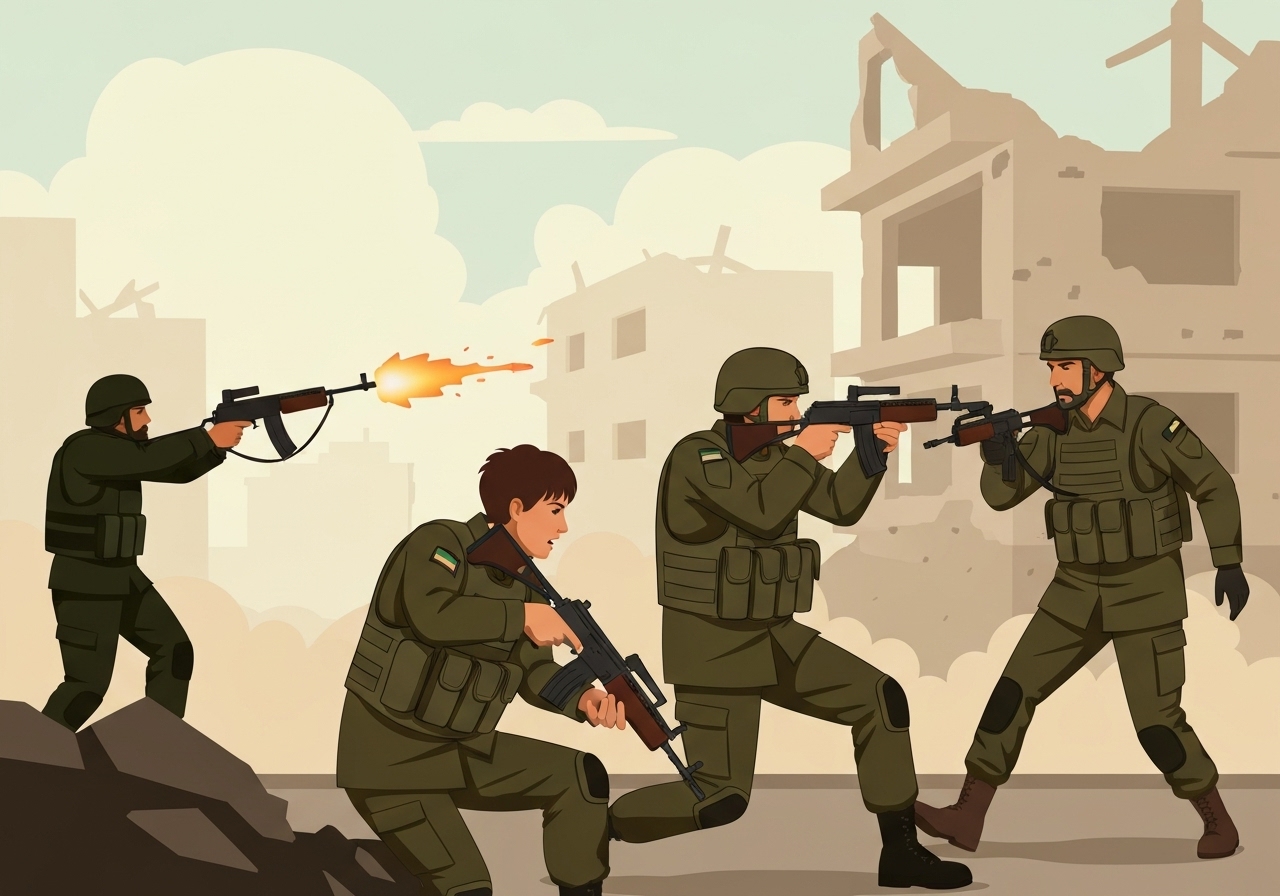
US soldiers, civilian interpreter killed during ambush in Syria by apparent ISIS gunman
Lead: On December 13, 2025, two U.S. servicemembers and a U.S. civilian interpreter were killed near Palmyra, Syria, after an ambush that U.S. officials say was likely carried out by an Islamic State gunman. The attackers engaged the small U.S. element while it was conducting a key leader engagement in support of ongoing counter-ISIS operations. Three other service members were wounded in the incident; Pentagon officials said two of the wounded were American. Defense Secretary Pete Hegseth said partner forces killed the gunman during a follow-up skirmish.
Key takeaways
- Casualties: Two U.S. soldiers and one U.S. civilian interpreter were killed on December 13, 2025, near Palmyra (Tadmur), Syria.
- Wounded: Three additional service members were injured; two of the wounded were confirmed to be American by two U.S. officials.
- Perpetrator: Initial U.S. assessments characterize the attacker as an apparent ISIS gunman; the shooter was later killed by partner forces, according to Defense Secretary Pete Hegseth.
- Mission context: The unit was carrying out a key leader engagement tied to counter-ISIS/counter-terrorism operations at the time of the attack.
- Territorial note: A Pentagon official said the incident occurred in an area outside the Syrian president’s control.
- Historical marker: These are the first combat fatalities in Syria for U.S. forces since 2019, when four Americans died in a suicide bombing in Manbij.
- U.S. Syria toll: Prior to December 13, 2025, U.S. military deaths in Syria totaled 10 (a mix of hostile and non-hostile); the most recent prior U.S. death there was a non-hostile fatality in February 2022.
Background
U.S. forces have maintained a limited, irregular footprint in northeastern and central Syria since the 2014–2019 campaign against the Islamic State, operating alongside local partner units to advise and assist counter-ISIS activities. Those operations have focused on intelligence sharing, training, and targeted missions intended to prevent a resurgent ISIS from reorganizing. The security environment across central Syria remains fractured: state control is uneven, and multiple armed groups—local militias, remnants of extremist organizations, and foreign-backed forces—operate in overlapping areas.
From 2019 through early 2025, U.S. presence in Syria was primarily advisory with occasional kinetic actions against identified ISIS targets; the deadliest recent hostile incident was the 2019 suicide bombing in Manbij. U.S. officials have cited a continued need to deter ISIS remnants while minimizing U.S. exposure. Local partner forces—frequently Kurdish-led or tribal coalitions backed by U.S. intelligence and logistics—handle much of the direct ground engagement and force protection in the region.
Main event
U.S. officials said the ambush unfolded on December 13 near Palmyra, a central Syrian city known in Arabic as Tadmur, as a small U.S. detachment met with local leaders. The unit came under sudden small-arms fire from an assailant who, based on initial indicators, was aligned with ISIS. The engagement lasted only minutes but resulted in multiple American casualties and the death of the civilian interpreter who was accompanying the team.
Three other service members sustained injuries in the attack; Pentagon spokesman Sean Parnell confirmed the wounded were evacuated and receiving treatment, and two U.S. officials told ABC News they were American. Defense Secretary Pete Hegseth said partner forces engaged and killed the shooter in a subsequent skirmish. The U.S. military is conducting casualty notifications; the names of the killed are being withheld pending next-of-kin notification.
A Pentagon official told reporters the strike occurred in territory not controlled by Syrian President Bashar al-Assad, underscoring persistent gaps in local governance and security. U.S. commanders are reviewing force-protection measures and the circumstances of the engagement, and the incident has prompted a fresh security assessment of U.S. activities across Syria.
Analysis & implications
The deaths mark a notable escalation in risk for U.S. personnel operating in Syria and will likely prompt a re-evaluation of the scale and visibility of advisory missions. Politically, the incident arrives early in the current U.S. presidential term and could pressure policymakers to clarify the limits and public justification of American involvement in Syria. Operationally, commanders must balance the need to maintain pressure on ISIS remnants with the heightened force-protection concerns after these combat fatalities.
Regionally, the attack highlights continuing volatility in central Syria, where multiple power centers and armed groups create opportunities for extremist actors to strike. Partner forces were credited with neutralizing the gunman, illustrating both the utility and the limitations of relying on local forces: they can respond rapidly, but their presence also signals a permissive nearby environment in which attackers operate.
For U.S. counterterrorism objectives, the loss of personnel may slow or complicate planned engagements and intelligence-gathering. Allies and regional partners will watch the U.S. response for signs of either increased direct action or a pivot toward alternative, lower-profile approaches—such as enhanced remote surveillance and reliance on partners for ground operations.
Comparison & data
| Year/event | U.S. deaths in Syria (select) | Notes |
|---|---|---|
| 2019 (Manbij) | 4 | Suicide bombing; hostile |
| 2022 | 1 | Most recent prior U.S. death was non-hostile (Feb 2022) |
| Prior to Dec 13, 2025 | 10 | Aggregate hostile and non-hostile deaths |
| Dec 13, 2025 | 3 | Two soldiers and one civilian interpreter killed |
| Total to date (approx.) | 13 | Includes prior 10 plus three fatalities on Dec 13, 2025 |
The table summarizes publicly reported U.S. fatalities in Syria referenced by Pentagon and media statements. Those counts mix hostile and non-hostile incidents and reflect the long-tail risk of operations in fractured territories where ISIS and other violent actors remain active.
Reactions & quotes
U.S. defense officials issued brief statements while casualty notifications were underway and investigations began.
“Partner forces engaged and killed the attacker after the incident,”
Defense Secretary Pete Hegseth (statement)
Defense officials emphasized the role of allied and partner units in the immediate tactical response and said details would be released after next-of-kin notifications and an initial inquiry.
“The attack occurred as the soldiers were conducting a key leader engagement in support of on-going counter-ISIS / counter-terrorism operations in the region,”
Pentagon spokesman Sean Parnell (press release)
Pentagon spokespeople added that a preliminary assessment attributes the attack to an ISIS-aligned gunman but that investigations remain ongoing. A separate Pentagon official noted the location was outside the Syrian government’s control, pointing to the complex security landscape.
Unconfirmed
- Attribution: While U.S. officials say the attack was “likely” carried out by an ISIS gunman, full forensic and intelligence confirmation of the attacker’s group affiliation has not been released.
- Partner identity: Officials described the force that killed the shooter as “partner forces,” but specific identification of that partner (Kurdish-led units, tribal forces, or others) has not been publicly confirmed.
- Motivation and wider plot: It remains unconfirmed whether the shooter acted alone or as part of a coordinated cell or directive from ISIS leadership.
Bottom line
The December 13 ambush that killed two U.S. soldiers and a U.S. civilian interpreter is a stark reminder that, even as U.S. operations in Syria have scaled down since the height of the ISIS campaign, the threat from remnants of the group persists and can produce lethal, asymmetric attacks. The incident will force U.S. commanders and policymakers to reassess the balance between mission objectives and force protection measures for advisory and engagement activities in contested areas.
In the short term, expect tightened security protocols for key leader engagements, a formal Pentagon inquiry, and additional briefings to Congress and allied partners. Over the longer term, U.S. decision-makers face a choice between sustaining partner-enabled pressure on ISIS with continued risk exposure or shifting toward lower-profile methods that rely more heavily on remote sensing and partner autonomy.
Sources
- ABC News — (U.S. news organization; original report)
- U.S. Department of Defense — (official; Pentagon statements and press releases)