
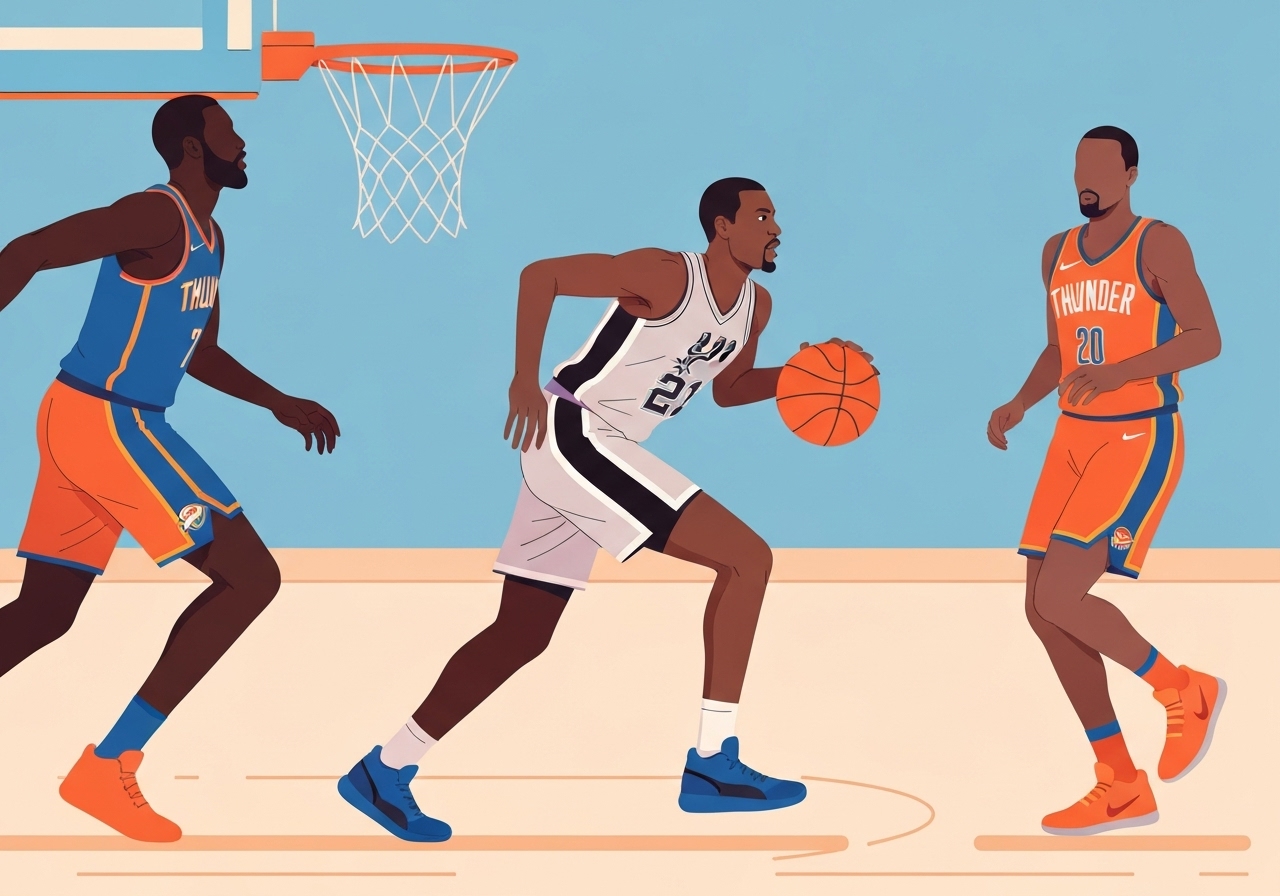
Lead: Victor Wembanyama returned from a three-week absence to help the San Antonio Spurs defeat the Oklahoma City Thunder 111-109 in the Emirates NBA Cup Semifinal in Las Vegas on Tuesday, snapping OKC’s 16-game winning streak. Wembanyama played 21 minutes and finished with 22 points and nine rebounds, supplying an emotional lift that swung the game’s final stretch. The Spurs advanced to the NBA Cup Championship while the Thunder, despite a 26-game strong start to the season, fell short in a tightly contested elimination game.
Key Takeaways
- The Spurs beat the Thunder 111-109 in the Emirates NBA Cup Semifinal in Las Vegas, advancing to the Cup final.
- Victor Wembanyama returned after a three-week absence, playing 21 minutes and posting 22 points and nine rebounds.
- Oklahoma City’s 16-game winning streak was snapped; the Thunder had started the season 26-2 before this loss.
- Shai Gilgeous-Alexander led OKC with 29 points, four rebounds and five assists, and also committed five turnovers.
- The Thunder shot 9-for-37 from three-point range (24.3%) and 41% overall as a team, struggles that contributed to the defeat.
- The Spurs were +21 with Wembanyama on the floor and -18 when he was on the bench, underlining his immediate impact.
- San Antonio went 9-4 during Wembanyama’s absence; his timely return coincided with postseason cup play.
Background
The Spurs entered the Cup semifinal after a stretch in which Victor Wembanyama missed multiple games with a calf strain. Prior to the injury he generated early MVP conversation after an opening-night 40-point performance, creating heightened expectations across the league. San Antonio managed a 9-4 record without him, suggesting the team had built positive momentum even while monitoring his recovery and adhering to a minutes restriction on his return.
The Thunder, meanwhile, came into Las Vegas as the league’s hottest team in terms of win streaks, having won 16 straight games and starting the season 26-2. Oklahoma City’s roster, built around Shai Gilgeous-Alexander and Chet Holmgren, has combined elite scoring with length and defensive versatility, making them a clear title favorite in short-format tournaments like the NBA Cup. Tuesday’s semifinal presented both teams with contrasting narratives: OKC’s sustained excellence versus San Antonio’s recalibration around a returning star.
Main Event
Wembanyama did not start and entered at the start of the second quarter to a warm ovation from the Las Vegas crowd. Trailing by 11 when he checked in, he immediately converted a tip-in and later assisted Dylan Harper on a 3-pointer, helping shift momentum in San Antonio’s favor. Those plays, coupled with his presence on the glass and at the rim, altered the game’s tenor even as he displayed some rust—turnovers, a few awkward falls and at least one blocked attempt by Lu Dort.
The game remained tight through the fourth quarter, and the Spurs chose to deploy Wembanyama in the final five minutes of a one-point game despite the minutes limit. His physicality—caught on at least one notable occasion flexing after a misfired attempt near Cason Wallace—appeared to provide an emotional jolt that the Spurs carried to the finish. Statistically, his 22 and nine did not fully capture the differential his presence created: San Antonio’s on-court/off-court splits favored the team heavily while he was active.
For Oklahoma City, Shai Gilgeous-Alexander produced 29 points, yet his performance differed from his season norm: five turnovers and only four trips to the free-throw line. Holmgren and Jalen Williams combined for just eight field goals, and the Thunder struggled to find consistent outside shooting, finishing 9-of-37 from deep. Those offensive difficulties, paired with San Antonio’s timely runs, were decisive in a two-point loss that ended the Thunder’s long streak.
Analysis & Implications
Wembanyama’s return in a meaningful, elimination setting served as a reminder of how a single impact player can change matchups and emotional dynamics. Even limited to 21 minutes, his rim protection, offensive gravity and defensive rebounding forced Oklahoma City to alter schemes and rotations. The Spurs’ plus-21 on-court differential with him suggests opponents must account for his presence in every possession.
From a roster and strategic standpoint, San Antonio now faces questions about how to balance his minutes against competitive opportunity. A successful comeback in Las Vegas reduces short-term uncertainty and places the Spurs in a favorable psychological position heading into the Cup Final. If the team can preserve his health while integrating him into late-game rotations, the Spurs’ ceiling rises substantially compared with the stretch when he was sidelined.
For the Thunder, the loss is a corrective moment rather than a fundamental regression. Shooting variance—especially 9-for-37 from three—helped determine the outcome; over an 82-game arc that type of night is expected to happen. Still, turnovers by primary playmakers and a lack of secondary scoring in the contest expose vulnerabilities that contenders will plan against in postseason matchups.
Comparison & Data
| Metric | With Wembanyama | Without Wembanyama (Spurs recent) |
|---|---|---|
| Team point differential (game) | +21 | -18 |
| Wembanyama minutes | 21 | — |
| Wembanyama box score | 22 pts, 9 reb | — |
| Thunder 3PT (this game) | 9-for-37 (24.3%) | |
The table summarizes the on-court swing tied to Wembanyama’s minutes and key game-level shooting figures for Oklahoma City. San Antonio’s 21-point advantage with him on the floor in this matchup is a single-game snapshot, not a season-long rating, but it highlights how quickly lineups can tilt when a generational two-way player returns. The Thunder’s 3-point inefficiency and limited secondary scoring amplified that tilt.
Reactions & Quotes
“I feel very lucky because it’s just this kind of situation where I know I can trust my inner self to get in that zone to just make the right things happen.”
Victor Wembanyama
Wembanyama framed the night as one where trust in his preparation and body management allowed him to contribute in a high-pressure environment despite limited minutes.
“I thought he played unapologetically. I thought he played relentless. I thought he played too fast at times and it was all for the right reasons and the right intentions.”
Mitch Johnson, Spurs coach
The coach emphasized process over perfection, highlighting that each minute of live play is part of Wembanyama’s development and the team’s long-term plan.
“It’s a good game for us to learn from in general. It’s an 82-game season. We want to be a team that gets better through all of our experiences.”
Mark Daigneault, Thunder coach
Daigneault positioned the loss as a teaching moment and downplayed the result as an outlier within a long season.
Unconfirmed
- Whether Wembanyama’s minutes restriction will be lifted for the NBA Cup Final remains unconfirmed and will depend on medical clearance and team decisions.
- Long-term implications for season workload and injury risk remain uncertain; a single successful comeback does not guarantee sustained durability.
- Any changes to rotation patterns in a potential extended postseason series are speculative until coaches reveal formal plans.
Bottom Line
Victor Wembanyama’s return produced both tangible box-score contributions and an immediate emotional edge that helped the Spurs defeat the Thunder 111-109 and reach the NBA Cup Final. The result snapped Oklahoma City’s 16-game win streak and underscored how a single elite talent can reshape competitive dynamics even after a multi-week absence.
For San Antonio, the priority now is to balance competitive ambition with measured load management; preserving Wembanyama’s health is central to unlocking the team’s long-term potential. For Oklahoma City, the loss is a reminder that elite teams can have off nights, and the Thunder will likely use the game as a diagnostic to refine secondary scoring and ball security as the season progresses.