
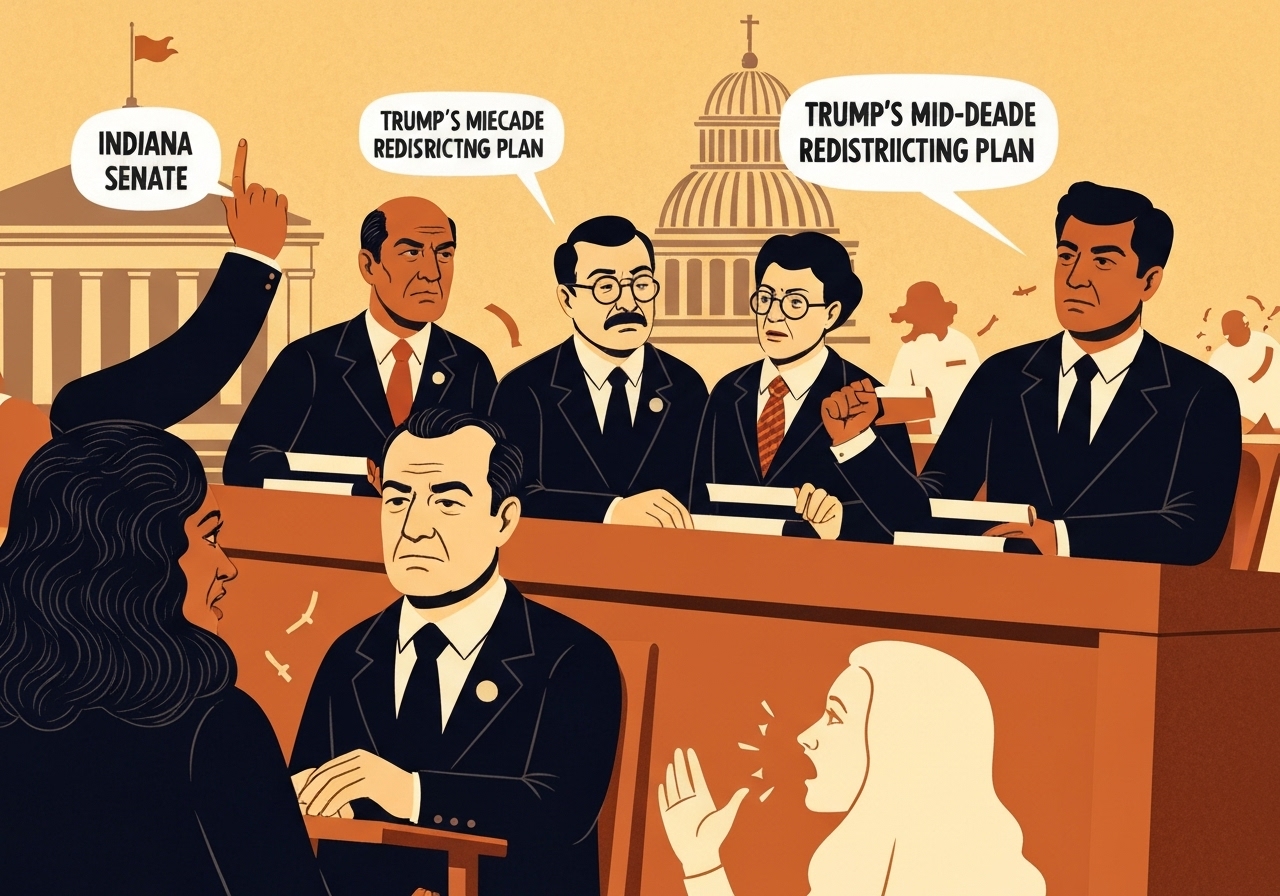
Lead: The Indiana Senate voted 31-19 on Thursday to defeat a mid-decade congressional redistricting plan backed by former President Donald Trump and national GOP operatives, prompting threats of political and financial retaliation. Twenty-one Republican senators joined all 10 Democrats to block the bill, ensuring it cannot be revived until the 2027 session. National Republican leaders, including Trump, Vice President JD Vance, and U.S. House Speaker Mike Johnson, immediately criticized the defecting lawmakers and signaled potential consequences. State leaders gave mixed responses, with some denying formal funding threats while advocacy groups amplified warnings online.
Key Takeaways
- The Indiana Senate rejected the redistricting bill by a 31-19 vote on Thursday; 21 GOP senators voted with all 10 Democrats to defeat it.
- Because of the vote, the mid-decade map cannot be reconsidered until the 2027 legislative session under current rules.
- President Trump and national GOP figures publicly criticized and threatened political consequences for defecting senators, naming Senate Pro Tem Rodric Bray in remarks.
- Heritage Action posted a warning that federal funding could be stripped if the map failed; Lt. Gov. Micah Beckwith echoed warnings on social media and later deleted his post.
- Indiana House Speaker Todd Huston denied being told federal funding would be withheld, calling the White House interactions professional and only advisory.
- Gov. Mike Braun said he would work with the president to challenge senators who opposed the measure; Senate Pro Tem Bray said the state will continue to function.
- U.S. Rep. Marlin Stutzman called the vote a mistake for Indiana’s federal cooperation but stopped short of endorsing funding retaliation on air.
Background
Mid-decade redistricting proposals are rare and contentious. Supporters argue they can correct perceived imbalances or reflect updated population data; opponents say they break precedent and enable partisan gerrymandering. In this case, the measure was promoted by Trump and allied Republicans as a way to redraw Indiana’s congressional map to potentially yield additional Republican seats in the U.S. House.
Indiana’s Legislature is Republican-controlled, but the plan faltered as more than half the Senate GOP caucus balked. Internal Republican disagreements reflected concerns about process, precedent and political risk in primaries. National figures, including Trump and Vice President JD Vance, made repeated outreach to state senators over months, elevating the issue from a state policy fight to a national intra-party clash.
Main Event
The Senate vote on Thursday ended in a 31-19 defeat for the redistricting bill. Twenty-one Republican senators joined all 10 Democrats to block the measure, ensuring the plan could not advance and would remain dormant until 2027. Republican leaders in Washington and at the state level had campaigned for the bill, citing potential Republican gains in the U.S. House if the new map were adopted.
President Trump, speaking from the Oval Office after the vote, singled out Senate Pro Tem Rodric Bray by name and predicted political consequences, saying Bray would likely lose a future primary. Trump also argued his electoral strength in Indiana made the redistricting effort sensible, saying he had won the state decisively in past elections and that the map could have produced additional Republican seats.
U.S. House Speaker Mike Johnson downplayed any notion that the Indiana result signaled waning Trump influence, telling reporters the vote was inconsequential to the party’s national prospects and that Republicans would prevail in upcoming elections. Johnson defended the broader GOP strategy and framed losses and wins as part of regular political cycles.
On the ground in Indiana, reactions split. Lt. Gov. Micah Beckwith posted on social media that the White House had been very clear about consequences for a failed map, a post he deleted the following morning. Indiana House Speaker Todd Huston denied receiving threats that federal funding would be tied to the redistricting vote, calling White House contacts professional and advisory.
Analysis & Implications
The rejection exposes a sharper fissure within the Republican Party between state-level lawmakers guarding procedural norms and national actors pursuing strategic map changes. For state senators, voting against a high-profile push from a former president carried immediate political risk; for national leaders, the defeat represents a setback to efforts to reshape the House map in 2026.
Threats of withholding federal funds, if carried out, would raise legal and constitutional questions about the limits of executive influence over federal spending and the separation between policy priorities and punitive actions. So far, the most explicit claims of funding retaliation originate from advocacy posts and deleted social media statements rather than verified federal directives, which complicates any immediate policy response.
Politically, the episode could sharpen primary challenges in Indiana. Gov. Mike Braun and other national-aligned Republicans signaled they would pursue accountability for senators who broke ranks, potentially paving the way for primary contests in 2026. At the same time, senators who opposed the plan framed their votes as protecting legislative precedent and state governance, a defense that may resonate with some constituencies wary of mid-term map changes.
Comparison & Data
| Measure | Count |
|---|---|
| Votes to defeat redistricting | 31 |
| Votes in favor | 19 |
| GOP senators joining defeat | 21 |
| Democrats voting against | 10 |
The table above summarizes the decisive roll call that blocked the bill. Because state rules bar reconsideration until the 2027 session, the vote effectively pauses any change to Indiana’s congressional map through the next two legislative years. Comparisons to past mid-decade efforts show such proposals often draw intense national attention, but successful enactment depends on unified state-level majorities—which was absent here.
Reactions & Quotes
National leaders and local officials offered contrasting takes; below are representative remarks and their context.
“You had one gentleman, the head of the Senate, I guess Bray, whatever his name is … He’ll probably lose his next primary, whenever that is.”
President Donald Trump
Trump used a post-vote Oval Office remark to single out Senate Pro Tem Rodric Bray and threaten support for challengers. His comments framed the vote as a personal and political rebuke to national strategy, and he reiterated that his electoral strength in Indiana justified the redistricting effort.
“We’re going to win on whatever maps are presented. I’m very bullish. I’m more bullish today than I was yesterday.”
U.S. House Speaker Mike Johnson
Speaker Johnson sought to contain broader narratives about weakened influence, arguing that state setbacks do not dictate national outcomes. His remarks aimed to reassure party activists and donors that GOP prospects in 2026 remain strong despite the Indiana result.
“Indiana will continue to function.”
Senate Pro Tem Rodric Bray
Bray, targeted in criticisms, pushed back on claims of imminent disruption, stressing continuity in state operations. He said he had extensive conversations with Washington figures and remained convinced the state could manage any fallout.
Unconfirmed
- That federal funding will be stripped from Indiana as a direct, confirmed consequence of the Senate vote. Public warnings came from advocacy posts and a deleted lieutenant governor post; state leaders have denied receiving formal threats.
- Claims that the White House directly told specific lawmakers and the governor that funding would be withheld; Lt. Gov. Beckwith asserted this on social media but Indiana House Speaker Todd Huston denied such warnings.
- Exact estimates that the proposed map would have produced precisely two additional Republican U.S. House seats; the plan’s projected partisan impact was offered by proponents but is subject to modeling assumptions and legal implementation.
Bottom Line
The Indiana Senate’s 31-19 vote to reject a Trump-backed mid-decade redistricting plan crystallizes a national-versus-state tension inside the GOP. National leaders framed the defeat as a strategic setback and signaled political consequences, while state lawmakers who opposed the bill defended precedent and procedural caution.
Immediate claims of federal funding retaliation remain unverified and are disputed by state leadership; any formal federal action would raise legal and political complications. For now, the practical effect is procedural: the proposal is shelved until 2027, and intra-party conflict is likely to shape Indiana primaries and national messaging ahead of the 2026 election cycle.
Sources
- WFYI (news outlet) — original report and updates summarizing the vote and reactions.
- Indiana Capital Chronicle (state news/States Newsroom) — quoted statements from state officials and photo attribution.
- Heritage Action (advocacy organization) — public social post cited for warnings about funding consequences.
- Office of the Speaker, U.S. House (official) — public remarks and press briefing summaries from Speaker Mike Johnson.