
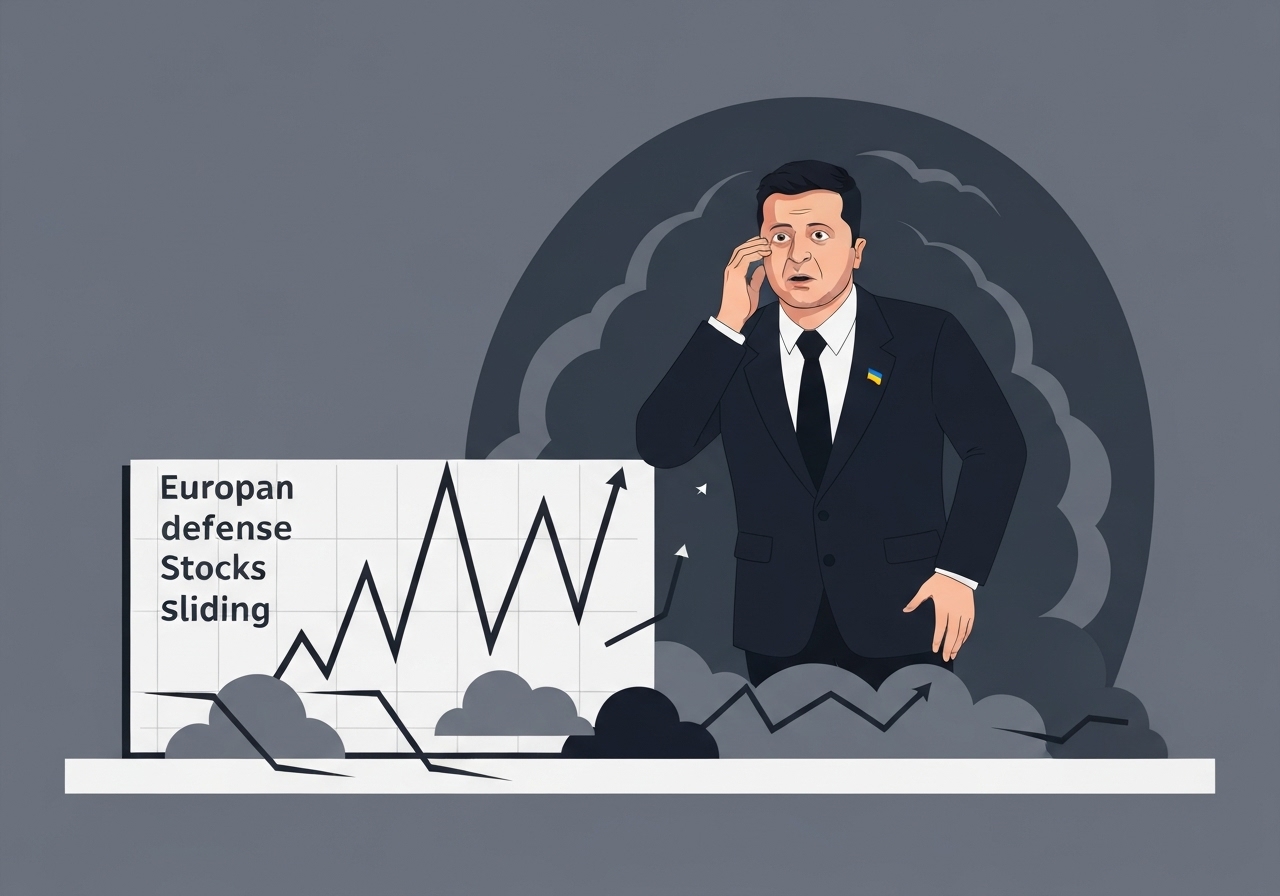
President Volodymyr Zelenskyy’s weekend statement that Ukraine is prepared to forgo its long-term goal of NATO membership in exchange for separate Western security guarantees sent European defense shares lower on Monday. Markets reacted in London and across the continent as investors digested the potential policy shift and its implications for arms demand. Major defense manufacturers including Rheinmetall, Hensoldt, Renk and Saab recorded notable intraday declines as traders reassessed the outlook for prolonged procurement and urgency-driven orders. The Stoxx Europe Aerospace & Defense Index also eased, pausing a strong year-to-date rally.
Key Takeaways
- President Zelenskyy said over the weekend Ukraine would consider abandoning its NATO membership bid in return for alternative security guarantees; the comments surfaced ahead of talks continuing this week in Berlin.
- Rheinmetall fell more than 2.5% by 11:30 a.m. in London (6:30 a.m. ET) on Monday, leading sector losses among large-cap European defense firms.
- Hensoldt traded about 2.2% lower, Renk slipped roughly 1.9% and Saab declined around 1.7% in morning European trading.
- The Stoxx Europe Aerospace & Defense Index was down more than 0.2% on Monday after rising more than 50% year-to-date prior to the move.
- Zelenskyy made the remarks during a WhatsApp exchange with reporters and amid meetings involving U.S. envoys Steve Witkoff and Jared Kushner; Kyiv is seeking separate security arrangements as part of potential ceasefire discussions.
- Russia continues to oppose Ukrainian NATO membership, and political resistance within the alliance makes accession prospects unlikely in the near term.
Background
The war in Ukraine, now approaching its fourth year, has driven unusually large defense procurement across Europe and beyond, lifting revenues for weapons makers and related suppliers. Kyiv’s longstanding stated objective of NATO membership has been a central political objective since 2014 and became more urgent after the 2022 invasion. NATO accession requires consensus among current members; several alliance states have signaled reluctance to extend full membership to Ukraine amid security and escalation concerns. Against that backdrop, any official pivot from Kyiv on NATO would mark a major diplomatic and strategic shift with direct consequences for defense demand projections.
European defense firms benefited from steady orders, modernization programs and direct supply to Ukraine, contributing to the sector’s strong year-to-date performance. The Stoxx Aerospace & Defense Index’s gain of more than 50% through mid-December reflects both the re-rating of companies and improved near-term revenue visibility from contracts linked to the conflict. Market participants have treated political developments—negotiations, ceasefire prospects and alliance dynamics—as key risk factors for future revenues and order books in the sector.
Main Event
Monday’s selling followed Zelenskyy’s weekend comments that Ukraine would be willing to abandon the NATO track in favor of legally binding security guarantees from Western states. The remarks were reported after a WhatsApp exchange with journalists and during private talks involving U.S. intermediaries, triggering immediate re-pricing in defense equities. In London trading, Rheinmetall led declines with a fall of more than 2.5% by 11:30 a.m., while Hensoldt, Renk and Saab recorded mid-single-digit percentage declines relative to recent peaks.
The market response reflected investors’ short-term expectation that a reduced chance of NATO accession could lower the probability of sustained, high-volume procurement programs tied to an extended, high-intensity conflict scenario. Dealers and portfolio managers said they were recalibrating risk premia and discounting some of the future backlog that had underpinned elevated valuations. Trading desks noted that the Stoxx index, which had been buoyed by momentum and fresh order flows, was giving back a portion of recent gains as uncertainty increased around defense spending trajectories.
Negotiations on potential ceasefire terms entered a second day in Berlin on Monday, adding another layer to investor focus. Kyiv’s push for separate security guarantees as an alternative to NATO membership changes the contours of diplomacy: guarantee providers, enforcement mechanisms and legal form would become central negotiation points. Market participants cautioned that details would determine whether any agreement reduces or preserves long-term demand for arms and defensive systems.
Analysis & Implications
Markets often price defense equities based on the expected duration and intensity of conflict and on government budgets for modernization and replenishment. A credible pathway toward a durable ceasefire that reduces the risk of expanded hostilities could temper demand assumptions that have supported recent valuations. That would likely weigh on companies whose near-term revenue depends on emergency procurement and sustained replenishment cycles.
However, a pivot away from NATO membership does not automatically translate into immediate cuts to defense budgets. Western states may respond to Kyiv’s security guarantee request by offering extended assistance, training, or multi-year procurement commitments designed to deter future aggression without granting alliance membership. If guarantees are structured to include equipment provisions or long-term funding, some defense firms could see continued or even increased order visibility.
For European governments, the negotiation outcome matters politically as well as economically. Officials balancing domestic budget constraints and public sentiment will face pressure to define what guarantees mean in practice—diplomatic commitments, bilateral defense pacts, or formalized security treaties. The credibility and enforcement mechanisms of any guarantees will shape whether Russia perceives a deterrent effect and whether markets treat the diplomatic move as de-escalatory or merely tactical.
Comparison & Data
| Company | Morning Move (London) |
|---|---|
| Rheinmetall | -2.5%+ |
| Hensoldt | -2.2% |
| Renk | -1.9% |
| Saab | -1.7% |
| Stoxx Europe Aerospace & Defense Index (YTD) | +50%+ |
The table above summarizes the intraday moves reported on Monday and the index’s year-to-date performance. Short-term declines were concentrated in larger-cap contractors that had benefited most from recent demand visibility. Investors are weighing whether index gains represent a permanent re-rating or a cyclical peak driven by extraordinary wartime orders.
Reactions & Quotes
“Such guarantees would provide an opportunity to prevent another outbreak of Russian aggression.”
President Volodymyr Zelenskyy (WhatsApp)
“Markets pared gains in defense stocks after the weekend statement as traders reassessed the probability of continued, high-volume orders tied to the conflict.”
CNBC market report
“Russia remains steadfast in its opposition to any Ukrainian membership of NATO,”
International reporting (summarized)
Unconfirmed
- Whether specific Western states have agreed in principle to legally binding security guarantees for Ukraine is not confirmed; discussions are ongoing and details remain private.
- The precise terms, enforcement mechanisms and potential providers of any guarantee package have not been released and are subject to negotiation.
- It is unconfirmed how a formal abandonment of NATO membership aspirations would affect long-term procurement contracts already negotiated or under consideration across Europe.
Bottom Line
Zelenskyy’s offer to set aside the NATO objective in return for security guarantees significantly alters the diplomatic landscape and immediately affected market sentiment in European defense stocks. Short-term share price moves reflect investor recalibration of future demand; the ultimate impact on revenues will hinge on the content and credibility of any guarantees offered by Western states.
Policymakers and market participants will now watch Berlin negotiations and subsequent disclosures closely. If guarantees include long-term equipment or funding commitments, some defense firms could retain or regain order visibility; if guarantees are primarily diplomatic with limited material support, sector valuations could face longer-term pressure. For now, uncertainty remains high and markets are pricing in a range of possible outcomes rather than a single trajectory.
Sources
- CNBC — news report summarizing market moves and Zelenskyy comments (media)