
Lead
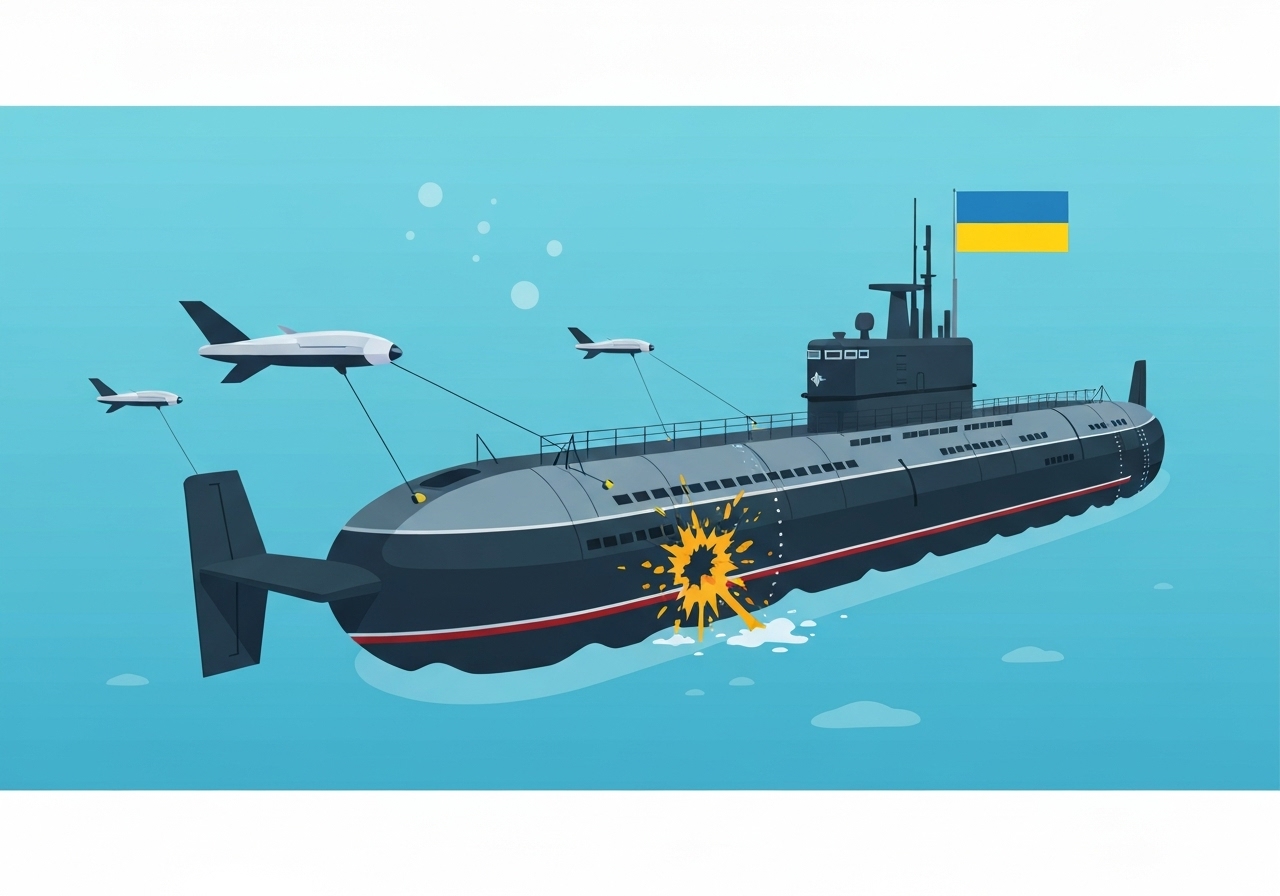
On 15 December 2025, Ukraine’s Security Service (SBU) reported that domestically produced Sub Sea Baby underwater drones struck a Russian Project 636.3 Varshavyanka (Kilo-class) submarine in Novorossiysk, Russia, leaving the vessel critically damaged and effectively put out of action. The SBU said the boat carried four Kalibr missile launchers used in long-range strikes against Ukraine. Ukrainian officials named the 13th Main Directorate of the SBU’s military counterintelligence and the Naval Forces as co-operators in the operation. Kyiv described the strike as the first confirmed successful use of underwater strike drones against a submarine of this class.
Key takeaways
- Ukraine says Sub Sea Baby underwater drones attacked a Project 636.3 Varshavyanka (Kilo-class) submarine in Novorossiysk on 15 December 2025, leaving it critically damaged.
- The SBU reported the submarine carried four Kalibr launchers; these missiles have been used repeatedly by Russia in long-range strikes on Ukraine.
- The struck boat is valued at up to €340 million; Ukraine estimated replacement costs, under current sanctions, could exceed €420 million.
- Ukraine credited a joint operation by the SBU’s 13th Main Directorate and the Naval Forces, marking an evolution in Kyiv’s maritime drone campaign.
- Kyiv also reported surface Sea Baby drones forced Russian vessels out of Sevastopol Bay, helping isolate the target in Novorossiysk.
- Ukrainian officials called this the first confirmed underwater-drones strike on a submarine of this class in history, signaling a new tactical capability.
Background
Since 2022, Ukraine has prioritized development and use of domestic maritime drones to contest Russian naval activity in the Black Sea and adjacent littoral areas. Kyiv has deployed a mixture of surface and underwater unmanned systems to harass and, in several cases, damage Russian ships and port infrastructure, aiming to limit Moscow’s freedom of movement. Novorossiysk on Russia’s Black Sea coast is a major naval and commercial hub; targeting vessels there increases operational impact by constraining assets close to Russian shipyards and logistics. The Kalibr family of cruise missiles has been repeatedly used by Russian forces in long-range strikes on Ukrainian cities and energy infrastructure, making vessels equipped with Kalibr launchers high-value targets for Ukrainian planners.
Sanctions imposed on Russia since 2022 have raised the monetary and logistical cost of replacing or repairing modern naval vessels, according to Kyiv’s assessment. Project 636.3 class submarines — widely known in NATO reporting as Kilo-class — are diesel-electric boats used for anti-surface and land-attack missions when fitted with Kalibr missiles. Prior to this strike, Ukraine had focused maritime drone operations on surface targets and port logistics; the claimed underwater engagement represents a technical and tactical escalation in Kyiv’s maritime campaign.
Main event
The SBU’s timeline states that on 15 December 2025 Sub Sea Baby underwater drones detonated against the Russian Kilo-class submarine while it was in Novorossiysk port, causing critical damage. Ukrainian officials said surface Sea Baby drones earlier cleared nearby defensive vessels and compelled Russian units to leave Sevastopol Bay, easing access for the underwater units. According to the SBU, the submarine sustained damage sufficient to render it inoperative and trapped in port for repairs or assessment.
Ukraine emphasized the strategic value of the specific target, saying the submarine carried four Kalibr launchers — a configuration that enables sea-launched cruise missile strikes on Ukrainian territory. Kyiv framed the operation as both tactical (removing an active weapons platform) and strategic (denying a missile launch base and raising replacement costs). The SBU also provided the figure of €340 million as the vessel’s value and suggested construction of a comparable replacement would now exceed €420 million under current conditions and sanctions.
Independent on-the-ground verification of the precise damage level is limited in the public domain; Russian state outlets had not provided detailed, independently verifiable damage assessments at the time of reporting. Ukrainian authorities described the action as the first successful use of underwater strike drones against a submarine of this class, and they released selective operational details while withholding tactical specifics for security reasons.
Analysis & implications
If independently confirmed, the operation would mark a notable expansion of Ukraine’s maritime strike toolkit by demonstrating an ability to threaten relatively modern, relatively low-signature diesel-electric submarines in port. Diesel-electric submarines like Project 636.3 are typically quieter on battery power than nuclear boats, but port vulnerability and logistic chokepoints create windows of exposure that unmanned systems can exploit. The strategic value of removing a Kalibr-capable platform extends beyond the single vessel: it reduces one axis from which long-range strikes might be launched against Ukraine and complicates Russian operational planning in the Black Sea.
Economically, Kyiv’s claim about replacement costs highlights a secondary effect of sustained maritime attrition: rising procurement and insurance costs for the aggressor. Under sanctions and disrupted supply chains, repairing or replacing modern subs may take longer and cost more, imposing financial strain on Russia’s naval modernization. On the operational side, increased use of underwater drones will likely force changes in Russian port defence routines, greater investment in counter-UUV (unmanned underwater vehicle) systems, and possibly more layered escort and surveillance measures.
There are broader escalation risks. Strikes on assets in Russian ports can be framed in Moscow as an expanded direct threat to Russian homeland territory, raising the potential for retaliation or changes in targeting doctrine. At the same time, successful asymmetric tactics by Kyiv could encourage allied investment in similar unmanned capabilities and reshape littoral security calculations across NATO and partnership states bordering contested seas.
Comparison & data
| Item | Reported value / figure |
|---|---|
| Project 636.3 (Varshavyanka) estimated value | €340 million |
| Estimated replacement cost under sanctions (Kyiv estimate) | Over €420 million |
| Number of Kalibr launchers reportedly aboard | 4 |
| Date of reported strike | 15 December 2025 |
The table summarizes figures provided by Ukrainian authorities and available reporting. Financial estimates reflect Kyiv’s stated valuations and are influenced by sanctions-driven cost increases and limited access to parts and shipyard capacity. Technical details such as exact damage type, repair timeline and operational impact on fleet readiness remain subject to independent confirmation and classification by the Russian authorities.
Reactions & quotes
Kyiv framed the operation as a milestone in its maritime campaign; the SBU released brief statements characterizing the strike as a precision special operation. Independent analysts noted the tactical logic of using unmanned systems to exploit port vulnerabilities.
“The damaged boat was effectively put out of action,”
SBU (official announcement)
The SBU statement framed the strike as both operationally decisive and strategically symbolic, given the vessel’s missile capacity. Kyiv also emphasized the joint nature of the operation between military counterintelligence and naval forces to indicate interagency coordination.
“This engagement shows how cheaper, domestically produced unmanned systems can change littoral dynamics,”
Independent maritime analyst (paraphrase)
Analysts cautioned that while the claim is significant if verified, independent on-site assessment and corroborating imagery or third-party confirmation would strengthen the public evidence base. Russian official public comment was limited at the time of reporting.
Unconfirmed
- Independent, third-party verification of the level and exact location of the damage to the submarine is not yet publicly available.
- Precise casualty or repair-timeline details aboard the submarine have not been disclosed by either side and remain unconfirmed.
- Attribution of every stage of the operation (timing, coordination inside Novorossiysk port) is presented by Kyiv and not fully corroborated by open-source imagery or independent observers as of publication.
Bottom line
Ukraine’s claim that underwater drones have critically damaged a Kilo-class submarine in Novorossiysk, if verified, marks a tactical shift in Kyiv’s maritime campaign and demonstrates increasing sophistication in unmanned naval operations. The removal of a Kalibr-capable platform would have immediate operational value for Ukraine and a broader strategic effect by constraining one avenue of long-range strikes.
However, public confirmation beyond Ukrainian official statements remains limited; independent verification and further detail on the extent of the damage will determine how durable the operational impact is. The incident, whether wholly confirmed now or clarified later, underscores the rising role of unmanned systems in maritime conflict and the consequent need for revised port and littoral defence measures.
Sources
- Euronews (news report summarizing SBU claims and context)
- Security Service of Ukraine (SBU) (official announcement / agency statement)