
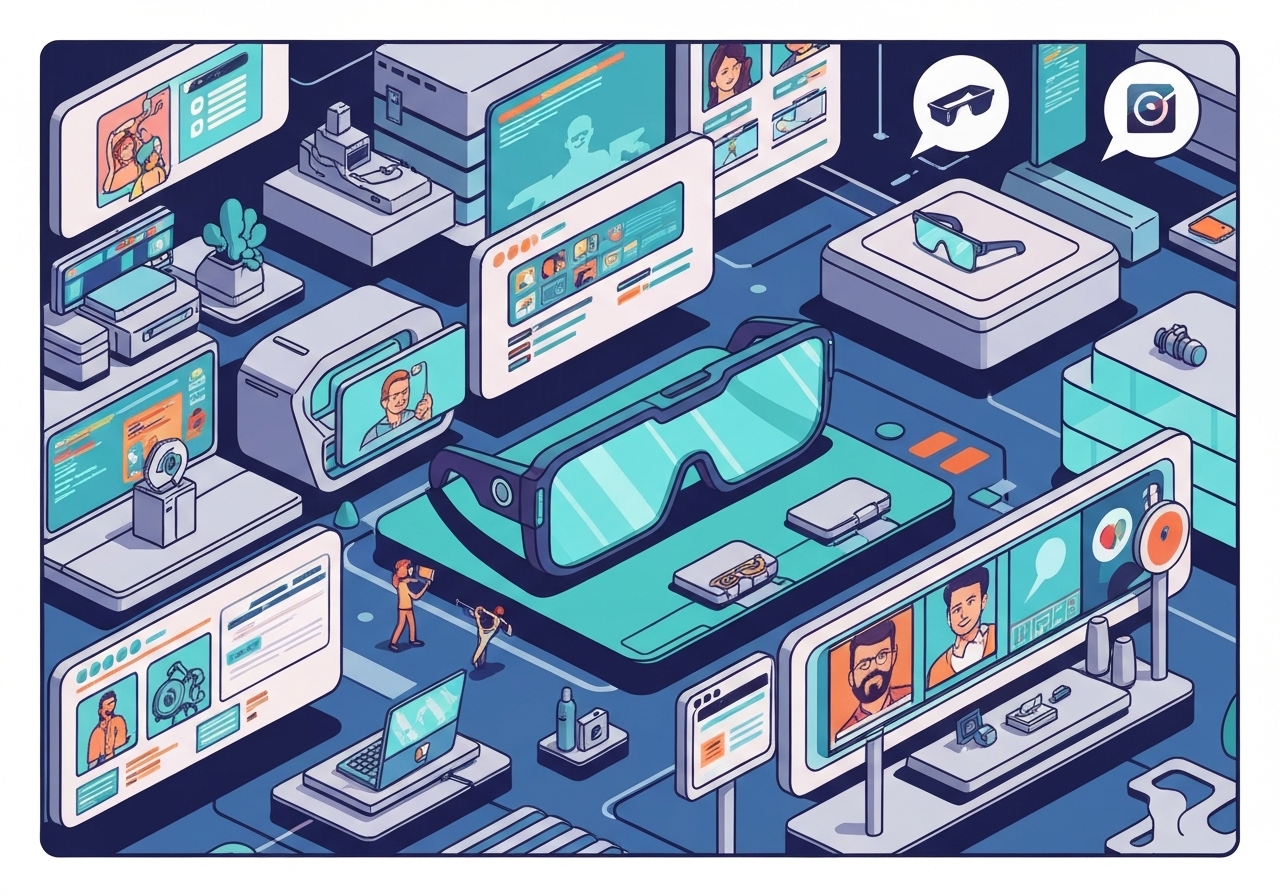
Lead: In 2025 major technology companies have shifted significant resources toward smart glasses as a mainstream computing platform. Leaders including Meta, Google and Apple (via reported plans) are investing in lightweight spectacles that overlay information rather than fully replace the world. That move follows years of mixed results for other device categories such as 3D TVs, some VR headsets and early AI-specific gadgets. The result: a renewed industry push to turn wearable eyewear into a mass-market personal-computing category.
Key Takeaways
- Tech giants are positioning smart glasses as a core personal-computing device in 2025, aiming to replicate the market impact of smartphones and laptops.
- Apple’s Vision Pro retail price is $3,500 and reportedly underperformed expectations, prompting talk of a pivot toward lighter glasses (reporting by Bloomberg).
- Meta sells the Ray-Ban Display family with pricing around $800 and bundles an optional wristband accessory for input and control.
- Google has launched Android XR support on Samsung’s Galaxy XR headset and invested $100 million to acquire a roughly 4% stake in Gentle Monster as part of a hardware partnership strategy.
- Multiple startups and OEMs — including Even Realities, Xreal, Viture, TCL and Rokkid — now offer display-equipped glasses or monitor-style wearable displays priced roughly between $400 and $850 depending on design.
- Current smart-glass designs split into three classes: basic camera/audio frames, thin waveguide HUD glasses (often single-color optics), and bulkier ‘birdbath’ monitor-style displays that resemble portable monitors.
- Major technical hurdles remain: cost, prescription optics, natural input (typing/navigation without keyboard), battery life and ecosystem fragmentation.
Background
The last decade produced several attempts to expand consumer electronics beyond phones and laptops: 3D televisions largely failed, tablets settled into a niche as large phones or laptop substitutes, and VR headsets remained a specialist purchase because of cost, comfort and content limitations. Smartwatches are the only recent new hardware category to reach broad consumer adoption, but they evolved primarily into health and fitness sensors rather than wrist-worn computers that replaced phones.
Early smart-glass experiments date back more than a decade — Google Glass in 2013 is the most cited example — but consumer acceptance was limited. The category re-emerged with devices like the 2019 Bose SoundFrames and the 2023 Ray-Ban Stories, which normalized audio and camera features in eyewear without adding a visible display. Those products paved the way for the current generation that integrates visual displays via optical technologies such as waveguides and beam-splitting optics.
Strategic bets by platform owners are now accelerating the category. Google’s Android XR aims to provide a common runtime for headsets and glasses, Samsung and other OEMs are shipping mixed-reality hardware, and reports indicate Apple is exploring lighter spectacles after the Vision Pro’s premium approach achieved limited sales. Together, these moves signal a coordinated industry effort to address hardware, software and developer support in parallel.
Main Event
Throughout 2025 manufacturers and partners announced or demonstrated multiple smart-glass reference designs and consumer models. Waveguide-equipped glasses from firms such as Even Realities and the Meta Ray-Ban Display show how full-color or single-color HUDs can be embedded into a frame that resembles ordinary eyewear. The optical tradeoffs and power constraints currently guide many design decisions: single-color optics reduce energy draw, while full-color displays increase complexity and cost.
A second stream of devices targets portable monitor use cases. Companies like Xreal and Viture produce thicker frames using birdbath optics and beamsplitters to deliver large virtual displays suitable for work or gaming. These models often require a wired connection to a phone or PC for full performance and typically use electrochromic or darker lenses to achieve usable brightness in varied lighting.
Platform players are pursuing complementary strategies. Meta’s Ray-Ban Display ships with a wristband accessory to enable discreet input and navigation; Google is enabling a diverse ecosystem through Android XR and commercial partnerships with eyewear brands; and Bloomberg reporting suggests Apple may deprioritize another bulky headset in favor of lightweight spectacles aimed at broader consumers. Financial bets — including Google’s $100 million stake in Gentle Monster — are meant to secure supply chains and design expertise.
Analysis & Implications
Why glasses rather than headsets? Smart glasses prioritize awareness of the real world and deliver bite-sized information without full immersion, making them suitable for navigation, messaging, translation and discreet teleprompter-style use. That use model avoids the social awkwardness and isolation of enclosed headsets and fits naturally into daily activities where users need to stay visually connected to their environment.
Market formation depends on three interlocking factors: convincing hardware design (comfort, prescription options, weight), durable and low-power optics, and natural input methods. Today’s input approaches — wristbands, rings, hand and eye tracking — are interim solutions. More seamless modalities such as reliable eye+hand tracking or future BCIs could unlock broader productivity use, but those technologies are not yet industry standards.
Economics will shape adoption pace. Current display-capable smart glasses often cost $400–$850, with premium eyewear and required accessories raising effective entry prices. Early buyers are likely to be professionals needing private screens, niche gamers, and technology enthusiasts. For mass-market penetration, price must fall, prescription integration must improve, and app ecosystems must offer clear daily value compared with phones and smartwatches.
A successful transition of smart glasses into core personal computing would have far-reaching consequences. Device makers that win platform control could capture new services and data flows; operators and advertisers would gain a new contextual surface; and user expectations for privacy, public norms around wearable cameras, and workplace device policies would need rapid evolution. Failure to solve these social and technical problems would leave the opportunity unrealized and could repeat past category mistakes.
Comparison & Data
| Category | Representative Models | Typical Price | Primary Use | Portability |
|---|---|---|---|---|
| Basic audio/camera frames | Ray‑Ban Stories, Bose SoundFrames | $150–$400 | Audio, photos/videos, notifications | High |
| Waveguide HUD glasses | Meta Ray‑Ban Display, Even Realities G2 | $400–$850 | Heads‑up info, AR overlays | High |
| Birdbath / monitor glasses | Xreal, Viture models | $400–$600 | Virtual large screens, gaming, productivity | Medium |
The table summarizes broad device classes, price brackets and typical uses as they stand in 2025. Waveguides favor a sleek consumer look but raise manufacturing costs; birdbath optics lower component cost at the expense of bulk and reduced outdoor brightness. Portability and social acceptability currently favor the thinner waveguide designs for everyday wear.
Reactions & Quotes
“Smartwatches are the only recent mass consumer wearable success, and glasses are the most likely next horizon for similar mainstream impact,”
Engadget analysis
“Bloomberg reporting indicates Apple is exploring lighter spectacles rather than another high‑end headset,”
Bloomberg (Mark Gurman)
“Google’s Android XR and investments with eyewear partners signal a platform-level push to support both headsets and glasses,”
Industry reporting and company disclosures
Unconfirmed
- Apple’s exact product plans for lightweight smart glasses remain unconfirmed by Apple and are based on reporting rather than an official announcement.
- The timeline for mainstream adoption and a potential trillion-dollar market projection is speculative and depends on cost, content and regulatory developments.
- Claims about specific mass sales figures for new smart‑glass models in 2025 are not yet publicly verified and should be treated as provisional.
Bottom Line
Smart glasses in 2025 represent a coordinated industry effort to create a new personal‑computing surface that complements phones and watches rather than replaces them outright. Major platform owners and a growing set of hardware makers are converging on designs that prioritize ambient awareness, discreet information delivery and improved social fit compared with enclosed VR headsets.
Significant technical and commercial challenges remain: price reduction, prescription support, natural input methods and an app ecosystem that delivers everyday value. If those are addressed, smart glasses could become a mainstream accessory within a decade; if not, the market may fragment and remain niche. For technologists, investors and early adopters, smart glasses are a category to watch closely over the next several years.