
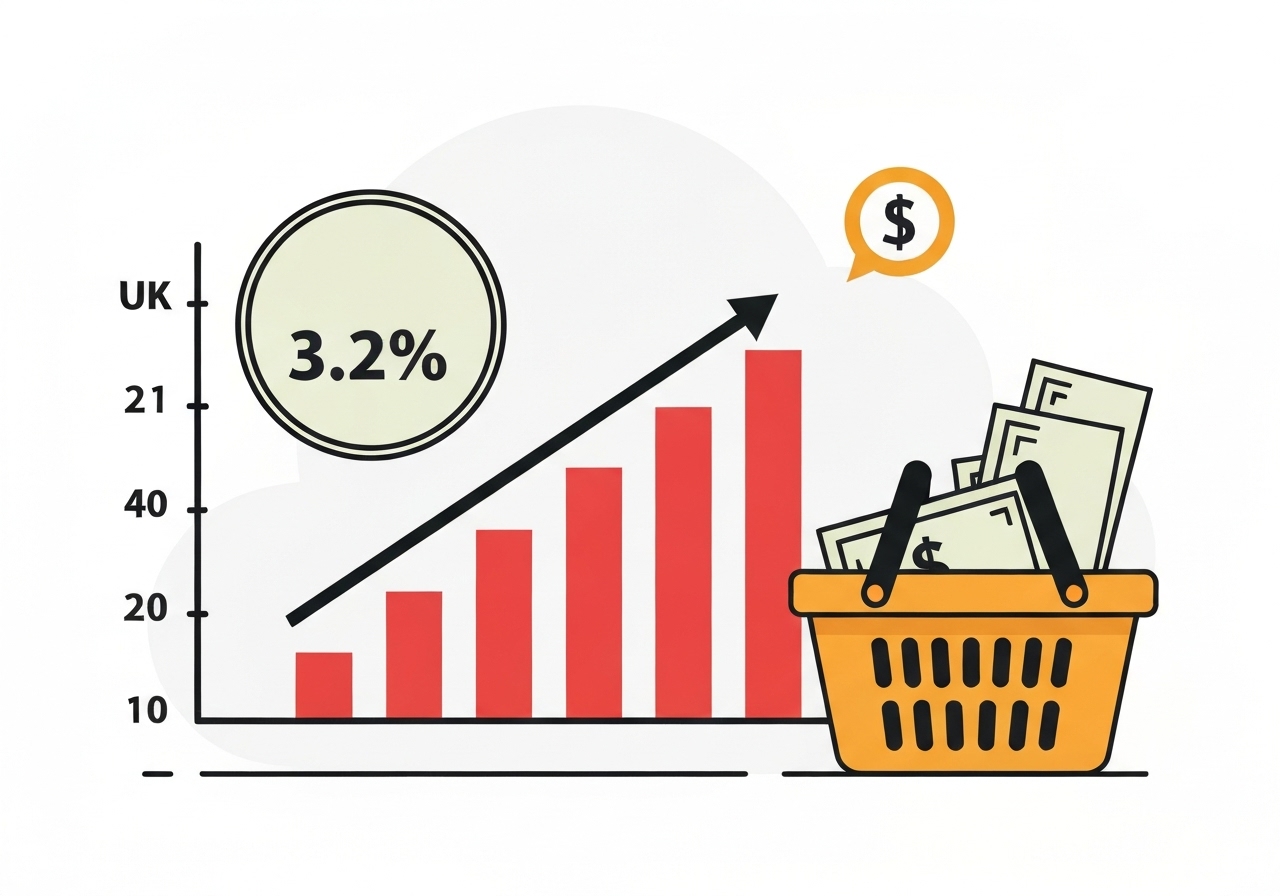
The Office for National Statistics reported that UK consumer price inflation eased to 3.2% in the year to November, down from 3.6% in October, marking the lowest annual rate in eight months. The November decline was led by falls in food, clothing and alcohol prices and came ahead of the Bank of England’s interest-rate decision this Thursday. Month-on-month data show food prices fell by 0.2 percentage points between October and November, contributing to an annual food inflation rate of 4.2% in the year to November, down from 4.9% previously. The move prompted a market reaction: the pound slipped about 0.7% against the dollar after the release.
Key Takeaways
- Headline CPI slowed to 3.2% in the year to November, down from 3.6% in October — the weakest annual rate in eight months.
- Food prices were the largest contributor to the fall: month-on-month food inflation dropped by 0.2 percentage points, leaving annual food inflation at 4.2%.
- Sharp declines were recorded for some grocery items: olive oil (-16.2%), flours (-6.1%) and pasta (-4.2%), while beef (+27.7%), chocolate (+17.3%), milk (+14.8%) and coffee (+14.5%) rose notably year-on-year.
- Clothing and footwear fell in November after deeper Black Friday discounts, helping push down overall CPI in the short term.
- The pound fell around 0.7% versus the US dollar after the data release, reflecting market reassessment of monetary policy timing.
- This print arrives just days before the Bank of England meeting, where a cut is widely anticipated but not guaranteed.
Background
The Consumer Prices Index (CPI) is the ONS’s measure of inflation and tracks a representative basket of goods and services including food, clothing, transport and housing-related items. Over the past two years the UK has experienced elevated inflation driven by energy, food and supply-chain pressures; headline CPI peaked significantly higher earlier and has been trending down through 2024. Monetary policy tightened substantially in response to that earlier inflation surge, with the Bank of England holding rates above pre-crisis levels for an extended period. Against this backdrop, monthly swings in volatile categories such as food and clothing can materially influence short-term CPI readings and market expectations about policy moves.
Household budgets have been strained by the prior period of rapid price rises, meaning even a slowdown in the rate of inflation does not immediately restore real incomes. Fiscal measures cited by the chancellor, including targeted freezes and one-off support, have aimed to ease bills for some households, but core price pressures and services inflation have remained areas of concern. Retail dynamics — notably heavier-than-usual Black Friday discounts this year — also played a role in November’s clothing price movements, highlighting the interaction between retail strategy and official inflation statistics. Analysts and market participants pay close attention to whether disinflation is broad-based or concentrated in a few categories.
Main Event
The ONS said decreases in the prices of cakes, biscuits and breakfast cereals were key contributors to lower food inflation in November, a countermovement to the typical seasonal pattern where food prices rise. Clothing and footwear prices fell sharply after retailers applied deeper discounts during Black Friday, particularly for women’s clothing and shoes, which weighed on the monthly CPI. Other downward contributors included lower costs for tobacco, restaurant meals, hotel stays, furniture and some transport-related items. Despite these declines, many categories still show year-on-year price increases, underscoring that prices remain higher than a year earlier even where inflation rates have fallen.
Grant Fitzner, the ONS chief economist, highlighted the role of specific grocery items and retail promotions in the November figures and pointed out that month-on-month changes can differ markedly from year-on-year rates. The market reaction was immediate: sterling traded about 0.7% weaker against the dollar as investors priced in an increased probability of near-term easing by the Bank of England. The data arrived shortly before the Bank’s policy meeting, prompting officials and market commentators to reassess the timing and scale of possible rate cuts in 2025. Some forecasters interpret the print as stronger evidence that disinflation is proceeding, while others caution that volatility in a handful of items can obscure underlying trends.
Retailers reported heavier discounting this Black Friday compared with recent years, which helped keep clothing and footwear prices down in November; several analysts warned those effects could reverse in coming months. Food price movements were mixed: large year-on-year increases for staple items such as beef and dairy contrast with steep falls for some pantry basics like olive oil and pasta. The ONS data therefore present a nuanced picture: headline inflation has eased materially, but the distribution of winners and losers among consumers and firms differs by product and region.
Analysis & Implications
For the Bank of England, the November CPI print strengthens the argument that inflation is moving closer to target, potentially increasing the scope for an interest-rate reduction. However, the BoE’s decision will weigh a range of indicators, including services inflation, wage growth, and incoming international data, not only the headline CPI for a single month. Markets have already priced in a higher chance of cuts, as seen in sterling weakness and shorter-term gilt moves, but the central bank will seek confirmation that disinflation is sustained before adjusting policy significantly. A premature easing risks reigniting price and wage pressures, particularly if supply constraints re-emerge.
Households may see relief in the form of slower price rises, but analysts caution that ‘falling inflation’ does not equate to ‘prices falling’ — many families still face higher absolute costs than two years ago. The mix of items driving the decline matters: reductions in discretionary spending categories (clothing, eating out) help consumer sentiment, while persistent increases in staples (meat, dairy, coffee) continue to strain lower-income households. Retailers may also adjust pricing strategies if demand rebounds or supply-side cost pressures shift, meaning some November discounts could be temporary.
On the fiscal front, the chancellor has framed the data as welcome news for households, pointing to targeted measures introduced this year. Policymakers will balance the political benefit of lower headline inflation against the need to maintain support for those still facing high living costs. Internationally, the UK move will be watched by other central banks assessing whether global disinflation trends are durable or reversible; a synchronized easing cycle could reduce exchange-rate pressures but would depend on continued progress in core inflation metrics.
Comparison & Data
| Indicator | Oct | Nov |
|---|---|---|
| Headline CPI (annual) | 3.6% | 3.2% |
| Food inflation (annual) | 4.9% | 4.2% |
| Pound vs USD (immediate move) | — | −0.7% after release |
| Selected food changes (y/y) | Beef +27.7%, Olive oil −16.2% | Chocolate +17.3%, Pasta −4.2% |
The table summarises the headline shift between October and November and highlights specific high- and low-moving food items. While the headline drop is meaningful, the concentration of declines in a subset of categories means the overall disinflation story is partial rather than universal. Analysts will watch upcoming monthly prints and core services inflation for confirmation that the easing is broad-based. If clothing discounts fade and energy or wage pressures pick up, the downward trajectory of CPI could stall.
Reactions & Quotes
Government officials framed the print as welcome news for families after a period of high price growth; the chancellor pointed to recent fiscal measures intended to ease bills and support households. Her comments underline the political focus on visible improvements in living-cost indicators ahead of next year.
“I know families across Britain will welcome this fall in inflation,”
Rachel Reeves, Chancellor (statement)
Independent economists and market analysts were cautiously positive, noting that discretionary-category declines improve consumer finances but warning that reversals are possible. One senior economist described the November mix as encouraging but urged further evidence before declaring a sustained trend.
“Disinflation appears to be happening faster than expected, but some price falls are tied to seasonal discounts,”
Paul Dales, Chief UK Economist, Capital Economics
Personal finance experts emphasised the role of retail promotions this year and the continued real-income squeeze for many households. Commentators stressed that while the headline is better, ongoing high absolute prices for essentials mean many families will not yet feel substantial relief.
“Heavier Black Friday discounts helped prices stay lower in November, particularly for women’s clothing and shoes,”
Sarah Coles, Head of Personal Finance, Hargreaves Lansdown
Unconfirmed
- Whether November’s fall marks the definitive peak of UK inflation remains uncertain; more monthly data are needed to confirm a sustained downtrend.
- The timing and size of prospective Bank of England rate cuts are not decided and depend on subsequent labour market and services-price readings.
- It is not yet clear how much of the clothing and food price falls reflect temporary promotions versus durable cost reductions.
Bottom Line
November’s CPI print — a drop to 3.2% from 3.6% — is a meaningful development that strengthens the case for a gradual easing of inflationary pressure in the UK, but the improvement is partly concentrated in a few volatile categories. Policymakers and markets will seek corroborating evidence in the coming months from services inflation, wage growth and international commodity trends before treating the disinflation as entrenched. For households, the headline improvement offers some relief in sentiment and budgeting, yet many consumers continue to face higher absolute prices for staples compared with a year or two ago.
Investors should expect ongoing volatility around economic releases and central-bank communications as participants reassess the odds for rate cuts. Policymakers will need to balance the desire to lock in early gains in inflation against the risk of loosening policy too soon; the next few monthly prints will be decisive in shaping the path of monetary policy and real incomes in 2025.
Sources
- BBC News (news report)
- Office for National Statistics – CPI bulletin (official statistics)
- Bank of England (official central bank)
- Capital Economics (independent economic research)
- Hargreaves Lansdown (financial services commentary)
- AJ Bell (investment platform commentary)