
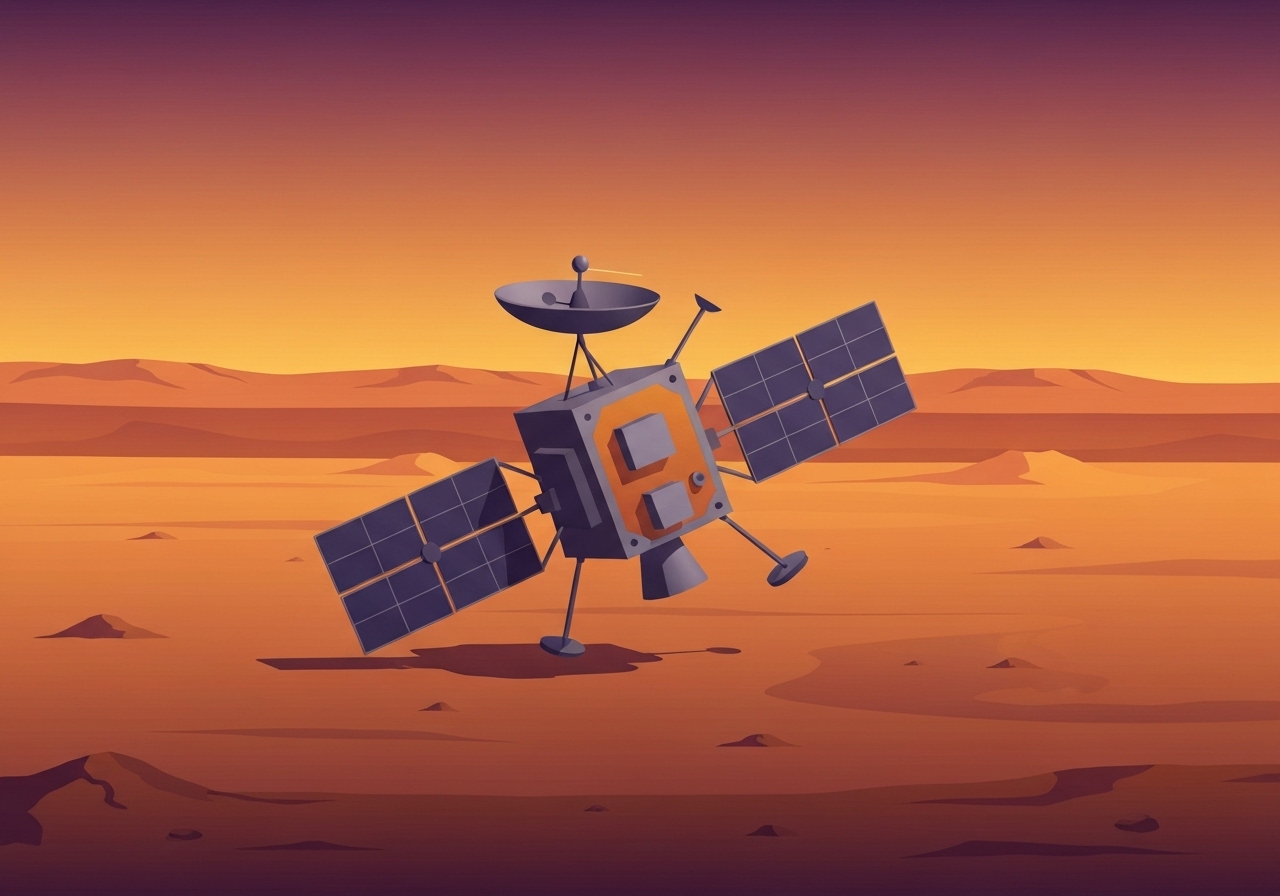
Lead: NASA’s MAVEN orbiter has not transmitted any telemetry since Dec. 4, and engineers working the mission reported an update on Dec. 15 that a fragment of tracking data recovered on Dec. 6 suggests the vehicle may be rotating. Launched in November 2013 and arriving at Mars about 10 months later, MAVEN was built to study the planet’s upper atmosphere and its interaction with the solar wind. The spacecraft has continued science and relay duties well beyond its one‑year primary mission, but teams are now relying on other orbiters to support surface operations while they attempt diagnostics.
Key Takeaways
- MAVEN has been silent since Dec. 4, with no confirmed two‑way communications as of the Dec. 15 status update.
- A partial set of tracking data recorded on Dec. 6 indicates the orbiter may be rotating unexpectedly, complicating antenna pointing.
- MAVEN launched in November 2013 and reached Mars roughly 10 months later; its primary mission lasted one Earth year but it continued extended operations.
- The orbiter has served both science and relay roles, linking NASA surface assets such as Curiosity and Perseverance to mission control.
- Other orbiters capable of relaying — Mars Reconnaissance Orbiter and Mars Odyssey (NASA), plus ESA’s Mars Express and ExoMars Trace Gas Orbiter — remain operational and are providing additional passes.
- NASA arranged extra relay opportunities from the remaining orbiters to sustain surface activities for at least the next two weeks of planned operations.
- Mission teams are analyzing limited telemetry fragments and planning fault‑diagnosis sequences but have not announced a confirmed root cause.
Background
MAVEN (Mars Atmosphere and Volatile Evolution) was designed to study how Mars lost much of its atmosphere and the role the solar wind played in that process. The spacecraft launched in November 2013 and reached Martian orbit about ten months later, completing a one‑Earth‑year prime mission that produced key measurements of atmospheric escape. After the prime phase it continued as an extended science mission, collecting data on dust storms, aurora, winds and other upper‑atmosphere phenomena.
Beyond its science objectives, MAVEN has been an important part of Mars’ communications architecture, acting as a relay between ground assets and Earth. Several orbiters now share that relay responsibility: NASA’s Mars Reconnaissance Orbiter and Mars Odyssey, and the European Space Agency’s Mars Express plus the ExoMars Trace Gas Orbiter. Those craft provide redundancy for surface mission communications and are standard parts of contingency planning when an individual element encounters trouble.
Main Event
Beginning Dec. 4, the MAVEN mission team ceased receiving routine telemetry from the orbiter. Engineers made repeated attempts to reestablish contact using standard ground station procedures and commanded recovery sequences, but two‑way communication has not been restored. On Dec. 6 teams recovered a fragment of tracking data; although partial, that record contained signatures interpreted as the spacecraft undergoing rotation rather than holding its nominal attitude.
Loss of stable attitude has immediate operational consequences: the high‑gain antenna must be pointed precisely to communicate with Earth, and instruments and solar arrays depend on controlled orientation for power and data collection. If the vehicle is indeed spinning, the ability to downlink extensive telemetry or to execute detailed recovery commands is reduced. Mission engineers are analyzing the limited data available to determine whether the rotation is a result of a hardware fault, software anomaly, or a transient event such as a thruster misfire.
NASA’s teams arranged additional relay passes from the other Mars orbiters to cover near‑term surface operations. The Perseverance and Curiosity teams have adjusted their daily sequencing and uplink plans to operate with the increased reliance on alternate relays while MAVEN remains unavailable. For now, surface science and rover safety are being managed through that multi‑orbiter network while MAVEN’s status is investigated.
Analysis & Implications
Operationally, the immediate concern is preserving surface mission continuity. MAVEN’s temporary loss heightens load on the remaining relay spacecraft but does not halt rover operations because multiple orbiters can substitute for relay passes. That redundancy was a deliberate architecture choice to mitigate just this class of contingency; it reduces near‑term risk to rovers but increases scheduling complexity for mission planners.
Scientifically, a prolonged outage would deprive the community of unique measurements of Mars’ upper atmosphere and plasma environment. MAVEN’s instruments have produced long‑baseline datasets that are valuable for understanding atmospheric escape and seasonal variability. If the spacecraft cannot be recovered, there will be a gap in those time series and potential loss of future opportunistic observations, for example during large dust events or solar storms.
Technically, a spinning spacecraft presents multiple failure modes. If attitude control hardware (reaction wheels, control moment gyros, or thrusters) failed, recovery might require switching to backup actuators or entering a safe mode that stabilizes spin. If the issue is power related — for instance if arrays cannot track the Sun because of rotation — prolonged battery depletion could lead to more permanent loss. Software faults, on the other hand, might be addressed with uplinked patches if a stable communication link can be established.
Comparison & Data
| Orbiter | Primary Role | Launch (year) | Current relay status |
|---|---|---|---|
| MAVEN | Atmosphere science, relay | 2013 | Silent since Dec. 4; analysis ongoing |
| MRO (Mars Reconnaissance Orbiter) | Imaging, relay | 2005 | Operational; providing extra passes |
| Mars Odyssey | Relay, neutron spectrometer | 2001 | Operational; providing extra passes |
| Mars Express | ESA science, relay | 2003 | Operational; contributing passes |
| ExoMars TGO | Trace gas science, relay | 2016 | Operational; contributing passes |
The table above summarizes roles and operational status as reported in the Dec. 15 mission update and public mission pages. While MAVEN’s extended mission provided distinct atmospheric datasets, the other orbiters together maintain sufficient relay capacity to support surface missions for the short term.
Reactions & Quotes
“For the next two weeks of scheduled surface operations, NASA is arranging additional passes from the remaining orbiters, and the Perseverance and Curiosity teams have adjusted their daily planning activities to continue their science missions.”
NASA (mission update)
NASA’s official status note emphasized contingency planning and immediate mitigation steps for surface operations. That communication aims to reassure partners and the public that rover activities can continue while the MAVEN anomaly is investigated.
“MAVEN has not been in contact since Dec. 4; engineers are analyzing partial tracking data recovered Dec. 6 to assess spacecraft motion and pointing capability.”
NASA MAVEN operations
The operations summary highlights the two technical facts driving the response: loss of telemetry and the interpretation of limited tracking data that points to possible rotation. Both facts constrain which diagnostics and recovery actions are feasible at present.
Unconfirmed
- Root cause of the communications loss: investigators have not confirmed whether the anomaly stems from hardware failure, software error, or an external event.
- Extent and persistence of the observed rotation: the tracking fragment suggests motion but does not yet establish whether spin will be transient or sustained.
- Probability of full recovery: mission teams have not released a definitive timeline or likelihood for reestablishing normal communications.
Bottom Line
MAVEN’s silence since Dec. 4 and the Dec. 6 tracking fragment indicating possible rotation present a serious operational problem for a spacecraft that has been a steady scientific and relay asset since 2014. Nevertheless, built‑in redundancy across multiple orbiters has allowed NASA to protect immediate surface activities and maintain rover science in the short term.
The next steps hinge on whether engineers can obtain clearer telemetry or stabilize the vehicle enough to receive diagnostic commands. If recovery proves difficult or impossible, the scientific community will need to adapt to the loss of MAVEN’s continuous atmospheric observations while relying on remaining assets and future missions to fill gaps.