
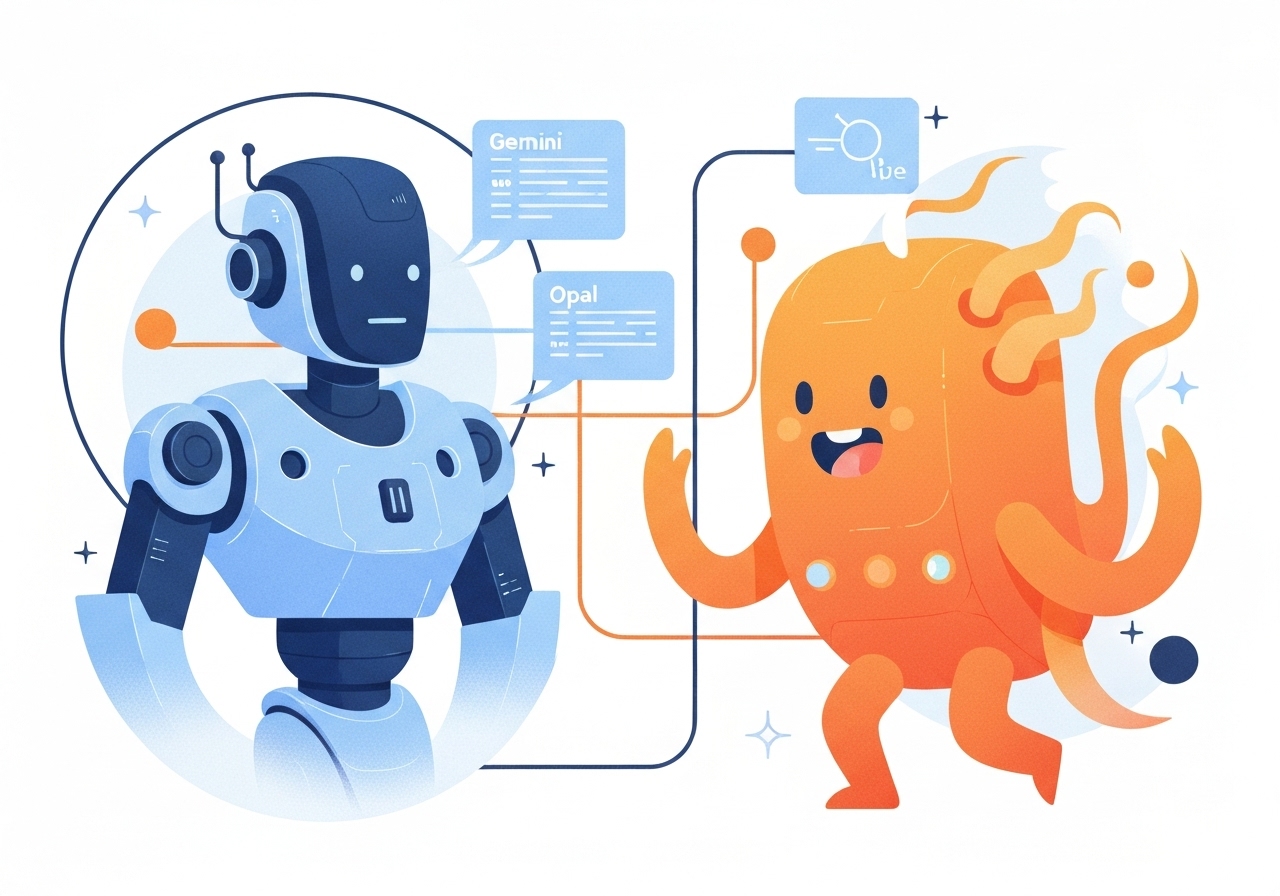
Lead: On Wednesday, December 17, 2025, Google announced that its vibe-coding toolkit Opal is now built into the Gemini web app, enabling users to create and reuse AI-powered mini-apps called Gems. The integration places Opal inside the Gems manager and adds a visual, no-code editor that converts natural-language prompts into ordered steps. Users can refine flows in the Gemini interface or jump to the Advanced Editor at opal.google.com for deeper customization. The move expands Gemini’s toolkit for personalized assistants such as learning coaches, brainstorming aides, coding partners, and editors.
Key Takeaways
- Opal is embedded in the Gemini web app’s Gems manager as of December 17, 2025, enabling on-platform creation of custom Gems without coding.
- Gems were introduced in 2024 as task-focused, customized Gemini instances; Google ships pre-made Gems for learning, brainstorming, career advice, coding and editing.
- The visual editor translates a user’s written prompt into a sequenced list of steps and lets users rearrange and link steps via drag-and-drop.
- Advanced users can switch from Gemini to the Advanced Editor at opal.google.com for finer controls and reuse of created mini-apps.
- Opal leverages different Gemini models to assemble multi-step flows, a workflow Google describes as vibe-coding—AI-assisted app construction from natural language.
- The vibe-coding market includes startups like Lovable and Cursor and offerings from AI providers such as Anthropic and OpenAI, plus consumer-focused builders like Wabi.
- Gemini’s web app is accessible at gemini.google.com and now exposes Opal features in the same interface for immediate experimentation.
Background
Over the past two years, AI-driven, no-code app builders have surged in popularity as developers and nontechnical users seek ways to package large language model capabilities into repeatable workflows. Google introduced Gems in 2024 to let users tailor Gemini for particular tasks, creating named, task-specific assistants rather than one-off prompts. That framing addresses demand for persistent, shareable configurations that can replace repetitive prompt engineering.
Vibe-coding—using natural-language instructions to assemble multi-step applications—emerged as a shorthand for this class of tools. Startups and established AI vendors have converged on similar ideas: remove barriers to building, allow reuse, and expose model capabilities through visual flows. The rapid expansion has also drawn attention from product teams and regulators about safety, data handling, and the quality of model outputs in assembled chains.
Main Event
Google’s December 17 update places Opal directly inside the Gemini web app’s Gems manager, making creation visible and immediate to users already interacting with Gems. In the Gemini interface, the Opal visual editor converts a user’s description into a list of steps, rendering an executable flow that can be rearranged and connected without traditional code. The goal is to let users see the logical structure of a mini-app and iterate quickly.
From the visual editor, creators can test flows and fine-tune step order or linkages; when deeper changes are needed they can export or continue editing at opal.google.com, where the Advanced Editor exposes more granular configuration. Google says these mini-apps are reusable, allowing creators to invoke the same Gem across sessions or share variants for specific contexts. The integration leans on Gemini models to handle each step’s interpretation and output.
Google also highlighted several prebuilt Gems it provides—examples include a learning coach, brainstorming assistant, career guide, coding partner, and editor—illustrating both consumer and productivity use cases. The company positions Opal-as-Gem formation as an on-ramp for people who want to convert prompts into durable, discoverable tools within the Gemini ecosystem.
Analysis & Implications
Embedding Opal into Gemini lowers friction for turning conversational prompts into structured workflows, widening access beyond developers to power users and mainstream consumers. For Google, this could increase daily engagement with Gemini and surface new signals that improve model tuning and product development. It also positions Gemini more directly against other AI platforms that offer building blocks for apps and automations.
Competition is already intensifying: startups like Lovable and Cursor emphasize developer- or creator-focused toolchains, while Anthropic and OpenAI supply model-level capabilities and platform integrations. Google’s advantage is coupling Opal to Gemini models and its existing user base, but that advantage depends on execution, UX quality, and how well Google manages safety and data governance for user-built Gems.
Risks include cascade failures when multi-step flows rely on models that hallucinate or return inconsistent outputs; chaining model calls can multiply error modes and complicate debugging. There are also intellectual property and privacy considerations when users combine proprietary prompts, third-party tools, or sensitive data into reusable Gems. How Google enforces usage policies, auditing, and access controls will shape enterprise and developer uptake.
Comparison & Data
| Provider | Primary focus | Positioning |
|---|---|---|
| Google (Opal + Gemini) | No-code mini-apps inside a conversational AI platform | Integrated consumer and productivity flows; Gemini model backend |
| Lovable (startup) | AI-assisted app composition (startup) | Creator/developer-focused tooling |
| Cursor (startup) | Developer IDE and AI coding workflows | Code-centric automation |
| Anthropic | Model provider with product integrations | Safety-oriented AI capabilities |
| OpenAI | Model platform and developer APIs | Wide ecosystem and third-party builders |
| Wabi | Consumer-facing app builders | Direct-to-consumer no-code tools |
The table above maps each provider to a high-level focus area. While it does not list usage metrics, it highlights how Google’s integrated approach contrasts with standalone startups that either target creators or developers. Contextualizing where Opal sits helps readers judge likely collaboration and competition paths across the ecosystem.
Reactions & Quotes
Opal’s integration removes a step between idea and product, turning natural-language prompts into visible, editable workflows in Gemini.
Google (official announcement)
The ease of turning prompts into reusable flows could broaden who builds AI tools, but it raises questions about debugging and governance for chained model calls.
Independent industry analyst
Users in early tests welcomed the visual conversion from prompt to steps and the option to refine flows without code.
Community testers (user reports)
Unconfirmed
- Whether Google will offer a separate API or enterprise controls specifically for Opal-created Gems beyond what Gemini currently exposes remains unconfirmed.
- Timing and pricing for broader commercial rollout of Opal features to enterprise customers and global markets have not been specified.
- It is not yet clear how Google will log, audit, or allow export of data and prompts embedded in shared Gems; specifics have not been publicly detailed.
Bottom Line
Google’s decision to embed Opal inside the Gemini web app represents a pragmatic push to make AI app-building accessible and visible to a broader audience. By translating prompts into editable, reusable steps, Google reduces friction for creating task-specific assistants and strengthens Gemini’s role as a platform, not just a conversational agent.
Adoption will depend on the quality of the visual editor, the robustness of step execution, and how Google addresses governance and safety for user-created Gems. Watch for further announcements on enterprise controls, pricing, and interoperability—those details will determine whether Opal in Gemini is primarily a consumer productivity enhancement or a foundational platform for broader AI-driven automation.