
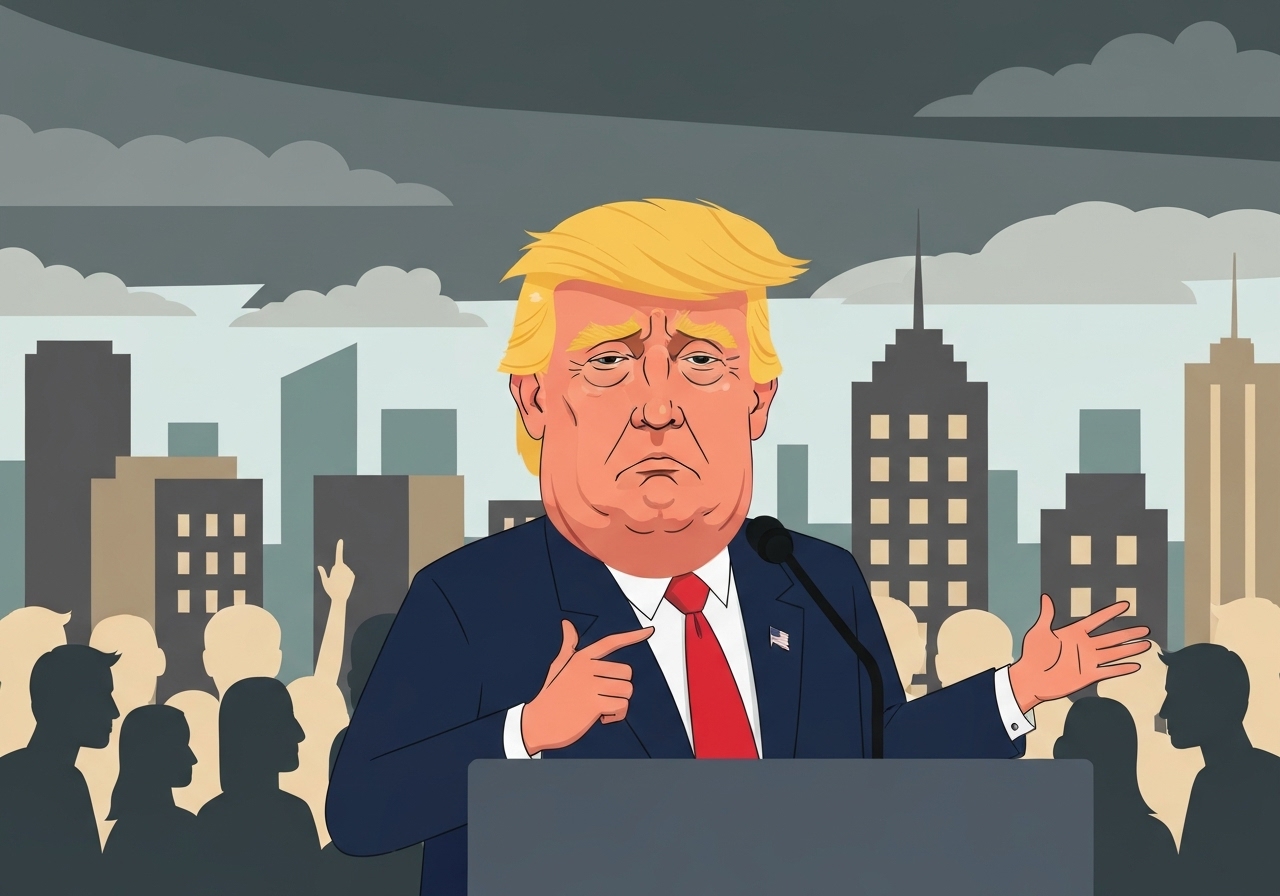
President Donald Trump will deliver a primetime address Wednesday as his overall approval has slipped below 40 percent and public concern about rising prices has grown. The speech comes after a stretch of campaign events and White House appearances aimed at shifting attention back to the economy and border security. Polling released this week shows inflation and day-to-day prices are the top economic worry for Americans, a weakness Democratic opponents highlighted in recent off‑year election gains. The address is positioned as an opportunity for the president to reassert his economic narrative ahead of a scheduled Friday speech in Rocky Mount, North Carolina.
Key Takeaways
- Trump will speak in primetime on Wednesday; the White House says the remarks will cover accomplishments and preview possible policy for the new year.
- Recent polling places the president’s overall approval below 40 percent and reports a new low for his handling of the economy, according to the latest NPR/PBS NewsHour/Marist survey.
- Forty‑five percent of Americans named rising prices as their top economic concern, compared with 18 percent citing housing costs.
- Trump has campaigned on promises of larger tax refunds in April and proposed so‑called “Trump accounts” for children born in 2025–2028 to appeal to voters worried about household finances.
- Federal Reserve Chair Jerome Powell told reporters that recent inflation growth is concentrated in goods and in sectors affected by tariffs, a factor cited by officials as pushing prices higher.
- Some critics, including conservative commentators, called the president’s recent characterization of the economy as “A+++++” tone‑deaf amid rising consumer concern.
Background
Economic anxiety has become a central political issue for U.S. voters in 2025. After years of post‑pandemic supply shocks and shifting trade policy, many households say day‑to‑day prices are squeezing budgets. Democrats emphasized cost‑of‑living issues in recent off‑year campaigns and won key races by focusing on pocketbook concerns, an outcome Republicans see as a signal to recalibrate messaging.
President Trump has responded by taking his case directly to voters, combining rallies with regional appearances and focused economic pitches. The White House has framed the administration’s record as delivering lower gas prices and stronger border security, and it has teased policy moves intended to bolster support heading into the new year. At the same time, disagreements within conservative circles and questions about the effects of tariffs on goods have complicated the administration’s communications strategy.
Main Event
The primetime address scheduled for Wednesday is intended to reach a broad television and streaming audience and to put the president’s accomplishments at center stage. White House spokeswoman Karoline Leavitt told Fox News the remarks will highlight border security and lower gas prices while also noting historic achievements from the past year and potential policy that may arrive in the new year.
In recent public appearances, Mr. Trump has repeatedly framed his economic record as producing tangible benefits for households, including promises of larger tax refunds next April tied to his policies. He has also promoted a proposal to create designated savings vehicles for children born in 2025–2028, a pitch meant to target younger parents and family voters who cite affordability as a key concern.
But messaging has faced headwinds: the president’s recent description of the economy as “A+++++” in an interview drew criticism for seeming out of step with widespread consumer worry. At the same time, Federal Reserve officials have pointed to tariffs and their effect on goods prices as a driver of current inflation, complicating the administration’s attribution of cause and effect.
Analysis & Implications
Wednesday’s address is both a communications test and a strategic play. With approval under 40 percent, the White House needs to regain momentum on the economy to avert further political losses; a clear, evidence‑based explanation of how administration policies will ease costs would aim to neutralize the Democrats’ pocketbook message. If the speech leans heavily on accomplishments without addressing immediate household pain points, it risks reinforcing perceptions of tone‑deafness.
Policy detail will matter. Promises of larger tax refunds or new child savings accounts can resonate if accompanied by concrete mechanics and timelines; without specifics, they are vulnerable to skepticism. Economically, tariffs that increase import costs may help achieve trade or industrial objectives but can elevate goods prices, which—per Fed commentary—have driven much of recent inflationary pressure. That dynamic makes it harder politically to claim credit for lower consumer costs while maintaining protectionist measures.
Internationally, a speech that stresses border control and domestic energy could reassure some voters but will have limited immediate impact on global market forces or supply chains that affect prices. Markets and trading partners will watch policy signals—especially any hints of new tariffs or trade shifts—for implications on cross‑border commerce. Politically, the address also offers an opportunity to set the frame for the coming months, shaping both Republican messaging and Democratic counterarguments heading into the presidential cycle.
Comparison & Data
| Measure | Reading |
|---|---|
| Share naming rising prices as top concern | 45% |
| Share naming housing costs as top concern | 18% |
| President’s overall approval (recent poll) | <40% |
These figures come from the recent NPR/PBS NewsHour/Marist poll showing inflation and consumer prices as the primary economic worry. The gap between price concern (45%) and the next issue, housing (18%), helps explain why Democrats emphasized affordability in off‑year campaigns. The administration’s approval standing below 40% indicates limited room for error: messaging missteps or policy ambiguity could further erode support.
Reactions & Quotes
White House officials framed the address as a broad review of the administration’s record and a preview of forthcoming policy. Karoline Leavitt described likely themes and sought to position the speech in the context of recent accomplishments and seasonal outreach.
“He’ll be addressing the country about all of his historic accomplishments over the past year and maybe teasing some policy that will be coming in the new year.”
Karoline Leavitt, White House spokeswoman (comment to Fox News)
Federal Reserve officials have drawn attention to the composition of inflation, emphasizing goods rather than services. Policymakers link parts of recent price gains to trade measures and tariffs that raise costs for imported goods, a point that complicates the political narrative about who is responsible for price trends.
“Inflation growth is happening entirely in goods, and that growth is entirely in sectors where there are tariffs.”
Jerome H. Powell, Federal Reserve Chair (press remarks)
The president’s own recent characterization of the economy drew commentary across the political spectrum for its tone relative to public sentiment. Critics argued the remark risked appearing disconnected from the daily experiences of many households struggling with prices.
“A+++++”
Donald J. Trump, in a Politico interview
Unconfirmed
- The precise effect of new proposals such as “Trump accounts” on household savings and tax refunds remains unverified until legislation or detailed rules are published.
- Any specific policy promises teased in the address—timelines, fiscal cost estimates, or eligibility rules—have not been independently confirmed before official release.
- Attribution of all recent goods‑price inflation solely to tariffs is contested; while Fed remarks link tariffs to some price rises, other supply‑chain and demand factors could also contribute.
Bottom Line
Wednesday’s primetime address is a tactical attempt to shift public focus back to the president’s economic stewardship and broader accomplishments. Given polling that places price concerns at the top of voters’ lists, effective communication will require more than slogans: it will require concrete, verifiable proposals and an acknowledgment of the immediate pressures households face.
Politically, the speech can help set the agenda for the coming weeks, but its impact will hinge on credibility. If the administration pairs clear policy detail with measurable near‑term relief, it can blunt opponents’ criticism; if it leans mainly on broad claims, the address risks reinforcing voters’ economic anxieties and offering limited political traction.