
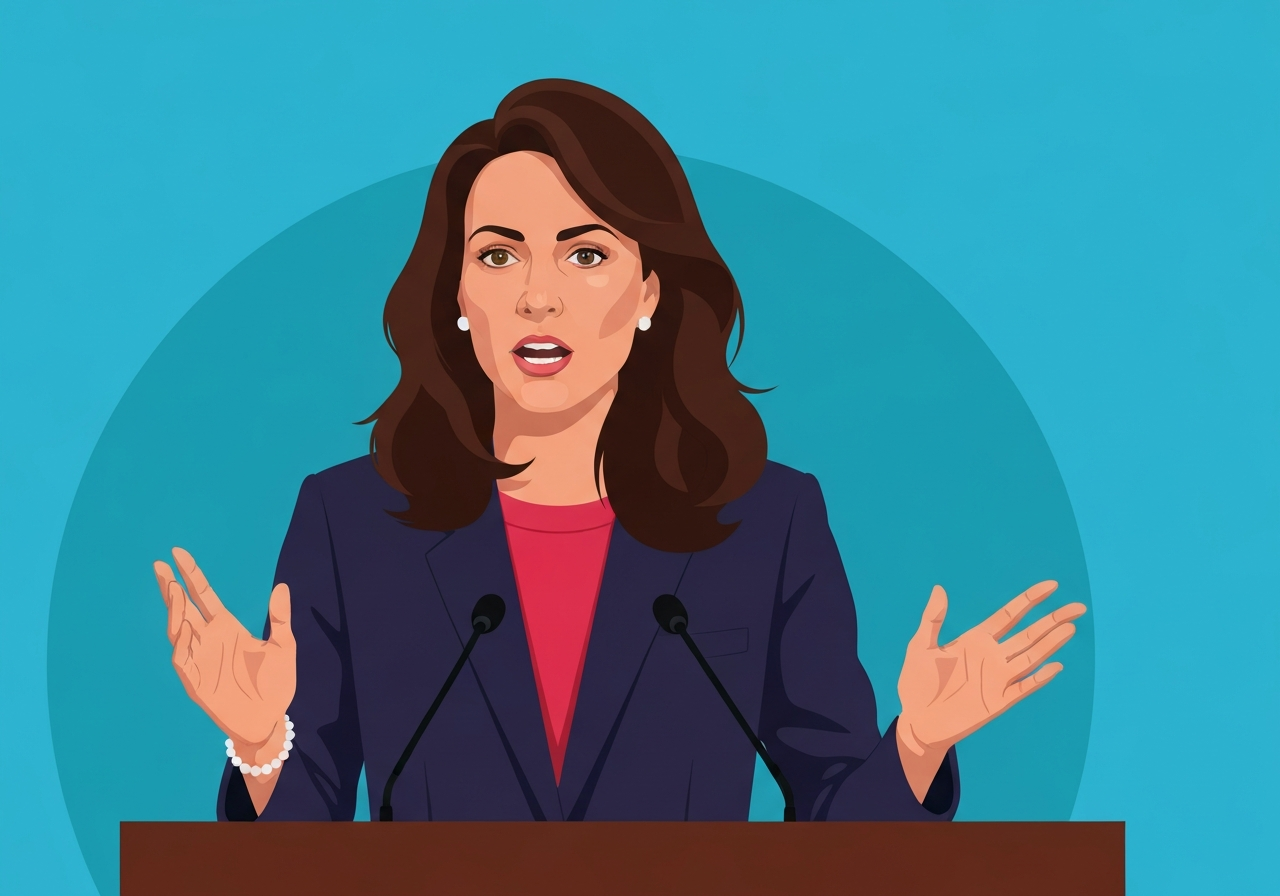
Abigail Spanberger delivered the Democratic rebuttal immediately after President Donald Trump concluded his State of the Union address on Capitol Hill, challenging his record on the economy, immigration and public safety. Spanberger, 46, framed her remarks around three questions she said every American should ask: whether the president is making life more affordable, whether he is keeping the nation safe, and whether he is working for ordinary people. She criticized recent Immigration and Customs Enforcement (ICE) operations in Democrat-led cities and called the administration’s tariff policy “reckless,” saying it has already cost families roughly $1,700 each. Her speech followed actions in Minneapolis that included the shooting deaths of two US citizens during immigration enforcement, which prompted administrative changes and the withdrawal of federal agents.
Key Takeaways
- Spanberger delivered the Democratic response immediately after Trump’s State of the Union, focusing on economy, immigration and safety.
- She is described in reports as 46 years old and as having served in Congress and at the CIA before being elected governor of Virginia in November.
- Spanberger said Trump’s tariff policy has cost American families an estimated $1,700 (about £1,260) each and cited a recent Supreme Court ruling against the administration’s tariffs.
- She condemned ICE operations in Democrat-led cities, citing the deaths of Alex Pretti and Renee Good in Minneapolis during enforcement actions.
- Spanberger said Republicans in Congress are failing to oppose the president and that such inaction is making life more expensive for Americans.
- Her political profile includes a 2018 congressional victory that reportedly flipped a district by 17 points and a November win with 57.6% of the vote.
- Because Virginia has a one-term gubernatorial limit, reports note she cannot seek immediate re-election to that post.
Background
The practice of delivering an opposition rebuttal to the State of the Union dates to the 1960s and is used by the opposing party to present an alternative agenda directly after the president’s address. The speaker chosen is often someone the party wants to promote nationally or who embodies a message the party wishes to highlight ahead of midterm contests. In this case, reports identify Abigail Spanberger — a former congressional member and ex-CIA officer — as the Democratic voice challenging the president’s policies.
The national context for her remarks includes heightened partisan battles over immigration enforcement, the use of federal agents in local jurisdictions, and a contentious trade policy that has drawn criticism for raising consumer prices. Minneapolis became a focal point after enforcement operations there led to public outcry and administrative changes, including the withdrawal of some federal agents. Economic concerns such as rising housing and health-care costs have been central Democratic critiques, and Spanberger positioned those issues at the heart of her rebuttal.
Main Event
Spanberger opened her remarks by asking three direct questions about affordability, safety and whether the president is working for ordinary Americans, then answered each with a clear negative. She accused the president of lying, scapegoating and distracting from solutions, and used pointed language to emphasize a lack of substantive policy responses to pressing challenges. The governor-level victory she reportedly earned in November was presented as evidence of Democratic momentum and a model for winning in November’s midterms.
She specifically targeted ICE operations, saying federal agents had been sent into cities where they arrested and detained people “without a warrant” and that actions had resulted in the deaths of US citizens on city streets. The rebuttal cited the recent deaths of Alex Pretti and Renee Good during operations in Minneapolis and described administrative changes that followed, including the replacement of a top official and the withdrawal of agents. Spanberger framed those events as symptomatic of a larger problem with federal enforcement strategies in local communities.
On economic policy, Spanberger criticized tariffs and argued they have raised costs for families, repeating an estimate that households have shouldered about $1,700 in extra expenses. She noted a Supreme Court decision that ruled against the administration’s tariff policy but said the economic harm to families was already done. She urged congressional Republicans to oppose the president’s measures and argued that their inaction contributes to higher costs for constituents.
Analysis & Implications
Politically, selecting Spanberger for the rebuttal represented a calculated, low-risk move by Democrats: she is newly elected and, according to reports, ineligible for immediate re-election as Virginia governor under the state’s one-term limit. That positioning allows the party to showcase a recent winner without exposing a long-term incumbent to attack. Her background — service in Congress and at the CIA, followed by the reported November governorship — was used to underscore competence on national security and public-safety issues.
Substantively, Spanberger’s focus on ICE and accountability taps into broader debates about federal intervention in local policing and civil liberties. The Minneapolis incidents sharpened those debates and gave Democrats a concrete case to tie to criticisms of federal tactics. If investigations or legal reviews substantiate claims of misconduct, the political fallout could amplify calls for policy or oversight changes; if not, Republicans may argue the rebuttal overstated facts.
On trade and the economy, the $1,700-per-household figure provides a headline number Democrats can use to link tariff policy to everyday pocketbook effects. Even with a court ruling against the administration’s tariff approach, the political impact depends on voters’ direct experiences with prices and on whether opponents can convincingly attribute rising costs to specific policies amid other inflationary pressures.
Comparison & Data
| Metric | Reported Figure | Context |
|---|---|---|
| November election vote share | 57.6% | Reported statewide win in one of the first major races after the president’s re-election |
| District swing | 17 points | Reported shift when Spanberger won a congressional seat in 2018 |
| Estimated tariff cost per household | $1,700 (≈£1,260) | Spanberger attributed this figure to administration trade policy |
| Reported age | 46 | Profile detail used in coverage |
The table summarizes the key numbers cited during and about Spanberger’s response. The election and swing figures are presented to illustrate her electoral track record; the tariff estimate is the administration-cost figure she used to make the economic case against the president’s policies. Readers should note that each figure carries different evidentiary standards: election returns are official, while policy cost attributions can vary by methodology.
Reactions & Quotes
The speech drew immediate attention because it directly confronted federal enforcement actions and trade policy while spotlighting a recent statewide victory as an example of Democratic success. Below are representative quotes from Spanberger delivered during the rebuttal, with brief context.
“Tonight the president did what he always does: he lied, he scapegoated, and he distracted, and he offered no real solutions to our nation’s pressing challenges.”
Abigail Spanberger
This line summed up her overarching critique of the president’s approach and set the tone for the remainder of the response.
“Our president has sent poorly trained federal agents into our cities where they have arrested and detained American citizens and people who aspire to be Americans.”
Abigail Spanberger
Spanberger used this charge to highlight specific enforcement actions in Democrat-led cities and to demand accountability for the tactics used.
“They’re making your life harder. They’re making your life more expensive.”
Abigail Spanberger
She returned to the pocketbook theme repeatedly, linking policy choices to everyday costs for families in an attempt to broaden the appeal of her critique ahead of the midterms.
Unconfirmed
- Claims that Abigail Spanberger is “the first female governor in Virginia’s history” are reported here but need independent confirmation against official state records and mainstream reporting.
- Assertions that all ICE arrests in the cited operations were made without warrants are put forward in the rebuttal; the warrant status of individual arrests remains subject to investigation and public records review.
- Attribution of the full $1,700 per-household cost to a single policy stream (tariffs) reflects one estimation approach and may vary by source and methodology.
Bottom Line
Spanberger’s rebuttal attempted to fuse a law-and-order posture with an economic pocketbook argument, using recent enforcement incidents and tariff impacts to make the case that the president’s policies are harmful to everyday Americans. The speech was designed to appeal both to voters concerned about safety and to those feeling financial pressure from housing, health-care and trade-related price changes.
Politically, the choice of Spanberger put a new statewide figure on a national stage with limited electoral risk, according to reports, while giving Democrats a succinct set of talking points heading into the midterms. The longer-term effect will depend on subsequent investigations into enforcement actions, legal rulings related to trade policy, and whether voters credit the rebuttal’s claims when they evaluate local conditions and national leadership.