
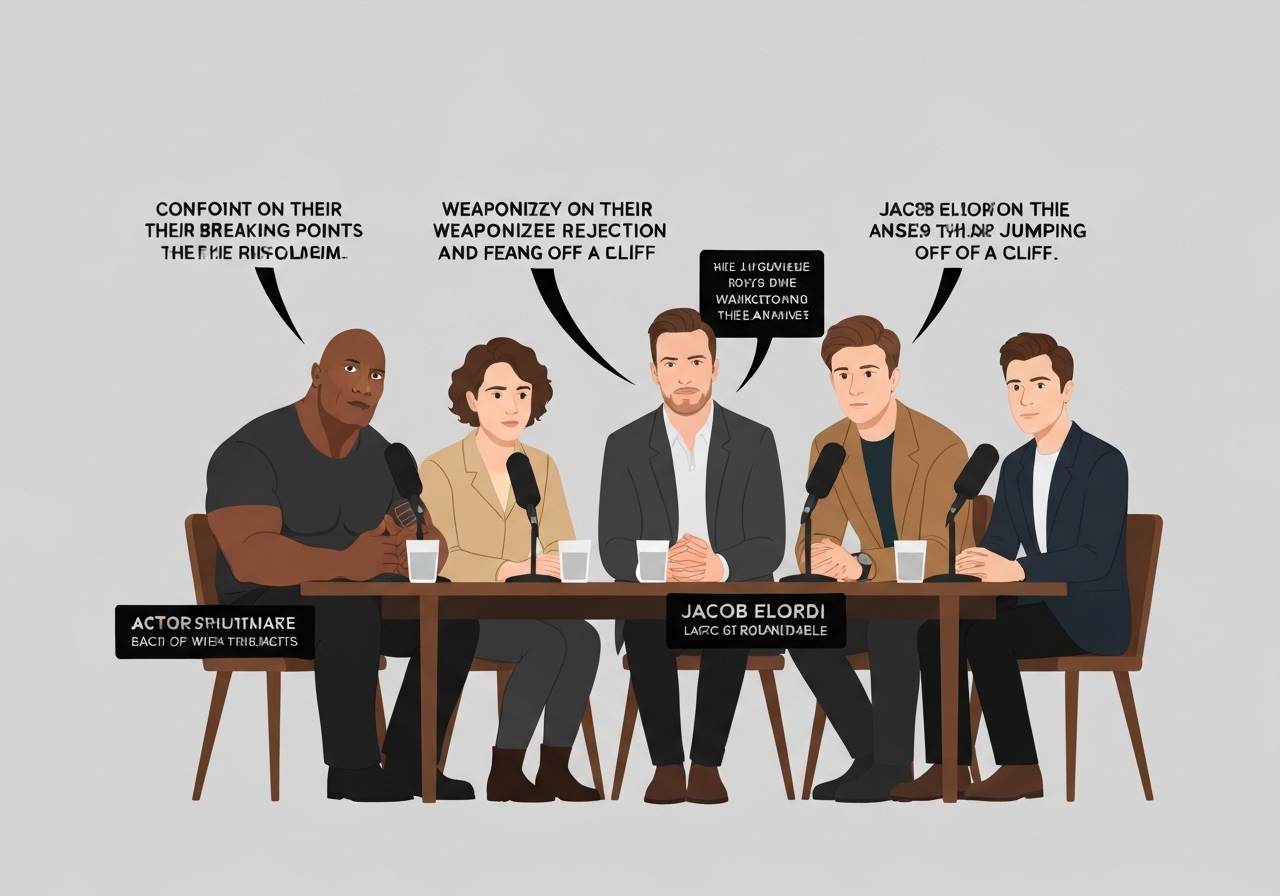
Lead: In mid-November at The Sun Rose in West Hollywood, seven leading men gathered for The Hollywood Reporter’s Oscar-season Actors Roundtable to discuss careers, craft and risk. The participants—Dwayne Johnson, Jacob Elordi, Mark Hamill, Michael B. Jordan, Wagner Moura, Adam Sandler and Jeremy Allen White—each delivered what many are calling a career-best performance in a 2025 film, yet none has an Oscar nomination to their name. Conversation ranged from the first breaks and repeated rejection to physical transformations and last-minute casting coups. The hour-long exchange underscored both divergent paths to prominence and a shared urge to push beyond comfort zones.
Key Takeaways
- Seven actors convened at The Sun Rose, West Hollywood, in mid-November for THR’s Oscar-season roundtable; participants span ages from Jacob Elordi (28) to Mark Hamill (74).
- Five are American (Hamill, Johnson, Jordan, Sandler, White), one Australian (Elordi) and one Brazilian (Moura), highlighting cross-border career trajectories.
- Dwayne Johnson has headlined 40 films that have grossed just under $14 billion worldwide, averaging about $349.7 million per film; he was the top-grossing actor in 2013, 2019, 2020, 2021 and 2024.
- Several panelists cited abrupt pivots: Elordi replaced Andrew Garfield on Guillermo del Toro’s Frankenstein with nine weeks to go; White had six months to learn singing and guitar for Springsteen: Deliver Me From Nowhere.
- Makeup and prosthetics played a decisive role in performance: Elordi described a 10-hour daily prosthetic for early Creature work; others spent 3–4 hours in chairs for transformative roles.
- Recurring themes were using rejection as fuel (Michael B. Jordan), embracing an outsider identity (Wagner Moura) and deliberately seeking artistic “cliffs” to jump off (Johnson).
- Three actors returned to frequent collaborators in 2025—Jordan with Ryan Coogler, Hamill with Mike Flanagan and Sandler with Noah Baumbach—showing the career value of creative shorthand.
Background
The roundtable assembled amid awards-season attention on films released or premiering in 2025. Panelists represent a mix of mainstream box-office stars and actors who rose through prestige television and international cinema; that variety reflects a broader industry trend where television, streaming and global markets feed film casting. Historically, Academy recognition has lagged behind commercial success, and the group’s shared lack of past Oscar nominations put a spotlight on how the industry values different career arcs.
Each participant’s path—wrestling to blockbusters (Johnson), teen TV breakout (Elordi), international acclaim (Moura), comedy-to-drama reinvention (Sandler), long TV runs (Jordan, White), and franchise origins (Hamill)—illustrates the porous boundaries between mediums today. At the same time, the conversation also touched on political and cultural contexts: Moura pointed out the relationship between his Brazilian work and the country’s recent political turbulence, while others noted how representation and accent retention are reshaping casting norms.
Main Event
The talk opened with origin stories: Johnson recounted his first on-set revelation on The Mummy Returns in the Sahara, when a director’s call of “Cut” crystallized his desire to act. Jordan described arriving in L.A. at 19 and turning early agency indifference into motivation. Hamill recalled a transient childhood and an early fascination with cinematic spectacle that led him to Hollywood at 17.
Panelists traded turning-point anecdotes: Elordi spoke about breaking his back at 16 and how stage work offered emotional refuge; White explained a transition from dance to drama and an 11-year apprenticeship on Shameless; Moura described rising through Brazilian cinema and resisting the pressure to erase his accent for Hollywood roles. Sandler recounted stand-up and SNL as launch pads and a later interest in dramatic work beginning with Paul Thomas Anderson’s Punch-Drunk Love.
Discussion turned to recent projects and on-set experiences. Elordi described a frantic six-day wait after Guillermo del Toro reached out about Frankenstein and then the prosthetic regimen—up to 10 hours for some Creature work. Johnson reflected on choosing Mark Kerr’s story in The Smashing Machine as an artistic risk despite a decades-long commercial career. White explained the steep preparation required to sing and play guitar convincingly for a Bruce Springsteen biopic, including heavy on-set involvement from the subject himself.
Risk and creative intention recurred: Johnson framed certain roles as intentional “cliffs”—deliberate leaps to reveal new facets of his craft. Jordan discussed returning to Ryan Coogler with an expanded perspective after directing Creed III, while Sandler emphasized how sympathetic, character-driven roles offer emotional payoffs beyond box-office tallies.
Analysis & Implications
The roundtable highlights a persistent industry tension: commercial visibility does not guarantee awards recognition. Johnson’s extraordinary box-office track record demonstrates mass appeal, yet awards often favor quieter, transformation-driven performances—precisely the kinds of roles several panelists pursued in 2025. If these films resonate with critics and voters, the group’s lack of prior nominations could become a compelling awards-season narrative.
Another implication is the growing importance of transnational talent. Moura’s insistence on keeping his accent and identity on screen signals a market increasingly receptive to non-U.S. storytelling. Casting directors and awards bodies are slowly adapting to a more global pool, which may shift nomination patterns and expand the types of performances celebrated.
The conversation also underscores how creative partnerships matter. Re-teaming with trusted directors can produce both comfort and invention; Jordan and Coogler’s shorthand is an asset when an actor is asked to stretch into unfamiliar territory. That dynamic reinforces a studio calculus: artistic risk is easier when supported by an established creative rapport.
Comparison & Data
| Metric | Value |
|---|---|
| Number of films starring Dwayne Johnson | 40 |
| Collective worldwide gross | Just under $14 billion |
| Average gross per film | ~$349.7 million |
| Years as top-grossing actor | 2013, 2019, 2020, 2021, 2024 |
These figures, discussed during the roundtable, illustrate the distinction between commercial dominance and awards visibility. Johnson’s financial footprint is vast and recurrent across more than a decade, yet the group’s conversation emphasized that artistic credibility sometimes requires deliberate detours from franchise work into smaller, riskier projects.
Reactions & Quotes
Panelists and observers offered succinct reflections during the session; brief excerpts below capture tone and context and are followed by short explanation.
“This is what I want to do for the rest of my life.”
Dwayne Johnson — on discovering acting on The Mummy Returns
Johnson used the anecdote to frame his long-term intent and explain why he pursued roles that tested him artistically, not just commercially.
“What’s for me is for me.”
Michael B. Jordan — on handling early rejection
Jordan framed rejection as a motivating force that helped him focus on projects that fit his trajectory rather than chasing every opening.
“I’ll never be like, say, Jeremy — I’m a Brazilian actor.”
Wagner Moura — on identity and accent
Moura used this comment to explain why maintaining cultural specificity matters to him and how it informs the roles he accepts.
Unconfirmed
- Any suggestion that one or more of these actors will receive immediate Oscar nominations is speculative; nominations are determined by separate voting processes and are not assured by favorable press coverage.
- Long-term awards trajectories mentioned in conversation—such as predictions about sweeping change in nomination patterns—remain projections rather than verified industry decisions.
Bottom Line
The THR Actors Roundtable made clear that high-profile careers can be intentionally rerouted toward artistic risk—whether by prosthetics, last-minute casting, or musical preparation. For several participants, 2025 represented a deliberate pivot: prestige roles that may finally align critical acclaim with longstanding commercial success.
How the awards season responds will depend on festival buzz, critics’ groups, and guild campaigning in the coming months. For readers, the most salient takeaway is how these seven careers illustrate contemporary acting paths: hybrid, global, and increasingly driven by personal choices to pursue creative “cliffs.”
Sources
- The Hollywood Reporter — entertainment trade; original roundtable reporting and transcript.
- Box Office Mojo — box-office database; referenced for Dwayne Johnson cumulative grosses and ranking data.