
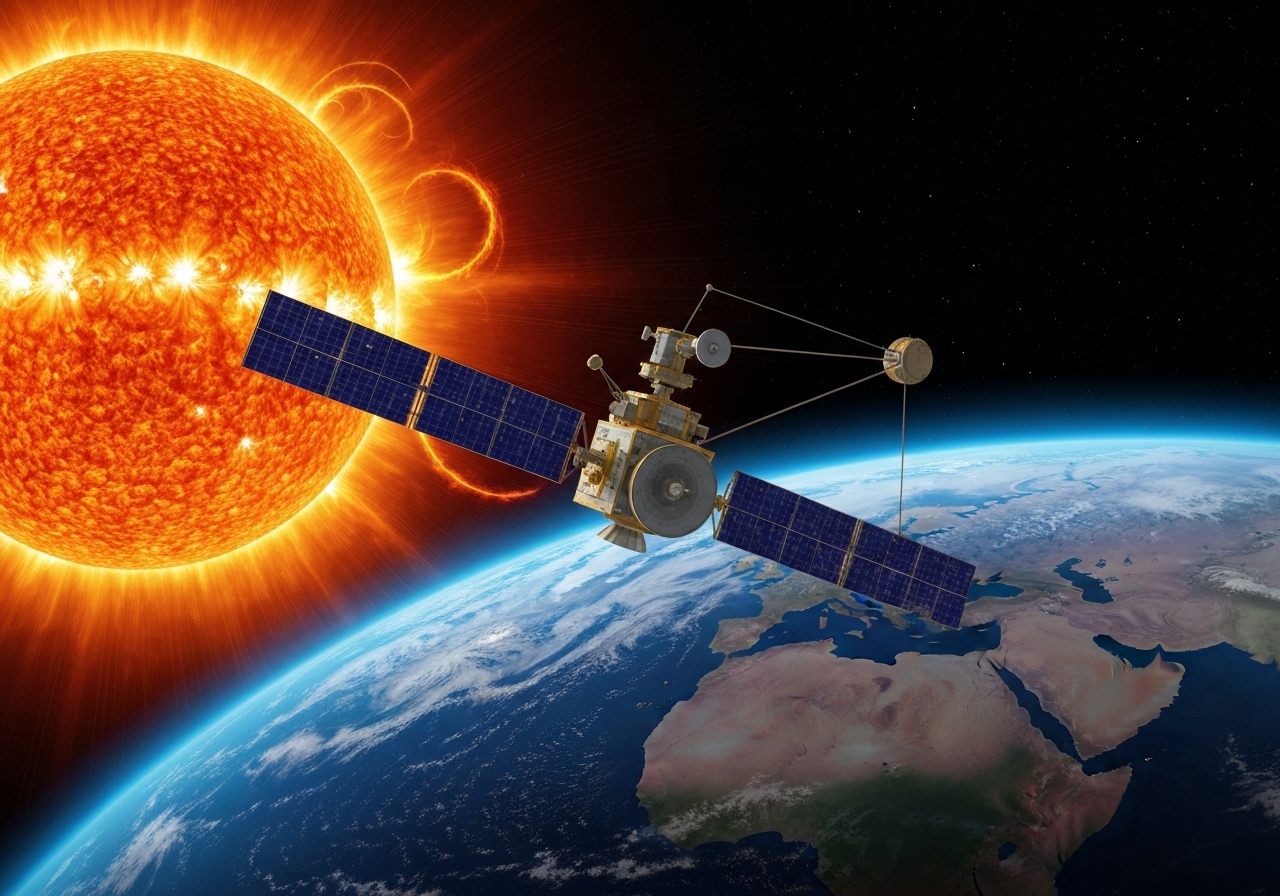
In 2026 India’s Aditya‑L1 solar observatory will witness the Sun reach peak activity in its roughly 11‑year cycle, offering an unprecedented opportunity to study coronal mass ejections (CMEs) and their impacts. Launched and placed at the Sun–Earth L1 point in 2024, the spacecraft carries seven instruments including the Visible Emission Line Coronagraph (VELC), which can continuously monitor the faint solar corona. Scientists expect the frequency of CMEs to rise sharply — from a few per day in quiet periods to potentially 10 or more daily during the maximum — making real‑time observations crucial for space weather forecasting. The mission aims both to advance solar physics and to help protect satellites, power grids and other infrastructure vulnerable to severe solar storms.
Key Takeaways
- Aditya‑L1 reached its operational orbit in 2024 and will observe the Sun through the upcoming 2026 solar maximum from the L1 Lagrange point.
- Solar maxima occur roughly every 11 years when the Sun’s magnetic poles reverse; they bring a large increase in solar storms and CMEs (NASA).
- CMEs can weigh up to a trillion kilograms and travel as fast as 3,000 km/s, reaching Earth in as little as ~15 hours over 150 million km.
- Observed 13 September 2024 CME: mass ~270 million tonnes, origin temperature ~1.8 million °C, energy ~2.2 million megatons of TNT — described by researchers as a medium‑sized event.
- In quiet times the Sun launches two to three CMEs daily; researchers expect 10+ daily events during the 2026 peak (Prof. R. Ramesh, IIA).
- Aditya‑L1’s coronagraph mimics an artificial Moon to block the bright photosphere and enable continuous corona observations, including visible‑light temperature measurements.
- Historical impacts include the Carrington Event (1859) and the 1989 Quebec blackout; NASA reported 38 commercial satellites lost after a severe CME in February 2022.
Background
The Sun follows an approximately 11‑year cycle of magnetic activity. At the cycle peak — the solar maximum — the Sun’s magnetic poles reverse and surface activity accelerates, producing more sunspots, flares and coronal mass ejections. Space agencies monitor this cycle because disturbances originating at the Sun can propagate through interplanetary space and trigger geomagnetic storms at Earth, affecting satellites, radio communications and electrical grids.
Aditya‑L1, India’s first dedicated solar observatory, was inserted into halo orbit around the Sun–Earth L1 point in 2024. Positioned about 1.5 million kilometres sunward of Earth, L1 provides a continuous, unobstructed view of the Sun. Among Aditya‑L1’s seven payloads, VELC is tailored to study the faint corona in visible light, enabling measurements of CME temperature and energy that other instruments observing different wavelengths may not capture.
Main Event
Researchers have already used Aditya‑L1 data to analyze a substantial CME that erupted on 13 September 2024 at 00:30 GMT. The event’s mass was measured at roughly 270 million tonnes, with an origin temperature of about 1.8 million °C and an estimated energy of 2.2 million megatons of TNT — values that, while large, were characterized by the team as medium‑sized relative to extreme historical benchmarks.
VELC’s capability to occult the photosphere — effectively acting as an artificial Moon — allowed continuous imaging of the corona during the event. That uninterrupted view let investigators trace the eruption’s structure, assess thermal properties in visible light, and follow the CME’s early trajectory, all of which are key to projecting potential impacts if an eruption is Earth‑directed.
The mission team has worked with international partners, including NASA, to cross‑validate observations and model the CME’s propagation. Combining Aditya‑L1’s temperature and energy diagnostics with heliospheric models helps estimate arrival times and expected geomagnetic effects on near‑Earth space assets.
Analysis & Implications
Aditya‑L1’s timing is particularly important: with the Sun approaching maximum activity in 2026, the observatory will collect a high cadence of CME events, improving statistics on frequency, speed and energy. A jump from a few to potentially 10+ CMEs per day will generate a much larger dataset, refining how scientists characterize CME initiation and early acceleration near the Sun.
Visible‑light temperature measurements from VELC provide a distinct advantage. Temperature and thermal energy are strong indicators of the magnetic energy released during eruption; by quantifying these properties at the source, researchers can better estimate a CME’s potential geoeffectiveness — that is, how strongly it might perturb Earth’s magnetosphere if directed our way.
Operationally, faster and more informative remote sensing enables better lead time for mitigation. If a CME can be detected, tracked and thermally profiled soon after launch, satellite operators and grid managers could implement protective steps — switching to safe modes, hardening systems, or delaying critical operations — reducing the risk of widespread outages or costly satellite losses.
On the scientific front, continuous corona monitoring from L1 will help test eruption models and refine our understanding of how solar magnetic fields store and release energy. These advances will benefit both fundamental heliophysics and practical space weather forecasting worldwide.
Comparison & Data
| Event | Date | Key metric | Impact |
|---|---|---|---|
| Carrington Event | 1859 | Strongest recorded geomagnetic storm | Global telegraph failures |
| Quebec blackout | March 1989 | Grid collapse in Quebec | 6 million people without power (~9 hours) |
| European airport disruption | Nov 2015 | Air traffic control interference | Flight disruptions in Sweden and elsewhere |
| Satellite losses (reported) | Feb 2022 | 38 commercial satellites lost (NASA report) | Significant financial and service impacts |
| Aditya‑L1 observed CME | 13 Sep 2024 | Mass ~270 million t; Temp ~1.8M °C; Energy ~2.2M megatons | Benchmark for medium‑sized eruptions |
The table places Aditya‑L1’s September 2024 CME into historical perspective. While far larger natural catastrophes (for example, the asteroid linked to the dinosaurs at ~100 million megatons) dwarf solar eruptions, CMEs still produce severe technological consequences at Earth when magnetic connectivity aligns. Aditya‑L1’s continuous corona coverage will supply the empirical basis for improved risk assessments.
Reactions & Quotes
Scientists leading the VELC instrument emphasize the operational and scientific value of the data, especially ahead of the 2026 peak.
“In normal activity the Sun launches two to three CMEs a day; next year we expect them to be 10 or more daily,”
Prof. R. Ramesh, Indian Institute of Astrophysics
Prof. Ramesh’s remark underlines the expected rise in event frequency and why continuous monitoring from L1 matters for both science and mitigation planning.
“The solar activity cycle peaks roughly every 11 years when the Sun’s magnetic poles flip, increasing the rate of eruptions,”
NASA (solar cycle briefing)
NASA’s summary of the cycle sets the global context: many missions and space‑weather services coordinate observations during maxima to protect assets and improve predictive models.
Unconfirmed
- Exact daily CME counts during the 2026 maximum are projected; forecasts vary and depend on real‑time solar behavior.
- Predictions of which specific satellites might be affected by any given CME require detailed orbital and magnetospheric modeling and are not determinable from source data alone.
- The probability and size distribution of extreme, Carrington‑class events during this cycle remain uncertain and cannot be ruled out but are not predictable in advance.
Bottom Line
Aditya‑L1 arrives at a pivotal moment in the Sun’s activity cycle. Its continuous, visible‑light view of the corona — including temperature and energy diagnostics from VELC — will produce vital data as the Sun moves into the 2026 maximum, when CMEs are expected to become far more frequent.
That data has two main values: first, it advances scientific understanding of eruption physics by capturing thermal and kinematic signatures at the source; second, it strengthens practical space‑weather forecasting, giving operators better lead time to protect satellites, power systems and communications. International collaboration and cross‑validation with other solar observatories will amplify these benefits.
For policymakers and infrastructure managers, the coming surge in solar activity underlines the need for preparedness plans, resilient system design and international data‑sharing protocols so that the scientific insights from Aditya‑L1 translate into tangible protections on Earth and in orbit.