
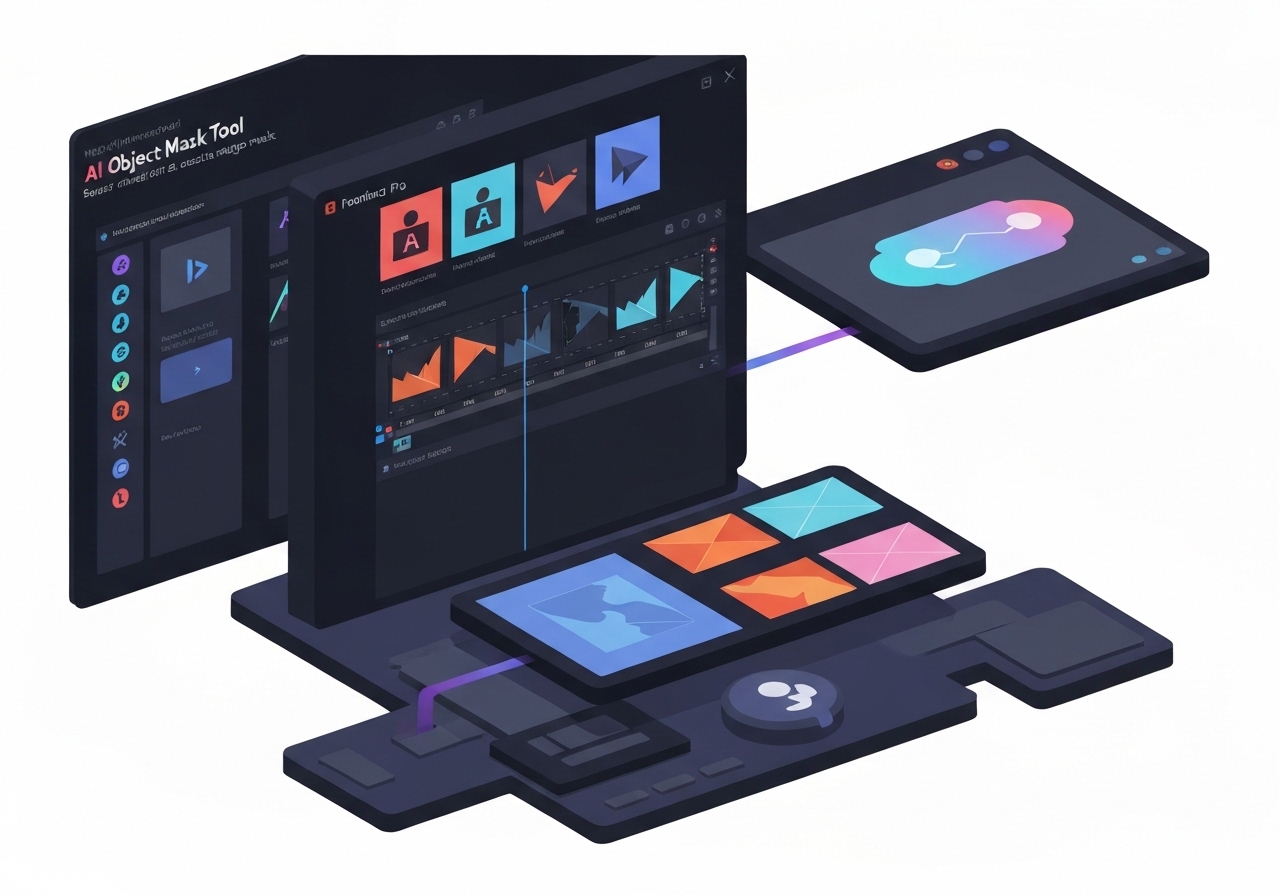
Lead: Adobe has rolled out a set of updates for Premiere Pro and After Effects that introduce new AI-driven editing features designed to speed routine tasks and streamline creative workflows. The headline addition for Premiere is an AI Object Mask that lets editors hover and click to generate and track masks for people or objects, with on-device processing and privacy controls. Shape Mask tools were redesigned for quicker creation and now track objects up to 20 times faster than before. After Effects gains SVG import and new 3D parametric mesh capabilities for building photoreal elements inside images.
Key Takeaways
- Adobe introduced an AI-powered Object Mask in Premiere that creates a mask overlay by hovering and clicking; the mask is editable after generation.
- Adobe says the Object Mask runs on-device using its own AI model and that user activity/data are not used to train Adobe models.
- Shape Mask tools (Ellipse, Rectangle, Pen) were redesigned for toolbar access and now offer controls for more precise adjustments.
- Mask tracking speed in Premiere is claimed to be 20 times faster than the previous implementation, reducing wait times during editing.
- Premiere now supports direct import of media from Firefly Boards and full integration with Adobe Stock inside the app.
- After Effects adds SVG import (commonly used with Illustrator) and 3D parametric meshes (cubes, spheres, cylinders, cones, tori, planes) for photoreal object creation.
Background
AI-assisted tools have been steadily incorporated into creative software to accelerate repetitive tasks and lower technical barriers for creators. Adobe has pursued this direction via its Firefly family and other Sensei-driven features, positioning generative and assistive AI as core differentiators for its Creative Cloud suite. Editors and motion designers have increasingly demanded faster, more intuitive masking and tracking, because manual rotoscoping and frame-by-frame adjustments remain time-consuming even for experienced professionals.
At the same time, privacy and data-use concerns have shaped vendor messaging: on-device processing and explicit non-use of user activity for model training are now recurring claims from major software vendors. The integration of asset systems — here, Firefly Boards and Adobe Stock — reflects a broader push to keep creators within a single ecosystem where assets, generated content and project workflows move more seamlessly between tools.
Main Event
The key Premiere feature is Object Mask, which detects and isolates people or objects in footage with a hover-and-click workflow that immediately produces a mask overlay. Users can then refine, resize or animate the mask as needed. Adobe states the feature relies on its own AI model and performs processing on the user’s device rather than routing footage to cloud servers.
Adobe also revamped the Shape Mask UX: Ellipse, Rectangle and Pen masks are now accessible from the toolbar for faster creation, and their controls have been updated to allow finer movement and adjustments. Importantly for performance, Adobe claims mask tracking is now 20 times faster than the prior system, which should reduce the time editors spend waiting for background tracking operations.
Workflow integrations were another focus of the update. Premiere can now import assets from Firefly Boards — Adobe’s collaborative AI canvas — directly into a timeline, and Adobe Stock is fully integrated inside Premiere to make licensed media easier to find and drop into projects. In After Effects, Adobe added SVG import support commonly associated with Illustrator workflows and introduced 3D parametric meshes (including cubes, spheres, cylinders, cones, tori and planes) to construct photoreal elements inside images.
Analysis & Implications
On-device AI processing addresses two practical concerns: latency and privacy. Local processing typically reduces round-trip time compared with cloud workflows, which can speed interactive tasks like mask generation and tracking. From a privacy standpoint, Adobe’s explicit statement that user activity isn’t used to train models aims to reassure professionals who handle sensitive footage and who may be wary of cloud-based training pipelines.
The 20x tracking-speed claim, if realized across typical editing hardware, could materially accelerate editorial throughput for many users. Faster tracking reduces idle time and allows editors to iterate more quickly on creative adjustments; that change benefits both solo creators and production teams on deadline-driven schedules. However, actual gains will vary by machine configuration, project resolution and clip complexity, so real-world benchmarks will determine the practical uplift.
The deeper integration of Firefly Boards and Adobe Stock into Premiere strengthens Adobe’s ecosystem play: creators can generate or source assets and move them into timelines with fewer manual steps. That convenience increases friction for users to remain inside Creative Cloud, which is advantageous for Adobe commercially but also useful for users who value a coherent, linked toolchain. For competitors and plugin authors, the updates raise the bar for built-in AI features and asset integration.
Comparison & Data
| Feature | Prior State | New Update |
|---|---|---|
| Mask generation | Manual roto and older auto-masks | Hover-and-click AI Object Mask (on-device) |
| Mask tracking speed | Baseline tracking speed | Up to 20× faster (Adobe claim) |
| Asset integration | Separate asset workflows | Firefly Boards and Adobe Stock inside Premiere |
The table summarizes claimed changes versus the prior Premiere experience. While the 20× tracking improvement is a clear headline, users should test on their own hardware and projects to validate end-to-end performance. The asset integrations remove several manual import/export steps, which can reduce project setup time and simplify collaborative review cycles.
Reactions & Quotes
Adobe framed the update as a productivity and privacy-forward step for editors and motion artists. Several independent creators and tool developers took note of the potential time savings and the convenience of deeper Firefly links.
“Processing happens on-device, and we don’t use your activity or data to train our models,”
Adobe (official statement)
Adobe’s explicit privacy phrasing aims to address user concerns around cloud-based training; the claim ties into a broader trend of software makers emphasizing on-device AI as a privacy feature. Users and privacy experts will want to verify how that promise maps to telemetry or optional cloud features.
“Mask tracking is now up to 20 times faster than before,”
Adobe (product update notes)
The speed claim is a major productivity selling point. Editors will likely measure how those gains translate across resolutions (HD, 4K) and complex shots; results can vary depending on system GPU, CPU and project complexity.
“Bringing Firefly Boards assets directly into Premiere removes a friction point between idea and timeline,”
Industry creator commentary
Creators describe the Firefly-to-Premiere link as reducing manual export/import steps, which can accelerate iteration during creative review and client feedback cycles.
Unconfirmed
- Whether the 20× tracking speed applies uniformly across all hardware classes is unconfirmed; Adobe’s claim may reflect ideal conditions.
- Details about precisely which telemetry or optional cloud features remain exempt from Adobe’s “not used to train models” statement were not exhaustively documented in the announcement.
Bottom Line
Adobe’s update brings tangible usability and performance claims to Premiere and After Effects: a one-click Object Mask, faster shape tracking and deeper Firefly and Stock integration all target the time editors spend on repetitive tasks. For many users, these changes can reduce mundane work and speed iteration, particularly if on-device processing performs as advertised on common workstations.
Adoption will hinge on real-world testing across diverse hardware and project types, and on clarity around privacy and data-use specifics. If the improvements hold up broadly, the release tightens Adobe’s lead in embedding AI into mainstream creative workflows while giving creators faster, more integrated paths from idea to finished frame.
Sources
- Engadget (technology news)
- Adobe Firefly (official product site)
- Adobe Premiere Pro (official product page)