
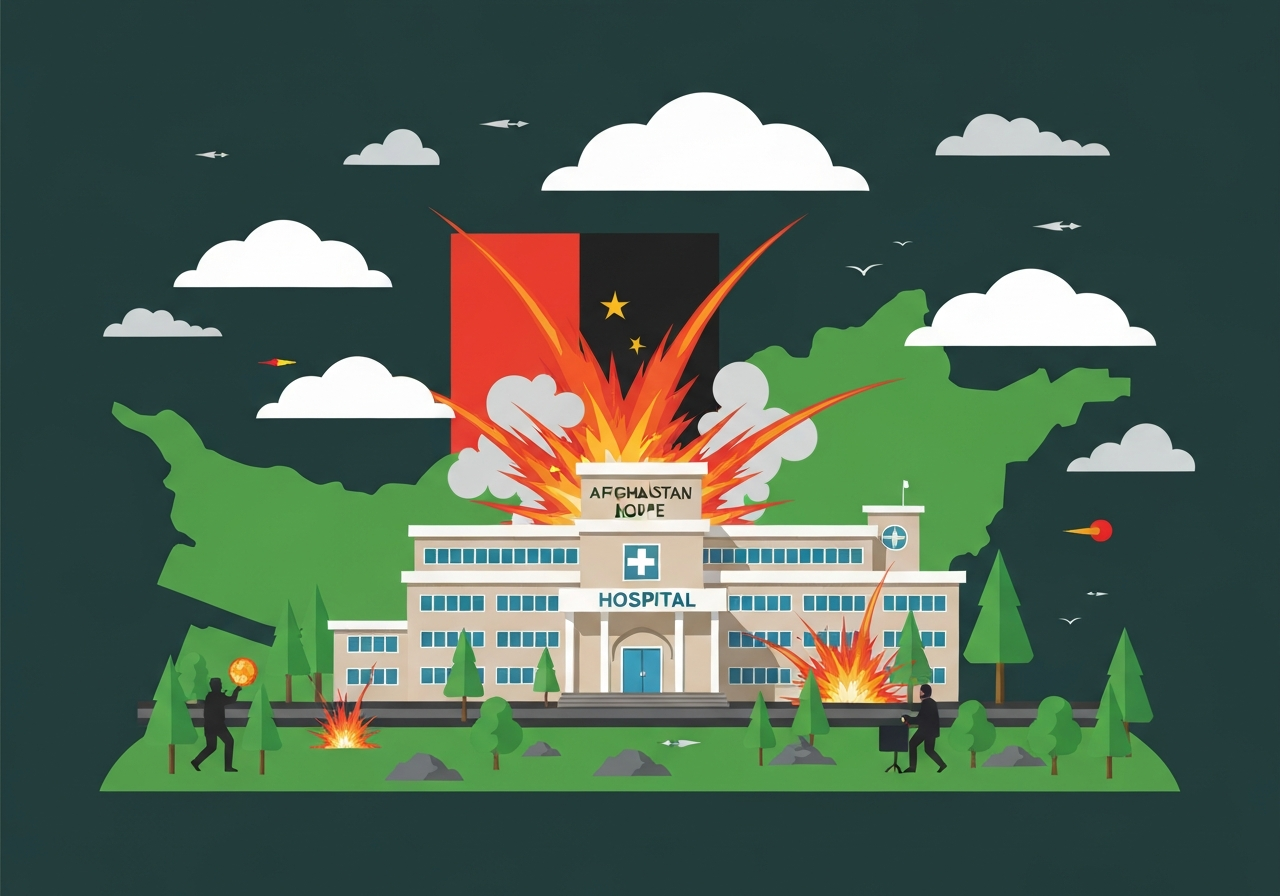
Lead: On Monday evening in Kabul, a drug rehabilitation hospital was struck by an air attack that Afghan authorities have blamed on Pakistan, leaving scores feared dead or wounded. Hospital staff and witnesses reported flames and chaos at the scene; BBC journalists observed more than 30 bodies on stretchers. Hospital officials said about 2,000 people were being treated at the facility and warned of potentially hundreds of casualties. Pakistan denied targeting the treatment centre, saying it struck military targets and so-called “terrorist support infrastructure.”
Key Takeaways
- Attack timing: Explosions were reported across Kabul at about 20:50 local time (16:20 GMT) on Monday, followed by sounds of aircraft and air-defence activity.
- Immediate impact: BBC reporters saw more than 30 bodies removed from the hospital; hospital officials said roughly 2,000 patients were present, and they fear many more casualties.
- Official claims: The Taliban government publicly blamed Pakistan for the strike via its spokesman on social media; Pakistan’s information ministry rejected that account.
- Health ministry statement: Afghan health ministry spokesman Sharafat Zaman Amarkhail said there were no nearby military installations close to the hospital.
- Context of escalation: Cross-border fighting between Afghanistan and Pakistan reignited last month; UNAMA reports at least 75 killed and 193 injured in Afghanistan since 26 February due to that fighting.
- Access and damage: Parts of the hospital remained on fire when journalists visited; family members gathered outside seeking news of loved ones.
Background
The attack comes amid renewed cross-border tensions between Afghanistan and Pakistan that re-erupted last month. Islamabad has accused Afghan territory of sheltering militant groups, allegations the current Afghan authorities deny. Historically, strikes and retaliatory incidents along the border have escalated quickly, drawing in diplomatic exchanges and humanitarian concern. Health and aid organizations have repeatedly warned that civilian sites, including health facilities and shelters for vulnerable populations, face elevated risk in such cross-border campaigns.
Drug rehabilitation centres in Kabul often treat thousands of patients, many of whom are living in communal wards with limited capacity to evacuate quickly. That concentration of patients and the limited emergency infrastructure in parts of the city increase the likelihood of high casualty figures when a single facility is struck. International agencies and UN missions have documented civilian harm in recent weeks as clashes have intensified, prompting calls for restraint from humanitarian organizations.
Main Event
Residents across Kabul reported a loud explosion around 20:50 local time (16:20 GMT), followed by the sound of aircraft and anti-aircraft defences. The strike struck the drug treatment facility on Monday evening; journalists at the scene reported parts of the compound still burning and saw more than 30 bodies being carried out on stretchers. Hospital officials told visiting reporters that roughly 2,000 people were being treated there at the time and expressed concern that casualties could number in the hundreds.
The Afghan government’s spokesman posted on X attributing the strike to Pakistan. In response, Pakistan’s information ministry issued a denial, stating its operations were aimed at military installations and “terrorist support infrastructure” in Kabul and the eastern Nangarhar province. Afghan health ministry officials, including spokesman Sharafat Zaman Amarkhail, said there were no military facilities near the hospital, challenging Islamabad’s account.
Family members and relatives of patients gathered outside the facility in Kabul, seeking information amid chaotic communications. Medical staff and local responders prioritised evacuating survivors and moving the dead to improvised holding areas. Local authorities have not released a final casualty tally; the hospital’s own staff warned that an accurate count could take time due to the scale of the patient population and damage to the centre.
Analysis & Implications
The alleged strike on a civilian medical facility raises immediate legal and humanitarian questions. Under international humanitarian law, hospitals and medical centres are protected sites; attacks on them can amount to serious violations unless the facility is used for military purposes and proportionality principles are observed. Afghan officials assert no military use, while Pakistan claims it targeted hostile infrastructure nearby; reconciling those accounts will require independent verification.
Politically, the incident risks further inflaming an already tense bilateral relationship. Cross-border exchanges of fire since late February have resulted in dozens of civilian casualties; a strike that visibly hits a community health facility could harden public sentiment and complicate diplomatic backchannels. International actors may increase pressure for investigations and for measures to prevent harm to civilians, including humanitarian access to affected sites.
Economically and socially, a large-scale casualty event at a centre treating thousands of people with substance use disorders could worsen public-health pressures. The loss of treatment capacity would displace patients and disrupt services at a time when medical infrastructure in parts of the country is already stretched. Longer term, repeated incidents that place civilian medical services at risk threaten to degrade trust in both health systems and cross-border conflict mitigation mechanisms.
Comparison & Data
| Figure | Reported number | Source |
|---|---|---|
| Bodies seen by BBC reporters | More than 30 | BBC (on-scene report) |
| Patients at hospital | Approximately 2,000 | Hospital officials (local) |
| Afghan civilian toll since 26 Feb | At least 75 killed, 193 injured | UNAMA (UN mission) |
The table above juxtaposes immediate on-scene observations with institution-level tallies. On-the-ground counts are preliminary and likely to change as responders complete recovery and registration efforts. The UNAMA figures reflect broader conflict-related civilian harm across Afghanistan since 26 February and provide context for the scale of recent cross-border impacts.
Reactions & Quotes
Officials on both sides issued brief public statements within hours, while families and local medical staff reacted at the hospital.
“This attack targeted a civilian medical facility and caused loss of life,”
Taliban government spokesman (posted on X)
The Taliban-run Afghan administration attributed the strike to Pakistan, framing it as an attack on non-combatants. That claim was central to immediate official messaging in Kabul and to public scenes at the hospital as relatives sought missing persons.
“Our strikes are directed at military and terrorist support installations, not medical centres,”
Pakistan information ministry
Pakistan’s information ministry denied responsibility for hitting a civilian hospital, saying its operations focused on military targets in Kabul and Nangarhar. Islamabad’s statement underscores the competing narratives and the need for independent verification.
“There are no military facilities near this hospital,”
Sharafat Zaman Amarkhail (Afghan health ministry spokesman)
The Afghan health ministry spokesman stressed the hospital’s civilian nature and disputed claims of nearby military targets. Health officials emphasised the presence of thousands of patients and called for urgent humanitarian support.
Unconfirmed
- Attribution of the strike: Claims that Pakistan carried out the attack remain disputed and require independent forensic or open-source verification.
- Final casualty figures: Hospital staff warned of potentially hundreds of casualties, but official counts have not yet been published or independently corroborated.
- Presence of nearby military targets: Pakistan asserts strikes hit military or support infrastructure near the site; Afghan officials deny any such nearby installations—this point is unresolved.
Bottom Line
The overnight strike on a Kabul drug rehabilitation centre has produced immediate human suffering and sharpened an already fragile cross-border dispute between Afghanistan and Pakistan. With roughly 2,000 patients reported on-site and more than 30 bodies observed by reporters, the potential scale of civilian harm is significant and will demand a prompt, independent accounting.
Beyond casualty counts, the incident risks escalating political tensions and drawing international scrutiny. Independent investigators and humanitarian agencies will be needed to verify facts on the ground, to assess compliance with international humanitarian law, and to ensure urgent medical and psychosocial support for survivors and families.
Sources
- BBC News — news report and on-scene reporting (media)
- UN Assistance Mission in Afghanistan (UNAMA) — official reporting on civilian casualties (UN/official)
- Afghan Ministry of Public Health — health ministry statements (official)