
Lead
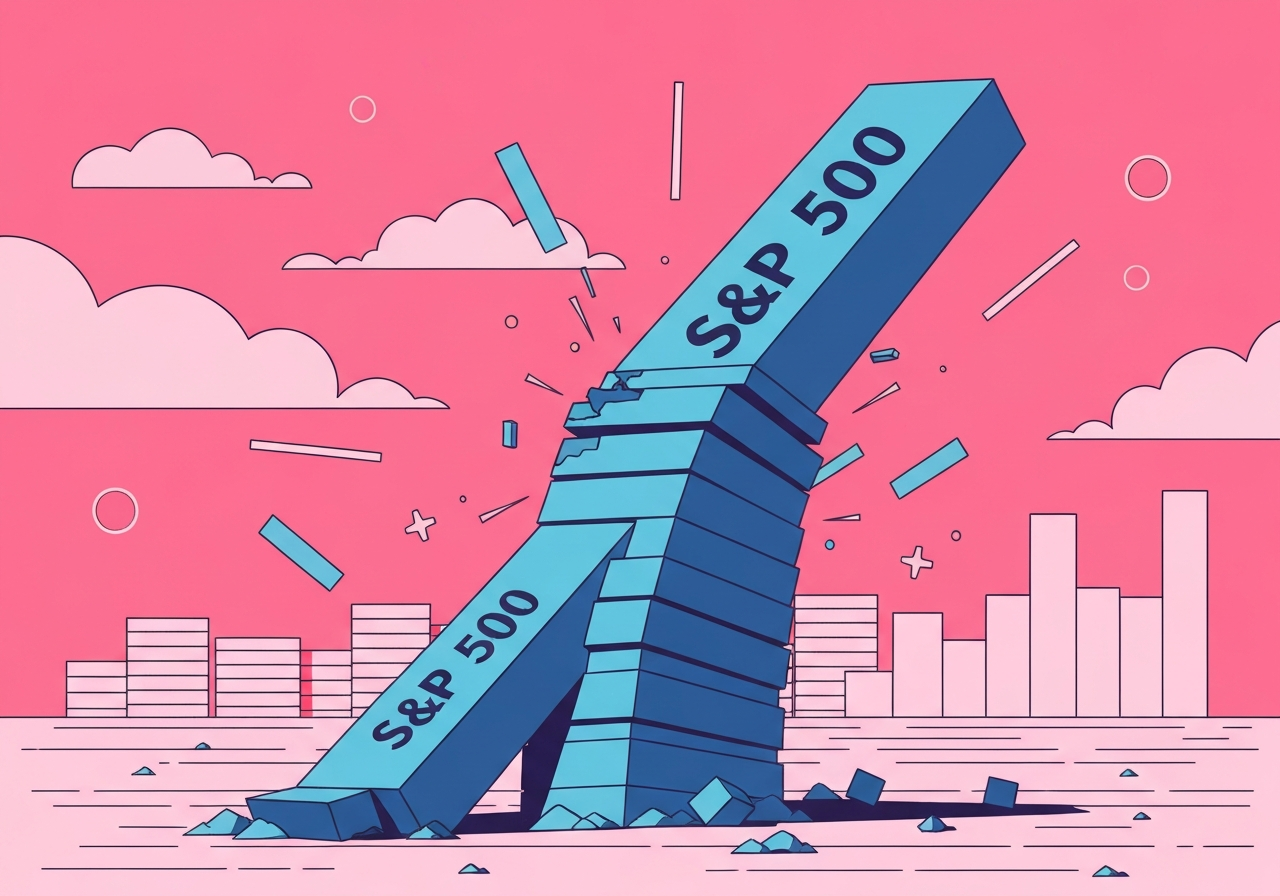
On Feb. 23, 2026, MarketWatch highlighted a widely shared commentary from Citrini Research, co-authored with Alap Shah of Lotus Technology Management, that frames a worst-case market outcome if AI delivers on its promise. The piece is written as a lookback from June 2028 in which unemployment has risen to 10.2% and the S&P 500 has fallen about 38% from its Oct. 2026 highs near 8,000. The scenario has circulated online over the weekend and prompted debate among investors, strategists and economists about whether a successful AI boom could paradoxically be bearish for broad markets.
Key Takeaways
- Citrini Research and guest author Alap Shah present a hypothetical June 2028 snapshot with national unemployment at 10.2%, a dramatic increase from mid-2026 levels.
- The scenario claims the S&P 500 slides roughly 38% from an Oct. 2026 peak near 8,000, implying a drawdown comparable to major historical corrections.
- The authors argue that a rapid AI-led productivity surge could accelerate job displacement in certain sectors, producing short- to medium-term consumer demand weakness.
- The commentary has gained traction on social platforms and financial forums since Feb. 21–22, 2026, amplifying investor concern and social debate.
- The piece is framed as a speculative lookback, not a contemporaneous forecast; its numbers are illustrative and designed to explore a risk pathway rather than to predict exact outcomes.
Background
Interest in AI’s macroeconomic impact has intensified as firms deploy large-scale automation, generative models and advanced decision tools across industries. Market valuations since 2023 have increasingly priced in an economic transformation driven by AI-driven revenue and cost gains, with some sectors concentrating much of the market’s market-cap gains. That concentration raises questions about systemic risk: if AI accelerates productivity but simultaneously disrupts income and employment for large worker groups, consumer spending could weaken even as corporate profits rise in certain pockets.
Historically, technological revolutions have produced both creative destruction and transitional dislocations; the 1990s internet boom and post-2008 automation waves offer precedents where sectoral gains coexisted with labor market stress. The Citrini piece uses a narrative technique — a retrospective from mid-2028 — to illustrate how those dynamics might play out under an especially rapid and uneven AI adoption path. Stakeholders include technology firms, labor groups, central banks, fiscal authorities and index investors, each with different incentives and tools to respond to such a shock.
Main Event
The commentary imagines an Oct. 2026 peak in the S&P 500 near 8,000, followed by a multi-quarter contraction culminating in a near-40% decline by June 2028. Authors posit that a concentrated AI gains cycle boosts profit margins in a handful of large firms while displacing jobs across services and mid-skill roles. The resulting rise in unemployment — presented as 10.2% in the scenario — is portrayed as a catalyst for lower aggregate demand and increased default risk for heavily leveraged households and businesses.
In the lookback narrative, policymakers initially delay aggressive fiscal or monetary offset because early data show productivity gains and subdued inflation, creating a policy lag. By the time labor-market deterioration becomes evident, central banks face a trade-off between supporting growth and addressing destabilizing financial conditions. The piece emphasizes feedback loops between concentrated equity market weakness, margin calls, and credit tightening.
Online reaction to the scenario has been mixed: some investors treat it as a plausible stress-test that highlights underpriced macro risk, while others dismiss it as alarmist because it assumes rapid, large-scale labor displacement without compensating demand-side adjustments. The MarketWatch summary on Feb. 23, 2026, captured this debate and noted the commentary’s role in stirring social-media discussion.
Analysis & Implications
If taken as a serious stress case rather than a literal forecast, the scenario serves three analytic purposes: it tests monetary and fiscal policy resilience, it probes the distributional effects of technology-driven growth, and it challenges the assumption that higher productivity automatically supports broad-based consumption. A central tension is timing — productivity gains can raise long-run output while transiently depressing incomes for workers whose skills are rendered less valuable.
For investors, the scenario underscores concentration risk in equity indexes. If a small set of mega-cap firms captures outsized profits, index-level valuations may mask underlying fragility in the broader economy. Diversified strategies, stress-testing for labor-market shocks, and attention to credit-market signals gain importance under this framing. Corporate earnings that hinge on cost cuts via automation may not translate into resilient demand if displaced workers reduce spending.
Policymakers would face hard choices. Expansionary fiscal policy targeted at displaced workers — retraining, wage supports, or income insurance — could mitigate demand shocks but requires political will and timely deployment. Central banks, observing an employment slump with mixed inflation signals, could be constrained in using standard playbooks. The scenario therefore highlights how technological success can create policy dilemmas rather than purely positive macro outcomes.
Comparison & Data
| Reference point | Value (Scenario) | Notes |
|---|---|---|
| Oct. 2026 S&P 500 peak | ~8,000 | Scenario baseline cited in the commentary |
| June 2028 S&P 500 | ~4,960 (−38%) | 38% decline from Oct. 2026 peak |
| June 2028 unemployment | 10.2% | Scenario figure presented by authors |
The table outlines the scenario’s headline numbers: an Oct. 2026 high near 8,000 on the S&P 500, a roughly 38% decline by June 2028, and unemployment at 10.2% in that retrospective. These figures are illustrative within the narrative device and are intended to quantify the pathway the authors wish to examine rather than to assert that these exact outcomes are imminent.
Reactions & Quotes
“If AI adoption runs faster than labor-market adjustment, near-term unemployment could spike even as certain firms post record profits.”
Citrini Research (paraphrased)
The Citrini Research framing—reported by MarketWatch—highlights the mismatch between firm-level gains and household incomes in the scenario. The phrasing above summarizes the piece’s core warning about distributional stress.
“A concentrated winners-take-most market can mask widespread demand weakness; that is the concern this retrospective seeks to illuminate.”
Alap Shah, managing partner, Lotus Technology Management (as quoted in MarketWatch)
Alap Shah, credited as a guest co-author, is cited in the MarketWatch summary as contributing to the narrative technique and the policy-focused implications described above.
Unconfirmed
- The precise projection of an Oct. 2026 S&P 500 peak at ~8,000 and a subsequent 38% drawdown by June 2028 is a narrative device within the commentary and is not an independently verified forecast.
- Exact causal pathways linking rapid AI adoption directly to a 10.2% national unemployment rate lack empirical validation in the piece; the authors present a stress-test scenario rather than an evidence-backed probability.
Bottom Line
The Citrini Research retrospective is valuable as a structured stress test: it forces investors, policymakers and the public to consider how concentrated technological gains might coexist with broader economic hardship. It does not predict a specific outcome but maps a plausible route by which AI-driven productivity could create troublesome distributional effects and macro instability if left unaddressed.
Readers should treat the numerical elements as illustrative. The scenario’s chief contribution is to shift the debate from a simple binary — AI is good or bad for growth — to a more nuanced question about who captures gains, how fast labor markets adjust, and whether policy frameworks can respond swiftly enough to blunt demand shortfalls. Those are the topics investors and officials should examine next.