
Lead
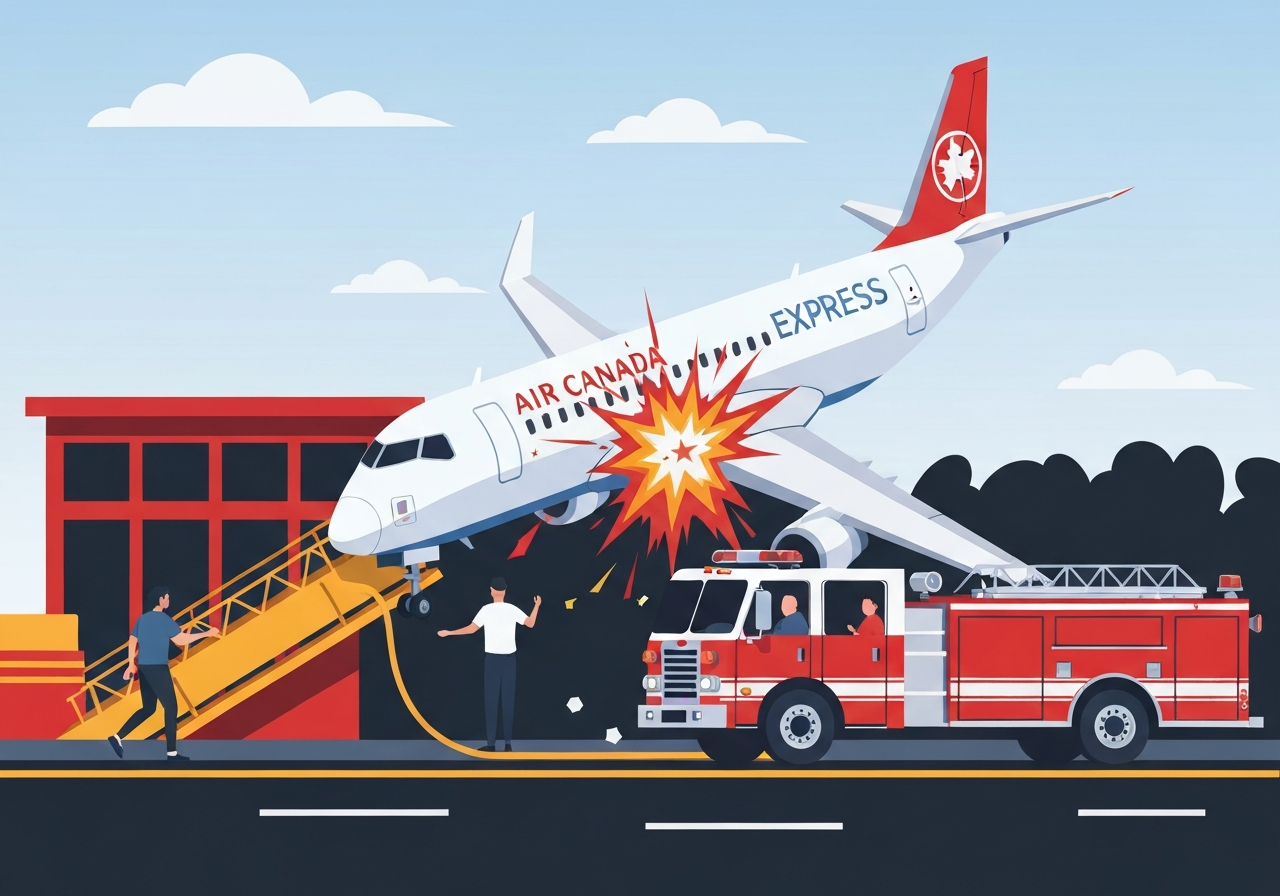
Late on Sunday night, March 23, 2026, Air Canada Express Flight 8646, a Bombardier CRJ-900 operated by Jazz Aviation, struck a Port Authority fire truck on Runway 4 at LaGuardia Airport, killing the two pilots and injuring dozens of people. The jet had arrived from Montreal with 72 passengers and four crew and came to rest with its nose sheared off; the collision occurred at about 11:40 p.m. Local emergency crews closed the airport and moved survivors to area hospitals while federal investigators opened a formal probe. Passengers described an abrupt, hard landing and an evacuation in which slides failed to deploy and many escaped via the wings.
Key Takeaways
- Two pilots were killed when Air Canada Express Flight 8646 collided with a fire truck at LaGuardia Airport at about 11:40 p.m. on March 23, 2026.
- The CRJ-900 was operating under Jazz Aviation with 72 passengers and four crew; 41 people were taken to hospitals and 32 had been released by early Monday.
- One flight attendant, identified as Solange Tremblay, was ejected from the aircraft and sustained a broken leg; she was alive and hospitalized.
- The fire truck was responding to a separate call reporting an odor in another aircraft; two truck occupants were hospitalized in stable condition.
- Air traffic audio reviewed publicly suggests controllers were managing an earlier emergency minutes before the collision; whether this contributed to the crash is under investigation.
- Flight data from FlightRadar24 shows the jet touched down at roughly 132 knots (151 mph) and slowed to about 21 knots (24 mph) within a minute, consistent with normal deceleration before impact.
- LaGuardia was closed until at least 2 p.m. Monday, forcing more than 500 cancellations and diversions to nearby airports and disrupting regional travel.
Background
LaGuardia Airport, in Queens, New York, is a high-density domestic and regional hub that handles roughly 900 daily flights. The facility has been the focus of safety and congestion initiatives following a string of runway incidents in 2023 that prompted Federal Aviation Administration reviews, grant programs and new runway-incursion mitigation efforts. Port Authority operations and the FAA have been implementing technology and training upgrades, while manufacturers and avionics suppliers have expanded runway-vehicle detection tools.
The aircraft involved, a Bombardier CRJ-900, was operated by Jazz Aviation for Air Canada under a capacity purchase agreement. Jazz is Canada’s largest regional carrier and operates the Air Canada Express brand on routes including Montreal–New York. The National Transportation Safety Board (NTSB) routinely leads investigations of U.S. runway collisions; Canada’s Transportation Safety Board has dispatched a team because the airframe and operator are Canadian-affiliated.
Main Event
Flight 8646 landed from Montreal late Sunday and, according to tracking data, decelerated sharply after touchdown. As the jet slowed on a rain-slick runway, it collided with a Port Authority crash truck that had been cleared to cross Runway 4 while responding to a separate aircraft reporting an odor in the cabin. Video reviewed by news organizations shows the airplane and the truck converging before a cloud of smoke and debris enveloped the scene.
Passengers and crew described rapid, chaotic moments during and after impact. Flight attendants had warned passengers before descent of a possible emergency landing; after impact, several passengers said emergency slides did not deploy and they evacuated over the wings. Multiple passengers suffered cuts and bruises; one flight attendant was ejected from the aircraft while still belted, according to family statements and eyewitness accounts.
Port Authority officials said 41 people were taken to hospitals, 32 of whom were later released, and that some remaining patients sustained serious injuries. Two officers in the fire truck were hospitalized in stable condition. Municipal and federal responders secured the scene, removed wreckage, and began evidence preservation for the NTSB investigation; the cockpit area was heavily damaged and partially sheared from the fuselage.
Airlines and ground operations at LaGuardia were disrupted well into Monday, with airline rebookings, cancellations and diversions creating a ripple effect across the Northeast air travel network. City officials advised avoiding the airport area because of road closures and ongoing emergency activity.
Analysis & Implications
The collision underscores the persistent risk of runway incursions when aircraft and emergency vehicles operate in close proximity on active movement areas. While runway safety programs and technology investments have reduced many categories of incursion risk, the incident highlights the operational complexity at busy airports during low-visibility or wet conditions and simultaneous ground responses. Investigators will examine clearance procedures, controller communications, and ground-vehicle dispatch protocols to determine if systemic gaps played a role.
Staffing patterns and shift levels in control towers are relevant but not determinative alone; air traffic staffing typically decreases overnight, and experts note that with fewer movements controllers nonetheless retain full responsibility for runway vehicle coordination. The publicly available tower audio indicates controllers were addressing an earlier emergency, but attribution of causality requires a full record of recordings, staffing logs, radar data and runway-surface vehicle transponder data.
Operational lessons could include stricter procedures for vehicle crossings during incoming landings, revised dispatch protocols for airport firefighting units, and technical mitigations such as geo-fencing for vehicles or integration of surface detection systems with tower displays. Manufacturers and airlines also face scrutiny over evacuation equipment performance after several passengers reported that slides did not deploy; maintenance records and post-crash system checks will be examined.
Comparison & Data
| Metric | Value |
|---|---|
| Flight | Air Canada Express 8646 |
| Aircraft | Bombardier CRJ-900 (operated by Jazz Aviation) |
| Occupants | 72 passengers, 4 crew |
| Hospitalized | 41 (32 released as of early Monday) |
| Fatalities | 2 pilots |
| Collision time | ~11:40 p.m. ET, March 23, 2026 |
In the 12 months ending September 2024, government data showed fewer than two dozen near-miss runway incidents categorized as serious each year, with contributory factors including pilot, controller and vehicle errors; those historical proportions provide comparative context but do not predict cause for this event. The immediate operational impact—over 500 canceled flights—reflects LaGuardia’s concentrated regional schedule and the limited alternative capacity on short notice.
Reactions & Quotes
Air Canada’s leadership and Canadian officials expressed sorrow and pledged cooperation with U.S. investigators; airline executives emphasized support services for affected families. Company and government statements indicated hotlines and consular assistance were activated for passengers and relatives.
“This is a difficult day for everyone. We are working to confirm the full extent of injuries and to support families.”
Michael Rousseau, Chief Executive, Air Canada (company statement)
Port Authority and city officials described a large-scale emergency response and confirmed that investigators would have full access to the scene. Local authorities urged travelers to check flight status and avoid the area while recovery operations continued.
“We were responding to a separate aircraft issue when this tragic collision occurred. Our teams are assisting investigators and caring for the injured.”
Kathryn Garcia, Executive Director, Port Authority of New York and New Jersey (official briefing)
Survivors and witnesses conveyed the immediacy of the evacuation and their belief that crew and pilots acted to protect passengers even as they were fatally injured. Family members of the ejected flight attendant described relief that she survived and required surgery for serious injuries.
“She really does have a guardian angel watching over her.”
Sarah Lépine, daughter of flight attendant Solange Tremblay (family interview)
Unconfirmed
- Whether a specific controller distraction or communication error directly contributed to the collision remains unconfirmed pending full NTSB review.
- Why the aircraft’s evacuation slides did not deploy for multiple doors has not been publicly confirmed and will require technical inspection.
- The precise braking, steering and control inputs by the flight crew during the final touchdown sequence are not yet released and remain under investigation.
Bottom Line
The March 23 collision at LaGuardia that killed two pilots and injured dozens is a rare but grave example of how ground and air operations can intersect with deadly results. Immediate priorities are supporting victims and families, preserving evidence for a thorough NTSB-led investigation, and restoring safe operations at a major regional hub.
Looking ahead, investigators will determine procedural and technical causes; regulators and airports may adopt additional controls or technology to reduce the chance of vehicle-aircraft conflicts. For travelers, the incident reinforces the value of real-time airline and airport communications as networks recover and flights resume.