
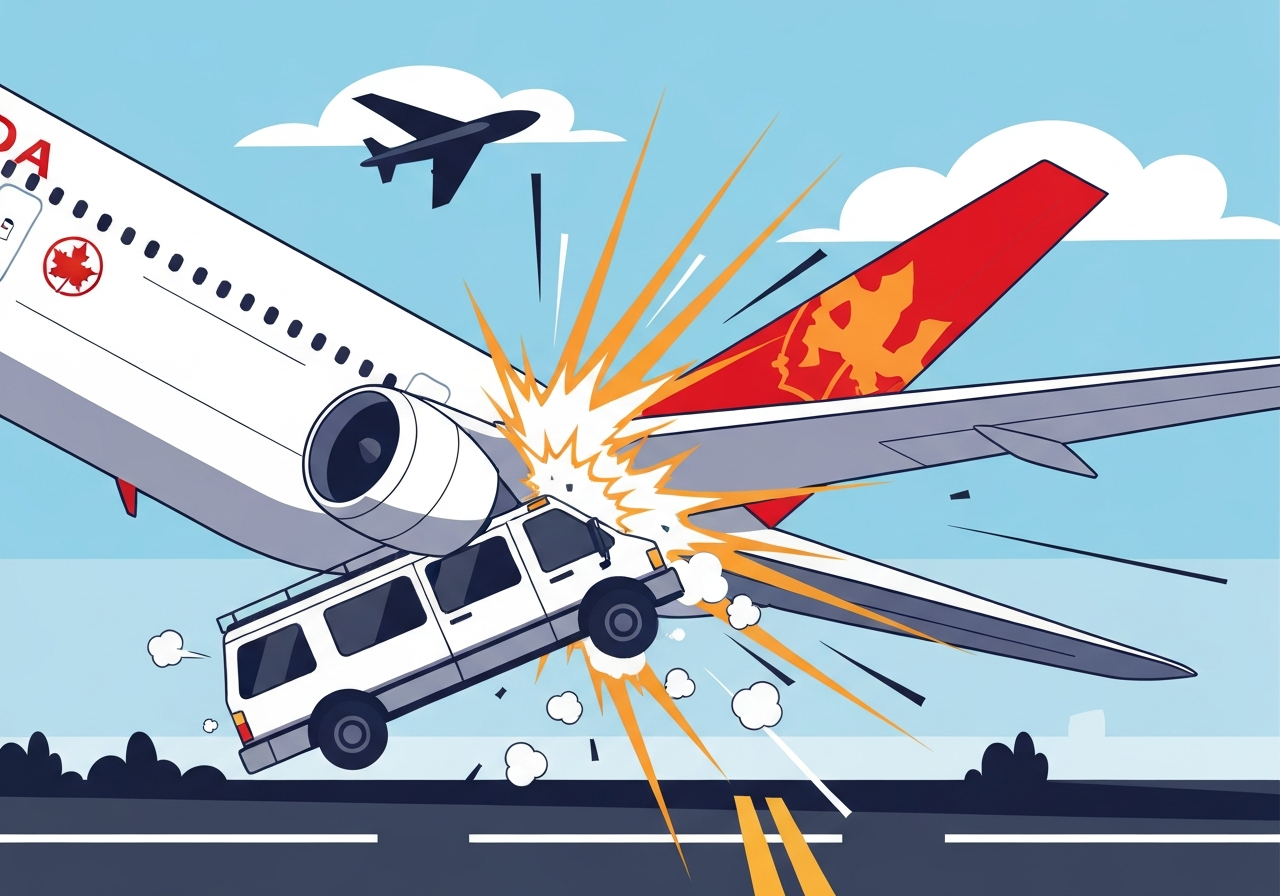
Shortly before midnight on Sunday, an Air Canada Express flight operated by Jazz Aviation struck a Port Authority aircraft rescue and firefighting (ARFF) vehicle on Runway 4 at New York’s LaGuardia Airport. The collision, reported at about 11:38pm local time, prompted an immediate emergency response from FDNY and NYPD and led the FAA to issue a ground stop that suspended all operations at LaGuardia. The flight had originated at Montréal–Pierre Elliott Trudeau International Airport and a preliminary passenger list indicated 72 passengers and four crew members. Authorities closed the field and warned travelers to expect widespread cancellations and delays while investigators and emergency crews secured the scene.
Key takeaways
- The incident occurred at approximately 11:38pm on Sunday on Runway 4 at LaGuardia Airport; the FAA issued a ground stop affecting all flights into and out of the airport.
- The aircraft was a Jazz Aviation-operated service flying for Air Canada Express from Montréal–Pierre Elliott Trudeau; a preliminary list showed 72 passengers and four crew.
- The Port Authority confirmed the aircraft struck one of its ARFF vehicles that was responding to a separate incident on the field.
- FDNY personnel responded to reports of a plane collision; NYPD confirmed the collision but had limited immediate details.
- New York City emergency management warned of cancellations, road closures and traffic delays near the airport and advised travelers to use alternate routes.
- FAA notices indicated the airport could remain closed until 2:00pm local time (1800 GMT), signaling a high probability of an extended disruption.
Background
LaGuardia is one of New York City’s primary domestic gateways and handles a high volume of short-haul commercial traffic; runway disruptions at the airport quickly ripple across the regional system. Aircraft rescue and firefighting vehicles are routinely staged to respond to incidents on the airfield and work under procedures intended to protect passengers and crews while clearing hazards. Jazz Aviation operates flights for Air Canada Express under a regional partnership; these services link major Canadian airports with key U.S. hubs, making the Montréal–New York route a frequent short-haul connection.
Runway operations at major airports are tightly coordinated among airport operations, carriers, and federal regulators, and an emergency on the field typically triggers layered responses: first-responder activity, operational holds or ground stops from the FAA, and passenger re-accommodation by carriers. The Port Authority of New York and New Jersey manages LaGuardia’s facilities and airport emergency services; when a Port Authority ARFF vehicle is involved in an incident, the agency becomes a central actor in both immediate response and subsequent investigation.
Main event
According to statements from the Port Authority, the collision occurred while an ARFF vehicle was responding to an unrelated incident on Runway 4. At about 11:38pm, the Jazz Aviation flight operating for Air Canada struck that vehicle. FDNY said its crews responded to reports of a plane colliding with a vehicle and worked on-scene alongside Port Authority personnel and NYPD officers to secure the area.
Air Canada Express confirmed the accident and noted a preliminary passenger manifest listing 72 passengers and four crew; the airline emphasized that the passenger list remains subject to confirmation. Online flight tracking data showed the flight had departed Montréal–Pierre Elliott Trudeau International Airport earlier in the evening. Airport operations were suspended while emergency teams assessed damage, checked for injuries and cleared debris from the runway.
The FAA issued a ground stop that halted all arrivals and departures at LaGuardia; its notice cited an emergency and warned of a high probability of extension. A separate FAA advisory indicated the airport could remain closed until 2:00pm local time (1800 GMT) the following day, creating the potential for dozens if not hundreds of cancelled or delayed flights across the New York metro area.
Analysis & implications
Operationally, a runway collision involving an ARFF vehicle is significant because those vehicles are integral to airport emergency response. The fact the vehicle was responding to another incident raises immediate questions about runway coordination and communication protocols between air traffic control, airport operations and emergency responders. Investigators will examine whether normal safeguards—such as NOTAMs, tower coordination and vehicle transponder/lighting protocols—were fully observed.
For passengers and airlines, the immediate consequence is disruption: rebooking, ground transportation congestion and potential ripple effects for connecting flights and crew schedules across carriers. LaGuardia’s constrained footprint amplifies these effects because alternative runways and taxiways are limited relative to larger hubs, so even a single runway closure can sharply curtail throughput for hours.
From a regulatory and liability perspective, the incident will likely prompt inquiries by the FAA, the Port Authority and local law enforcement. Potential outcomes range from procedural revisions and retraining to technical changes in vehicle-tracking or tower-ARFF communication systems. Any injuries, damage assessments and final causal findings will shape whether regulatory enforcement actions or litigation follows.
Economically, while one incident rarely causes systemic financial damage, the timing and duration of a closure at a high-density airport like LaGuardia can have outsized effects on short-haul business travel, same-day connecting itineraries and time-sensitive cargo flows in and out of the region. Airlines and the Port Authority will have to coordinate restoration plans and traveler communications to limit longer-term reputational impacts.
Comparison & data
| Item | Detail |
|---|---|
| Flight origin | Montréal–Pierre Elliott Trudeau International Airport |
| Operator | Jazz Aviation (operating for Air Canada Express) |
| Passengers / Crew | Preliminary: 72 passengers, 4 crew |
| Location | Runway 4, LaGuardia Airport (Queens, NY) |
| Reported time | About 11:38pm local time (Sunday) |
| FAA advisory | Ground stop; possible closure until 2:00pm local (1800 GMT) |
The table summarizes core public facts reported by authorities and flight tracking sources. Those figures provide the baseline for operational and investigative actions: passenger accounting and manifest verification, ARFF vehicle condition and location, tower transcripts and surveillance video. Investigators will combine these elements to reconstruct the sequence and determine whether human error, equipment failure or procedural gaps contributed to the collision.
Reactions & quotes
“At approximately 11:40pm on Sunday, a Jazz Aviation flight operating on behalf of Air Canada was involved in an incident on Runway 4… in which the aircraft struck a Port Authority aircraft rescue and firefighting vehicle that was responding to a separate incident.”
Port Authority of New York and New Jersey (official statement)
“Firefighters responded to reports of a plane that crashed into a vehicle on the runway at 11:38pm,”
FDNY spokesperson (official response)
“Expect cancellations, road closures, traffic delays and emergency personnel near LaGuardia — use alternate routes.”
New York City Emergency Management (social advisory)
Unconfirmed
- No official, confirmed statement on passenger or crew injuries has been released at the time of reporting.
- The precise cause of the collision—whether procedural breakdown, communication lapse or equipment failure—remains under investigation.
- Final estimates for the duration of the airport closure beyond the FAA advisory window (until 2:00pm local) have not been confirmed.
Bottom line
The collision between an Air Canada Express-operated aircraft and a Port Authority ARFF vehicle on LaGuardia’s Runway 4 has produced an immediate operational shutdown and prompted multi-agency responses. Key near-term priorities are passenger safety, scene clearance and restoring safe runway operations while investigators reconstruct the sequence of events.
Travelers should expect continued disruption through the advised FAA window and monitor official airline and Port Authority channels for rebooking and status updates. The incident will also trigger scrutiny of runway-vehicle coordination and emergency response procedures; investigators’ findings will determine whether corrective measures, procedural changes or equipment upgrades are warranted to reduce future risk.
Sources
- The Guardian (media report)
- Port Authority of New York and New Jersey (official/press statements)
- U.S. Federal Aviation Administration (official advisory/ground stop notices)
- FlightAware (flight-tracking data)
- New York City Emergency Management (official public advisories)