
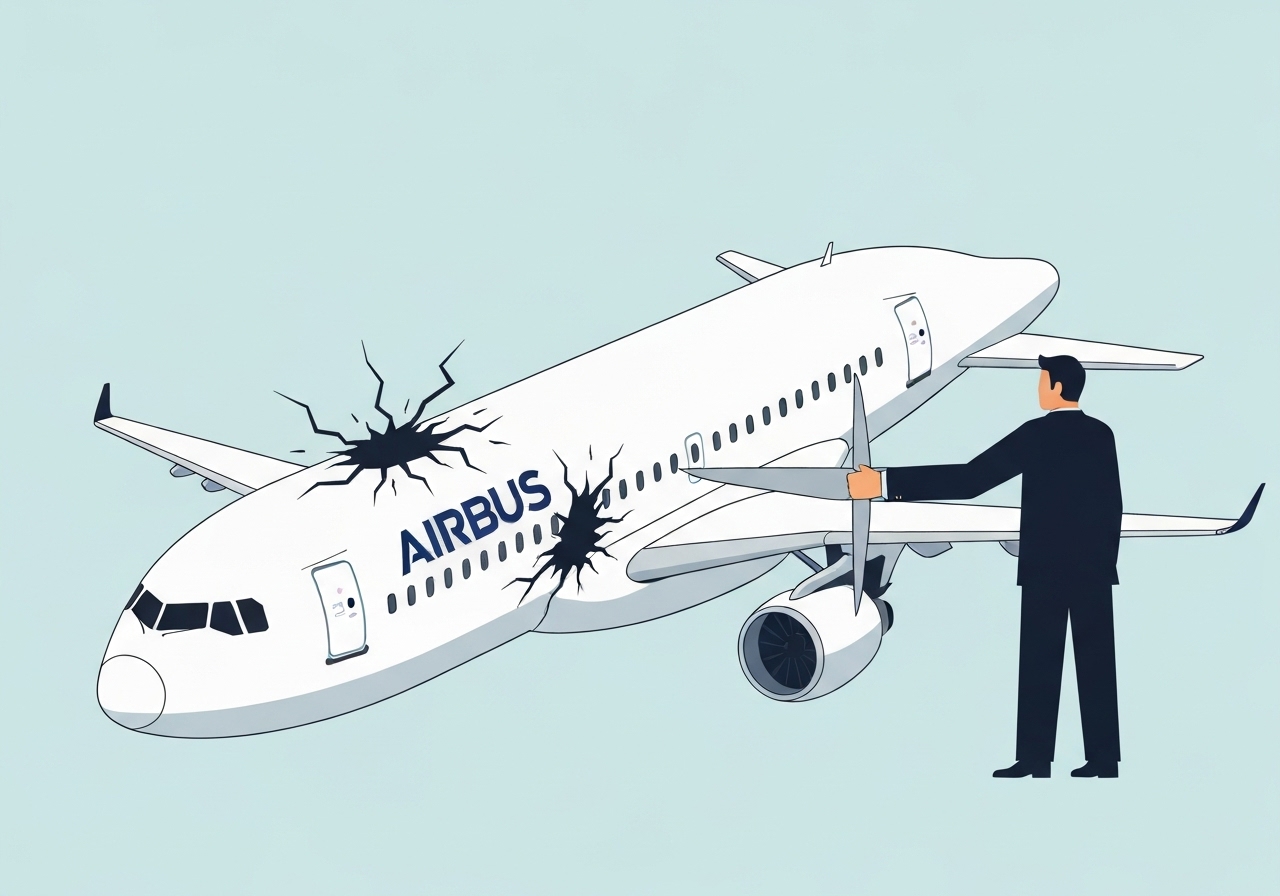
Airbus said on Wednesday it will cut its 2025 commercial delivery target to “around 790” aircraft after discovering incorrect-thickness metal fuselage panels on certain A320-family jets, forcing inspections across hundreds of airframes and temporary operational disruptions for carriers. The reduction of 30 units from the prior 820-plane target follows a weekend series of fixes and checks that began with software updates on about 6,000 A320s and then expanded when metal-skin anomalies were identified. The company said the parts in question were supplied by Seville-based Sofitec Aero and that, while inspections are extensive, the panels are not currently believed to pose an immediate safety risk. Airbus maintained its full-year adjusted operating profit target of roughly €7bn (£6.1bn) even as it prepares to publish November delivery figures on Friday.
- Airbus reduced its 2025 delivery target from 820 to “around 790”, a cut of 30 aircraft.
- A presentation reviewed by Reuters indicated 628 A320-family jets require inspection: 168 in service, 245 on final assembly lines and 215 at major component assembly.
- Earlier this weekend Airbus ordered software updates affecting about 6,000 A320s, more than half of the global A320 fleet.
- When the weekend recall was issued to over 350 operators, roughly 3,000 A320-family aircraft were airborne, prompting some cancellations and delays.
- The panels at issue are metal skins behind the cockpit, beside each forward door; the supplier named in briefings is Sofitec Aero, based in Seville.
- Airbus signalled it still expects a full-year adjusted operating profit of about €7bn (£6.1bn) despite the delivery cut.
- Recent supply-chain strains, including Pratt & Whitney engine delays, have compounded production pressures at Airbus.
Background
The A320 family is the world’s most-delivered commercial aircraft model and remains central to Airbus’s production and airline backlog. That record-setting status came into sharper focus recently when Airbus overtook Boeing’s 737 as the most-delivered jet. High-volume production across multiple lines and global suppliers creates efficiency but also raises exposure to component defects and logistics disruptions when they arise.
Airbus has faced repeated supply-chain challenges in 2025, from engine delivery delays by Pratt & Whitney to sporadic supplier-quality issues. The company runs a tightly sequenced manufacturing system: major component assembly, final assembly lines, and entry-into-service processes, so a problem at one supplier can ripple across multiple production stages. Regulators and airlines closely monitor such events because they affect capacity planning and near-term schedules.
Main Event
The incident began earlier in the weekend when Airbus asked operators to apply software updates across roughly 6,000 A320-family aircraft to address a separate technical issue; many carriers paused flights while updates were installed. Although most software-related glitches were resolved by Monday, Airbus then identified a distinct problem with the thickness of certain metal fuselage panels at the forward section of some A320 variants.
A briefing slide seen by Reuters and discussed with carriers listed a total of 628 aircraft needing inspection: 168 already in service, 245 on final assembly lines and 215 at the major component assembly stage. The affected skins are located behind the cockpit on each side of the two forward doors, and Airbus has said the parts were produced by Sofitec Aero in Seville.
Airlines reported cancellations and delays over the weekend as inspections and temporary fixes were rolled out; by midweek most immediate software issues were addressed but complementary checks for the metal panels continued. Airbus said there were no current indications the panels posed an immediate safety threat, but ordered rigorous inspections to confirm conformity and airworthiness prior to delivery or further flight operations.
Analysis & Implications
The delivery cut to around 790 aircraft reduces short-term throughput but, by Airbus’s account, is manageable within its financial planning: the firm reiterated guidance for an adjusted operating profit near €7bn. That suggests Airbus expects the inspections and rework to be absorbed without large additional charges, at least for now. However, if more widespread quality defects emerge or repairs require significant rework, costs and delivery slippages could widen.
For airlines, the immediate risk is operational disruption. Carriers that planned to take recently built A320-family frames may face short-notice substitutions, delays or deferments, complicating winter schedules. Lessors and airlines with tight fleet utilization plans may need contingency capacity or short-term wet-lease agreements, which are costly and logistically complex during peak travel periods.
From a supply-chain perspective the episode highlights the fragility of multi-sourced, high-rate manufacturing. Sofitec Aero’s role as the supplier cited in briefings will draw scrutiny from Airbus and regulators; buyers may push for more intensive supplier audits, higher incoming inspection rates, or design-tolerance reviews. Longer term, pressure to diversify suppliers or to increase vertical control could reshape vendor relationships but would take time and investment to implement.
Comparison & Data
| Metric | Previous target | New/affected |
|---|---|---|
| 2025 delivery target | 820 aircraft | ~790 aircraft |
| Planes requiring inspection (total) | – | 628 aircraft |
| Of which in service | – | 168 aircraft |
| On final assembly lines | – | 245 aircraft |
| At major component assembly | – | 215 aircraft |
| A320s affected by software update | – | ~6,000 jets |
The table shows inspection counts and the revised delivery target; Airbus’s decision to hold its profit guidance suggests the company currently expects the issue will be operationally disruptive but financially contained. Market reaction has been mixed: shares rose more than 2% on Wednesday morning but have not fully recovered losses seen since the software event first surfaced.
Reactions & Quotes
Airlines and regulators moved quickly to apply the checks Airbus recommended, while industry observers flagged the event as another illustration of supply-chain sensitivity at high production rates.
“We now expect to deliver around 790 commercial aircraft this year,”
Airbus (official statement)
An independent aviation analyst noted the reputational and scheduling risks even when immediate safety concerns are limited; carriers must weigh the cost of rapid inspections against operational disruption. A trade-body spokesperson said they were working with members to assess the scale of schedule impact and to secure contingency capacity where needed.
Unconfirmed
- Whether any additional undisclosed suppliers beyond Sofitec Aero produced affected panels remains under investigation and has not been independently verified.
- The full cost impact to Airbus and the precise schedule delays for specific airline customers are not yet publicly confirmed and could change as inspections conclude.
Bottom Line
The A320-family inspections have forced Airbus to trim its 2025 delivery target by about 30 aircraft and to run targeted checks across hundreds of jets, but the company currently expects to hold its full-year adjusted operating profit guidance near €7bn. In the short term airlines face scheduling disruption and possible aircraft substitutions; in the medium term this episode may intensify scrutiny of suppliers and strengthen incoming quality control measures across the industry.
Investors and operators should watch for the November delivery report due on Friday and for any regulator findings or supplier remediation plans that could change the financial and operational outlook. If inspections identify wider conformity problems, the cumulative effect on deliveries and costs could grow significantly, but for now Airbus frames the issue as contained and manageable.
Sources
- The Guardian (media report summarising the event and industry reaction)
- Airbus Newsroom (official corporate statements and press releases)