
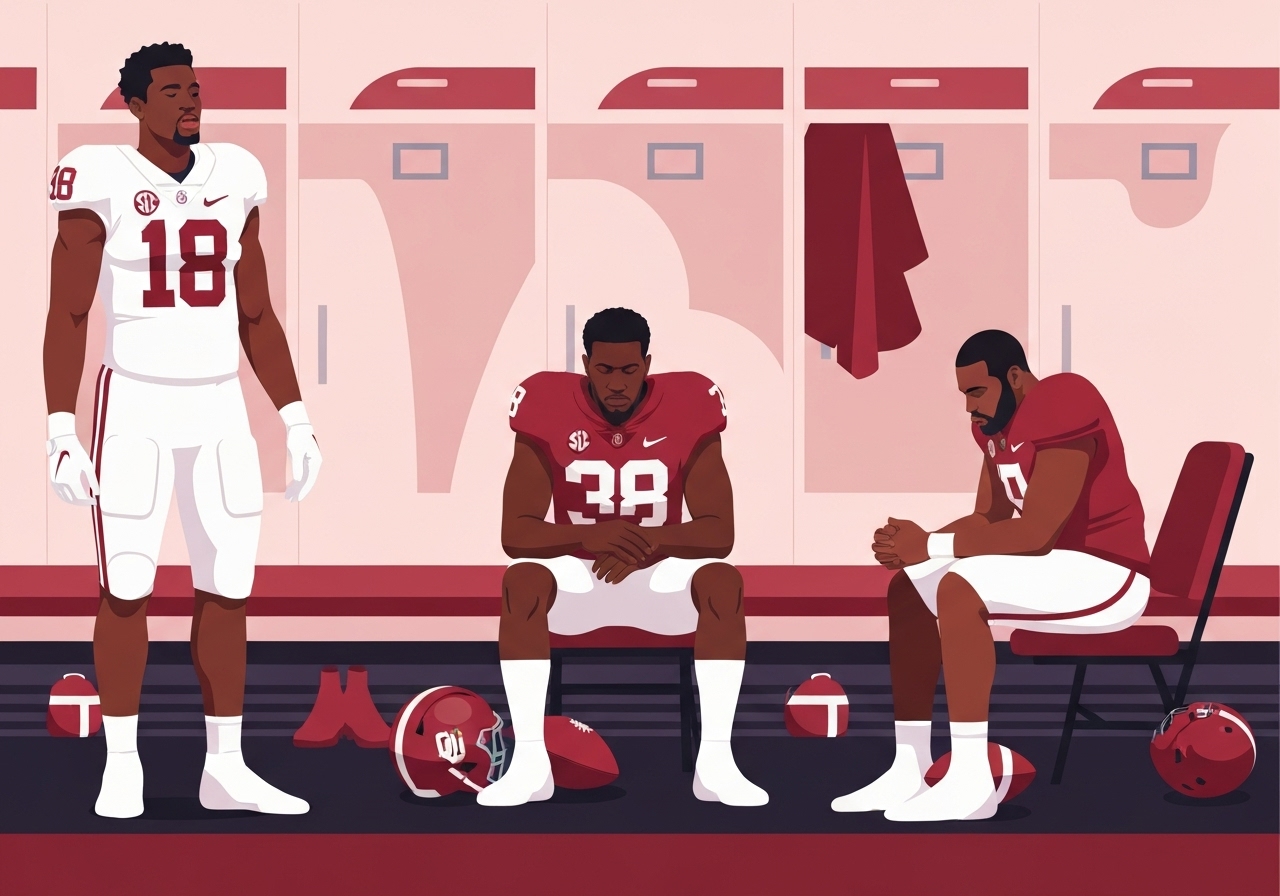
Lead: After Alabama’s 23-21 loss to Oklahoma at Bryant-Denny Stadium on Saturday, the Tide’s locker room was a study in stunned focus rather than collapse. Many players on the roster had never experienced a home defeat at Bryant-Denny, and only five who played against Oklahoma also appeared in Alabama’s most recent home loss to Texas. With no remaining players from the last SEC home loss in 2019, the young roster processed the setback together and turned quickly toward recovery. Team leaders framed the moment as disappointment mixed with resolve to return to work.
- Score and setting: Alabama lost 23-21 to Oklahoma at Bryant-Denny Stadium on Saturday, a rare home defeat for the Tide.
- Roster continuity: Only five players in the Oklahoma game also played in Alabama’s most recent home loss to Texas; none remain from Alabama’s last SEC home loss in 2019.
- Locker-room mood: Captains described the postgame room as predominantly silent but unified, with players supporting one another and preparing to refocus.
- Leadership response: Quarterback Ty Simpson and captains Deontae Lawson and Tim Keenan emphasized anger, unity, and a commitment to immediate work.
- Team culture: The squad reiterated a stated theme of being ‘unbreakable,’ framing the defeat as a rallying point rather than a fracture.
- Short-term impact: Players said there was no rift in the locker room and that preparation for the next steps began quickly after the final whistle.
Background: Alabama football under head coach Nick Saban has long cultivated an expectation of dominance at Bryant-Denny Stadium; home losses are comparatively uncommon and register sharply with fans and players alike. The program’s recent home setbacks are infrequent: the Tide’s most recent home loss to Texas occurred more than two seasons prior to the Oklahoma game, and the last home loss to an SEC opponent dates to 2019, from which no current roster members remain. That turnover means the current squad includes many who had never been through a home defeat at Bryant-Denny, heightening the emotional impact.
Within that context, locker-room rituals and leadership roles carry extra weight after a rare setback. Team captains and upperclassmen are expected to set the tone, and coaching staff typically moves quickly into corrective sessions focused on technique, assignments, and mental approach. For Alabama, a program that measures success by conference titles and national contention, a single close loss can prompt substantial internal review while avoiding public fracturing. The interplay between public fan reaction on the streets of Tuscaloosa and private team processing in Saban Field’s locker room frames how the program will respond in the days that follow.
Main Event: The final score — 23-21 — produced stunned silence among many in the visiting stands and a stream of disappointed fans into the streets of Tuscaloosa. Inside the basement of Saban Field, players described a locker room where visible anger and quiet reflection coexisted. Quarterback Ty Simpson summarized the immediate mood with a terse appraisal: ‘Everybody’s mad. We should feel like that.’ That short quote captured leaders’ intent to convert emotion into effort rather than blame.
Linebacker and team leader Deontae Lawson invoked the squad’s declared identity when discussing the aftermath, saying the group remains bonded under a theme of being ‘unbreakable.’ Lawson framed the locker-room scenes not as evidence of division but as proof of mutual support: teammates were still exchanging gestures of solidarity and committing to work. Defensive tackle and captain Tim Keenan, who was also on the roster for the recent Texas loss, called the room ‘silent’ but insisted that regrouping would follow immediately. Keenan emphasized the need to ‘get back to work,’ signaling a focus on corrections rather than recriminations.
Fifth-year tight end Josh Cuevas said the immediate atmosphere was one of disappointment tempered by hunger to improve. He described players as concentrated on fundamentals and trusting one another to execute moving forward. Coaches and staff, according to players, began schematic and mental adjustments that night, preparing meetings and practice plans aimed at addressing the issues exposed in the contest. The combination of veteran voices and a largely young roster shaped a postgame dynamic oriented toward growth.
Analysis & Implications: A close home loss like this carries several implications for Alabama’s season and program narrative. First, the rarity of home defeats underlines how such outcomes can amplify scrutiny: because most of the roster had no prior experience with home losses, the event functions as a learning moment that may accelerate leadership development. The presence of only five players who also played in the Texas loss means institutional memory is limited, placing greater responsibility on the current captains and coaching staff to translate the setback into constructive change.
Second, the public display of unity in the locker room — players dapping up and reaffirming support — helps mitigate rumors of a fractured team culture. For recruiting, public perception, and internal morale, quick demonstrations of cohesion reduce the risk of secondary effects that sometimes follow high-profile losses. However, unity alone does not fix tactical or executional problems; coaching adjustments and player accountability must follow.
Third, the short-term competitive impact depends on how the staff and leaders address specific breakdowns that cost the team points or field position. A narrow loss suggests marginal differences in execution or decision-making were decisive, and Alabama’s corrective window is narrow in a season where each game can shift rankings and postseason trajectories. Externally, conference opponents and national media will dissect the film; internally, the team must balance critical self-assessment with preserving confidence.
| Game | Score | Players from prior loss still on roster |
|---|---|---|
| Alabama vs Oklahoma (Saturday) | 23-21 | 5 also played in recent Texas home loss |
| Last SEC home loss (2019) | N/A | 0 remain on current roster |
The table underscores roster turnover and the comparative rarity of home defeats. With no roster carryover from the 2019 SEC home loss, institutional reactions rely on coaches and a relatively young leadership group. The five players who bridge the Texas and Oklahoma games serve as important conduits for continuity, but the broader trend is one of renewal, which can affect how the program internalizes and responds to setbacks.
Reactions & Quotes: Team leaders and observers offered concise takes that illuminate the locker-room tone and the team’s next steps. Players describe a mix of anger, silence, and rapid refocusing, consistent with a program that seeks to convert disappointment into preparation.
Before and after the locker-room recaps, teammates emphasized unity and work ethic as the immediate response to the loss. The following quotes reflect that atmosphere:
Everybody’s mad. We should feel like that.
Ty Simpson
Simpson’s short remark communicated both frustration and the expectation that emotion should translate into effort rather than give way to defeatism. As the team’s quarterback, his tone set a simple directive: recognize the disappointment and respond in practice and preparation.
We’re just unbreakable. I don’t feel as anyone on our team is going to split from each other… We going straight to work.
Deontae Lawson
Lawson tied the locker-room behavior to a stated team identity, stressing that gestures of support and immediate commitment to work were visible. His framing aims to reassure stakeholders that the program’s internal bonds remain intact and that the leadership intends to channel emotion productively.
We just got to regroup and get back to work.
Tim Keenan
Keenan’s assessment echoed a pragmatic approach from an upperclassman with prior experience of a home loss. His emphasis on regrouping points to concrete next steps — coaching meetings, film review, and practice adjustments — rather than extended public commentary.
Unconfirmed:
- Reports of any internal disciplinary measures for specific players after the game have not been confirmed and remain unreported.
- Details about particular tactical decisions or play calls that are claimed by unnamed sources to have cost the game have not been independently verified.
Bottom Line: The 23-21 loss to Oklahoma at Bryant-Denny Stadium is a notable event for a roster that, in large part, had not experienced a home defeat. Players and captains framed the immediate aftermath as a mixture of disappointment and unity, signaling that the team will focus on corrective work rather than internal division. The limited roster continuity with the 2019 SEC home loss means leadership and coaching will shape how the program absorbs this setback and adapts on the fly.
In the short term, Alabama’s response will hinge on specific tactical corrections, accountability at key positions, and maintaining team confidence. For observers, the visible unity in the locker room reduces the likelihood of a lingering public narrative of collapse; the real test will be whether the coaching staff and players translate that unity into improved execution in upcoming games.
Sources:
- 247Sports (media report)