
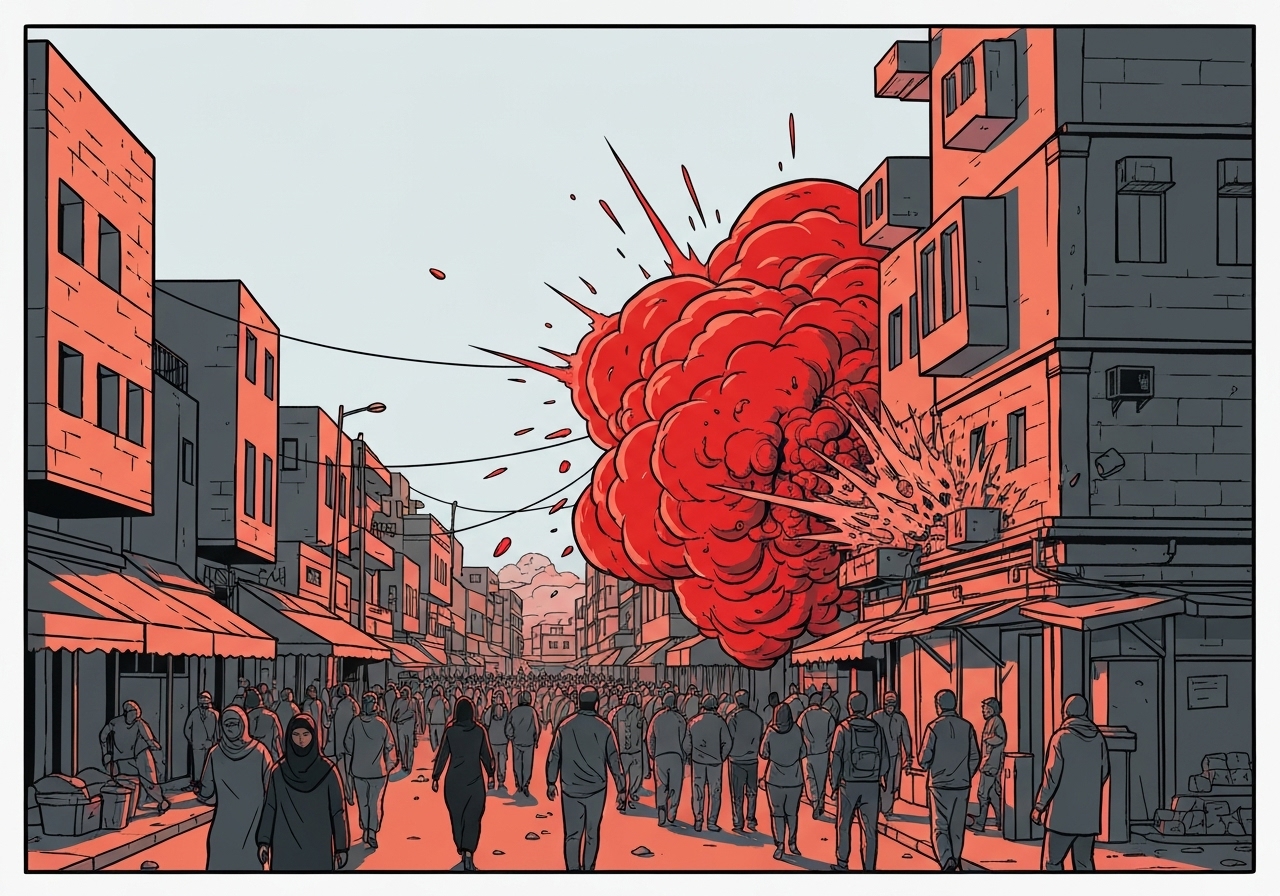
On 31 December 2025 a suicide bomber detonated an explosive belt in Aleppo’s Bab al‑Faraj neighbourhood, killing one police officer and wounding two others as security personnel who were guarding New Year’s Eve events moved to detain him. State media SANA and officials quoted by Al‑Ikhbariah said officers had observed the suspect and tried to arrest him before the device was set off. Authorities have sealed the scene, opened an investigation and said the wounded are receiving hospital treatment. No group has publicly claimed responsibility for the blast.
Key Takeaways
- One police officer was killed and two others wounded in a suicide bombing in Aleppo on 31 December 2025 while protecting New Year’s Eve gatherings.
- Officials, including Syria’s Interior Ministry spokesman Noureddine al‑Baba, said the bomber detonated an explosive belt when officers moved to detain him.
- Authorities say the likely intended target was a church gathering in Bab al‑Faraj; this assessment remains under investigation.
- Aleppo governor Azzam al‑Gharib reported that one officer physically restrained the attacker before the detonation.
- No immediate claim of responsibility has been made; the blast follows a 26 December attack on an Alawite mosque in Homs that killed at least eight people.
- Security forces established a perimeter at the scene and are continuing forensic and criminal inquiries.
Background
Syria continues to face sporadic, deadly attacks after more than a decade of conflict that reshaped the country’s security landscape. The civil war, which lasted more than 13 years and culminated in the fall of the Bashar al‑Assad government late in 2024, left fragmented authority across large parts of the country and created persistent pockets where militant groups can operate.
The recent uptick in violence includes the 26 December bombing of an Alawite mosque in Homs that killed at least eight people and, earlier this month, US strikes targeting ISIL remnants after an attack that killed two US soldiers and a civilian translator. Simultaneous tensions on coastal frontlines and between different local armed actors have compounded instability and raised concern about retaliatory or opportunistic attacks.
Main Event
According to official accounts released on 31 December 2025, security personnel monitoring New Year’s Eve crowds in Aleppo identified a suspicious individual in Bab al‑Faraj. Officers approached to detain the suspect, and one member of the security forces managed to restrain him physically. At that moment, the assailant detonated an explosive belt, killing that officer and injuring two colleagues.
SANA reported the incident and quoted Interior Ministry spokesman Noureddine al‑Baba saying authorities “were able to thwart this attack,” while lamenting the death of an officer. Aleppo’s governor, Azzam al‑Gharib, described the scene and confirmed the wounded were taken to hospital for treatment; no further medical condition details were released publicly.
Local authorities quickly imposed a security perimeter around the blast site and dispatched forensic teams to collect evidence. Investigators are examining CCTV, witness statements and fragments from the explosive device to establish the bomber’s identity and affiliations. So far, no organisation has claimed responsibility, and officials have not publicly linked the attack to a named group.
Analysis & Implications
The attack underscores the fragile security environment in urban centres such as Aleppo, where crowded public events offer both targets and opportunities for attackers seeking symbolic impact. Even as parties attempt to normalise governance after the 2024 political shifts, gaps in intelligence and contested control of territory leave security services exposed to asymmetric strikes.
Sectarian and regional dynamics complicate the picture. The reported possible target — a church gathering — would, if confirmed, indicate an intent to inflame communal tensions ahead of a holiday period. That risk is heightened after the Homs mosque bombing, and could prompt local communities to adopt defensive measures that further strain social cohesion.
Operationally, the incident may lead security authorities to intensify checkpoints, tighten event screening and carry out targeted operations against suspected cells. Internationally, the attack could influence foreign actors’ calculus in Syria — from the US stance on ISIL remnants to Israeli activities along the south — by reinforcing narratives about ongoing violent threats within Syria’s borders.
Comparison & Data
| Incident | Date | Fatalities | Location |
|---|---|---|---|
| Aleppo suicide blast | 31 Dec 2025 | 1 police officer | Bab al‑Faraj, Aleppo |
| Homs mosque bombing | 26 Dec 2025 | At least 8 civilians | Homs |
| US‑linked ISIL attack (aftermath) | Early Dec 2025 | 2 US soldiers, 1 translator | Central Syria (various) |
These incidents illustrate a pattern of concentrated strikes in December 2025 targeting religious sites, security personnel and foreign forces or their convoys. While casualty figures vary, the clustering of attacks over weeks raises concerns about capability and intent among militant actors to exploit holiday periods and transitional governance phases.
Reactions & Quotes
Government and security officials framed the Aleppo blast as a foiled attack with tragic loss, emphasising that measures were in place to protect public gatherings. Local residents conveyed alarm at the timing and proximity to New Year celebrations, describing heightened anxiety in surrounding neighbourhoods.
“We were able to thwart this attack although, unfortunately, the martyrdom of one of our colleagues is a great loss.”
Noureddine al‑Baba, Interior Ministry spokesman (quoted by Al‑Ikhbariah)
The governor’s office provided operational detail on the arrest attempt and resulting detonation, stressing the immediate medical response and perimeter security.
“One of the security officers managed to physically restrain him. At that point the terrorist detonated his explosive belt.”
Azzam al‑Gharib, Governor of Aleppo
Unconfirmed
- The exact intended target (reports say a church gathering) has not been independently verified by investigators or third‑party sources.
- No claim of responsibility has been made; any link to ISIL or other groups remains unconfirmed pending forensic and intelligence findings.
- Detailed medical conditions of the two wounded officers have not been publicly disclosed by health authorities.
Bottom Line
The Aleppo bombing on 31 December 2025 is a stark reminder that security threats persist even as Syria navigates a post‑conflict transition. The death of a police officer while attempting to detain an attacker highlights both the exposure of frontline security personnel and the potential for holiday events to be targeted.
Key items to watch in the coming days include forensic findings about the explosive device, any claims or intelligence linking the bomber to organised groups, and government responses such as tightened security measures or broader operations. International actors monitoring Syria will likely cite the incident in assessments of residual militant capabilities and the risks to civilians and officials alike.
Sources
- Al Jazeera — International news outlet reporting the incident and quoting officials (media).
- SANA — Syrian state news agency reporting official statements on the attack (official/state media).